
Most guitarists think of pedals as tone-shapers. Devices that change how a chord sounds after you’ve already chosen it. That framing misses something important. The pedals on your board don’t just color the chords you play. They quietly bias the chords you reach for in the first place.
A long reverb makes you write fewer chords, held longer, with more space between them. A tempo-synced delay pulls you toward two-note arpeggios over sustained pads. A polyphonic octave makes you think orchestrally, often with simpler triads, because the pedal is already doing the harmonic stacking for you. Each pedal has a harmonic personality, and once you understand it, your pedalboard becomes a compositional collaborator instead of a finishing tool.
This guide is for the songwriter who wants to use that fact deliberately. Below is a working tour of the major pedal categories and the specific compositional choices they nudge you toward. As well as concrete examples of progressions and techniques each one favors, plus product recommendations for writers who want to add a particular compositional bias to their setup.
The goal isn’t to recommend a board. It’s to help you choose the pedal that matches the kind of songs you want to be writing more of. Every product mentioned has a copyable link at the bottom of this guide.
Gear Appearing In This Article
Reverb Pedals (For Slower, Sparser Progressions)
- Walrus Audio Slö Multi-Texture Reverb
- Strymon BlueSky
- Walrus Audio Mako R1
- TC Electronic Hall of Fame 2
- JOYO R-15 Atmosphere
Delay Pedals (For Rhythmic-Gap Writing)
Octave and Pitch Pedals (For Orchestral Thinking)
Harmonizer and Intelligent Pitch (For Voice Leading)
Modulation Pedals (For Static-Chord Writing)
- Boss CE-2W Chorus
- Strymon Flint (Tremolo + Reverb)
- Walrus Audio Julia (Chorus/Vibrato)
- EarthQuaker Devices Sea Machine
Tremolo Pedals (For Rhythm Without Strumming)
Volume Pedals (For Pad-Style Writing)
Compressors (For Sustain-Based Writing)
Drive and Overdrive (For Triadic/Power-Chord Writing)
Loopers (For Counterpoint Writing)
Granular and Texture (For Two-Chord-Becomes-A-Song Writing)
The Idea Behind the Argument: Pedals Have Compositional Bias
Before we get to specific categories, it’s worth saying clearly why this works. A chord progression that sounds inspiring through one signal chain often sounds wrong through another. Play a slow, sparse two-chord vamp through a dry amp and it sounds underwritten.
Play the same vamp through a long shimmer reverb and it sounds like a finished verse. The chord progression hasn’t changed. The acoustic context has, and the acoustic context tells you whether the progression is enough.
This is why writers who collect pedals end up writing different songs than writers who don’t. Each new effect quietly redefines what counts as a complete musical statement, and the songs you write while listening to that signal chain reflect those redefined boundaries.
A guitarist with a board full of high-gain pedals tends to write power-chord progressions because those are the progressions that sound right through high gain. A guitarist with a board full of long, modulated reverbs tends to write held, modal, drone-leaning progressions because those are what sound right through that chain. The pedals are voting on the songs.
Once you understand which way each pedal votes, you can buy pedals to push your writing in directions you specifically want to grow. That’s the whole craft of building a writing-focused board.
Reverb Pedals: They Want You to Write Fewer Chords, Held Longer
A reverb with a long decay does a specific thing to your compositional intuition: it makes single chords sound complete. When a held chord blooms for six seconds after you play it, you stop reaching for the next chord as quickly. Your harmonic rhythm slows. The progressions you write through long reverbs tend to share specific traits: two- or three-chord vamps instead of four-chord loops, modal interchange instead of standard cadences, suspended and add9 voicings instead of plain triads, and pedal-tone bass lines that anchor a single note across chord changes.
This is why ambient, post-rock, and modern singer-songwriter material so often uses the same small set of progressions (IV–I, vi–IV, I–iii, the Aeolian i–VI motion). These aren’t lazy choices. They’re the chord movements that sound complete through a long reverb tail, and the writers who use them are responding to what their signal chain is telling them is enough.
Pedals that push you in this direction include the Walrus Audio Slö Multi-Texture Reverb, with its three voices (dark, rise, dream) and a sustain switch for held chords; the Strymon BlueSky for cleaner, more polished long tails; the Walrus Audio Mako R1 for deeper algorithm control; and at the budget end, the JOYO R-15 Atmosphere or TC Electronic Hall of Fame 2. If your songs feel cluttered and you suspect you’re writing too many chords, a long-decay reverb on your board will quietly fix the problem within a few writing sessions.
The complementary technique to know: a shimmer reverb (where the wet signal is also pitch-shifted up an octave) creates an implied harmony above your fundamental chord. Two-chord progressions that sound thin without shimmer become orchestral and complete with it. The writers who first explored shimmer in earnest — The Edge, Sigur Rós, every modern worship guitarist — built entire compositional vocabularies around the fact that shimmer makes the IV chord sound like a cathedral.
Delay Pedals: They Want You to Write Around the Gaps
Where a reverb biases you toward held chords, a delay biases you toward rhythmic gaps. A tempo-synced delay fills in the silence between notes with a repeated copy of what you just played, which means the most inspiring progressions to play through a delay are ones that leave silence to be filled. Two-note arpeggios across a held chord. Single-note motifs over a sustaining pad. Dotted-eighth patterns that create a polyrhythmic conversation with the original part.
This is the harmonic logic behind The Edge’s playing on songs like “Where the Streets Have No Name.” The chord progression is exceedingly simple (often just I–vi–IV or I–V–vi–IV), but the delay pattern turns each chord into a cascading, rhythmically active texture. Writers who add a tempo-synced delay to their board often find themselves moving from “what should the next chord be?” to “what should the next gap be?” A meaningfully different question that produces meaningfully different songs.
Pedals that push you in this direction include the Boss DD-8 with its tap tempo and eleven delay modes (the analog and warm modes are particularly inspiring for writing); the Strymon El Capistan for tape-style delays that interact musically with chord changes; the Strymon Timeline for serious delay control with subdivision options; and at the budget end, the MXR Carbon Copy for a single great analog voice or the JHS 3 Series Delay for clean digital repeats.
The technique most worth learning if you have a delay on your board: choose a delay subdivision (a dotted eighth, a triplet, a quarter) and play a chord progression in which the spaces between your notes are exactly the length of the delay’s repeat. The delay will sound like a counter-melody you didn’t write. That’s the writing trick that turns simple progressions into recognizable songs.
Octave and Polyphonic Pitch Pedals: They Want You to Think Orchestrally
A polyphonic octave pedal (one that can track chords, not just single notes) adds a parallel voice an octave above or below whatever you play. The compositional consequence is that you stop having to write the bass line yourself. A pedal-down octave under your chord becomes the bass; a pedal-up octave becomes a string-like upper voice. Your single guitar starts to feel orchestrated.
This bias produces a specific kind of writing. Progressions through a polyphonic octave tend to use simpler triads (because the pedal is already doing the harmonic stacking) but more interesting voice leading (because the parallel octave makes any chromatic motion immediately audible across multiple registers). It also encourages bass-line composition. Once your octave-down voice is acting as the bass, you start writing chord progressions whose bass lines are themselves melodic, not just root-position roots.
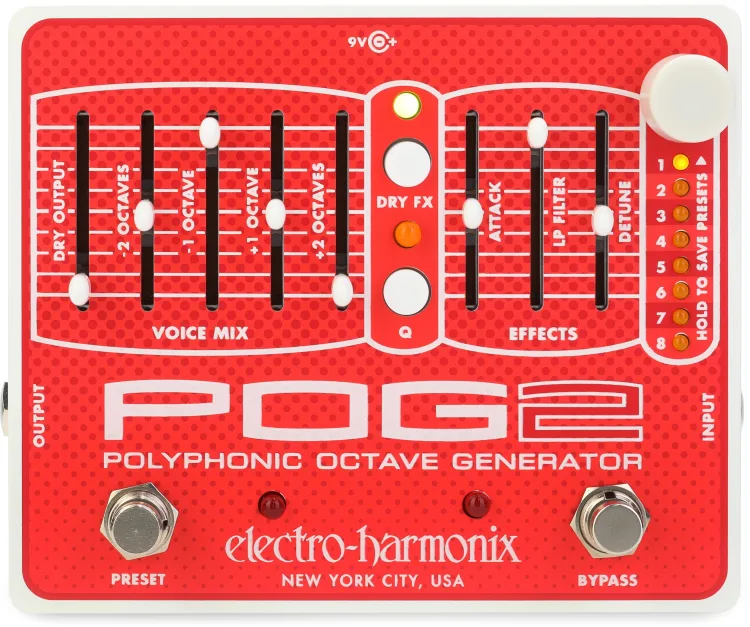
Pedals that push you in this direction include the EHX Micro POG for polyphonic octaves with a clean, tracking-perfect implementation; the EHX POG2 for the deluxe version with more voice options; the Boss OC-5 for an alternative voicing; and the EHX Pitch Fork for diatonic intervals beyond just octaves. The Pitch Fork in particular is worth flagging for songwriting purposes. It can add a major or minor third above whatever you play, which means you’re effectively writing two-voice harmony every time you play a single line.
The technique to learn: turn on a polyphonic octave-down and play single-note bass lines under your chords. Suddenly you’re writing in a way that sounds like a band, even though it’s just one guitar. Many ambient and post-rock writers built entire albums around this trick.
Harmonizers and Intelligent Pitch Pedals: They Make Voice Leading Audible
A harmonizer adds an interval (typically a third, fifth, or octave) above or below your part, but it does so diatonically. The pedal stays in the key you’re playing in and adjusts the harmony accordingly. The compositional effect is that voice leading suddenly becomes loud and obvious. Any clumsy chord change reveals itself immediately because the harmony part highlights the awkwardness.
For songwriters, this is genuinely educational. Writing through a harmonizer trains your ear to hear voice leading the way arrangers and string writers do. You start avoiding parallel fifths because they sound bad; you start preferring stepwise motion because it sounds smooth; you start hearing the inner voices of your progressions instead of just the chord roots. Within a few months of writing through a harmonizer, your chord progressions will be tighter even when the pedal is off.
Pedals that push you in this direction include the EHX Pitch Fork+ for serious intelligent pitch shifting; the TC Electronic Quintessence Harmony for a polished diatonic harmonizer; the Eventide PitchFactor for the boutique flagship; and the Digitech Whammy for pitch shifting more broadly (less subtle, more dramatic, but compositionally inspiring in its own right).
Modulation Pedals: They Make Single Chords Feel Like Songs
Chorus, phaser, flanger, vibrato, and tremolo all modify the wet signal in ways that introduce movement, even when the underlying chord is static. The compositional consequence: a single held chord stops feeling underwritten, because the modulation is doing the moving for you.
This is why so many shoegaze, dream-pop, and ambient guitar songs are built on two or three chords held for unusually long stretches. The chords aren’t enough on their own. But with a chorus or vibrato widening them and a tremolo pulsing them, they become complete musical statements. Writers who add modulation to their boards almost always start writing with slower harmonic rhythm, because the rhythmic content has migrated from the chord changes to the pedal’s movement.
Pedals worth knowing here include the Boss CE-2W Chorus, the modern reissue of the legendary CE-2 that defined indie and alternative chord-pad sounds; the Strymon Flint, which combines vintage-style tremolo and reverb in a single enclosure (genuinely one of the best songwriter pedals on the market); the Walrus Audio Julia for analog chorus and vibrato with deep control; and the EarthQuaker Devices Sea Machine for chorus that’s more sound-design tool than effect.
If you’ve never tried it, take any one of these pedals, hold a single Cadd9 chord, and listen. The amount of musical interest you can get from a single voicing through good modulation is the entire point. Songs can live there.
Tremolo: Rhythm Without Strumming
Tremolo deserves its own mention because of how specifically it changes what you write. A tremolo pedal pulses the volume of your signal at a tempo-synced rate, which means a single held chord becomes a rhythmic groove. The compositional consequence is that you stop needing to strum to create rhythm, and once you stop strumming, you start writing differently.
Progressions through tremolo tend to be sparser, with longer-held chords and more melodic content played over the top of them. The tremolo provides the rhythm, the held chord provides the harmony, and your job becomes melody and arrangement rather than constant chordal rhythm. This is the harmonic logic of records like Cat Power’s The Greatest, Beach House’s catalog, and most of post-millennial dream pop.
The Strymon Flint mentioned above is the canonical tremolo recommendation for songwriters because it combines tremolo with reverb and lets you treat both as a single textural unit. The Boss TR-2 is the cheaper, simpler alternative. The Walrus Audio Monument is the boutique option with deep tap-tempo and shape control.
Volume Pedals: When You Erase the Attack, You Write Differently
A volume pedal used for swells removes the attack of every note. The percussive transient that gives strummed chords their rhythm. Playing chords without their attacks turns them into pads. The compositional consequence is profound: you can no longer write progressions that depend on rhythmic strumming, because the rhythmic strumming is gone. Instead, you write progressions where the chord changes themselves are the rhythm.
Writers who lean on volume swells almost universally end up writing slow, modal, ambient progressions. Two-chord vamps. Drone-based pieces. Long IV–I motions with the I held for sixteen bars. The volume pedal removed an entire compositional dimension (rhythmic articulation), which forced compositional invention in another (chord-change pacing).
The standard pick is the Ernie Ball VP Jr, which has been the volume pedal of record for decades. The Lehle Mono Volume is the boutique upgrade. The Boss FV-500H is the heavier alternative. Any of them will reshape the way you write within the first session.
Compressors: They Encourage Sustain-Based Writing
A compressor extends the sustain of every note, which has the same compositional effect as a long reverb but at the source rather than the tail. Through a compressor, fingerpicked patterns ring longer, single notes hold their power across longer phrases, and the natural decay of a chord becomes part of the song. Writers who add a good compressor to their board start writing slower-changing, more sustain-dependent progressions because those are the ones that feel right through the compressed signal.
Compressors are also the secret behind most country and pop session guitarists’ chord-arpeggio writing. The compression evens out the dynamics across a fingerpicked pattern, letting every note ring at the same volume regardless of which finger plucked it. This even articulation makes complex chord-melody passages possible without obsessive technical control.
Pedals worth knowing here include the Keeley Compressor Plus, a long-time songwriter favorite; the Wampler Ego Compressor, which adds tone-shaping controls beyond pure compression; the JHS Pulp ‘N’ Peel V4, which combines compression with EQ and a DI output for direct recording; and the MXR Dyna Comp for the classic country-style sound.
Drive Pedals: They Compress Your Harmonic Choices
A drive or distortion pedal compresses the harmonic spectrum of whatever you play, which is the technical reason that complex chords sound muddy through high gain. A G7add9 played clean has clearly defined intervals; played through a fuzz, it turns into noise.
The compositional consequence is straightforward: drive pedals push you toward simpler chord voicings, often with dropped fifths, power chords, or triadic shapes that can survive heavy distortion without becoming indistinct.
This is the entire harmonic logic of rock music. The chord progressions in classic rock are simple not because the players couldn’t write more sophisticated ones, but because their gear couldn’t reproduce more sophisticated ones. The drive pedal voted for simpler harmony, and decades of writers wrote what the drive pedal wanted to hear.
For songwriting purposes, this is something to be aware of rather than something to avoid. A high-gain drive is a constraint that produces certain kinds of songs. A low-gain transparent drive — like the JHS Morning Glory, the Wampler Tumnus, or the Ibanez Tube Screamer Mini — preserves more of your harmonic choices and lets you write with the chord vocabulary you’d use clean. If your chord progressions feel limited, try writing with less gain and see what opens up.
Loopers: They Force You to Commit
A looper is the most direct compositional pedal you can own. It forces you to commit to a progression (once you’ve recorded a loop, that loop is the progression for the next several minutes) and then it lets you react against it.
The compositional consequence is that loopers are uniquely good at producing counterpoint, polyrhythm, and chord-against-bass-line writing. Once you’ve laid down a four-chord loop, the natural next move is to play something that isn’t the chord progression on top of it: a counter-melody, a syncopated rhythm part, a single drone note that anticipates the next chord change.
Writers who use loopers consistently develop a more sophisticated harmonic ear than writers who don’t, because they’re constantly making real-time decisions about what notes work against a given chord. The looper is, in effect, an ear-training device disguised as a pedal.
Pedals worth knowing: the Boss RC-5 Loop Station, which has become the songwriter’s standard for its clean recording and easy use; the TC Electronic Ditto Looper, which strips away features in favor of one-knob simplicity; the Boss RC-500 for serious multi-track looping; and the Hotone Wally Plus for the budget pick.
Granular and Texture Pedals: They Turn Two Chords Into Songs
Granular and texture pedals (a relatively new pedal category) break your signal into small fragments and recombine them into evolving textural beds. The compositional consequence is that two chords can become an entire song. The texture pedal generates so much musical activity from minimal source material that the writer’s job shifts almost entirely to dramatic pacing and arrangement decisions.
Pedals worth knowing here include the Hologram Microcosm (the canonical pick); the Chase Bliss Mood MKII (a cult-favorite generative texture pedal); and the EarthQuaker Devices Afterneath (a reverb that lives in textural rather than reverberant territory). Any of these will dramatically change what you reach for harmonically — usually toward fewer, slower, more deliberate chord changes, because the pedal is doing so much of the moving.
A Practical Experiment to Try This Week
If you want to feel this whole argument viscerally, try the following experiment in a single sitting.
Pick a four-chord progression you’ve used before — something safe, like C–G–Am–F. Play it dry through your interface or amp for two minutes. Notice how complete it sounds, what tempos it suggests, what melody you hear over it.
Then add a long shimmer reverb and play the same progression. Notice how the harmonic rhythm wants to slow down. Notice how you stop wanting to change chords as quickly. Notice that you can hold the F for an entire bar longer than you did the first time.
Then add a tempo-synced dotted-eighth delay on top of the reverb. Notice how the spaces between your notes start to matter more than the notes themselves. Notice that you naturally start playing two-note arpeggios instead of full strummed chords. Notice that the same progression now sounds more like a different song than the same one.
Then add a polyphonic octave-down. Notice how you stop having to play a bass line because the pedal is doing it. Notice that the progression now sounds almost orchestral. Notice that your melodic ideas have moved up the neck because the bass register is full.
You’ve played one chord progression through four different signal chains, and you’ve effectively written four different songs. That’s the entire thesis of this guide, demonstrated in a single fifteen-minute experiment.
Common Mistakes Songwriters Make With Pedals
The first mistake is treating pedals as something to add at the end of the writing process. Pedals shape what you write; if you only turn them on after the song is finished, you’ve missed their compositional value. Write through the pedals from the beginning.
The second mistake is buying versatile multi-effects units instead of single-character pedals. A pedal with one beautiful sound that biases your writing in a specific direction is more useful than a pedal with twenty mediocre sounds that bias nothing. Character beats versatility for compositional purposes.
The third mistake is trying to neutralize the compositional bias of your pedals. If a long reverb is making you write slower-changing progressions, that’s a feature, not a bug. Lean into the bias instead of trying to write around it. The songs that come out the other side will be more cohesive than the ones you’d write fighting the signal chain.
The fourth mistake is assuming the pedal that helps you write is the same pedal that records well. The pedal you write through and the pedal you commit to a final master can be different pedals. Use whatever helps you finish the song; worry about final tone after the song exists.
Frequently Asked Questions
Do these compositional biases work for piano players, too? Many of them do, in the form of plugins and software effects. A long algorithmic reverb plugin on a piano patch produces the same writing bias as a long reverb pedal on a guitar. The principle (each effect biases composition) is universal; the implementation (hardware vs software) is incidental.
What’s the single most compositionally generative pedal? A long, modulated reverb with shimmer is the most-recommended single answer for songwriters, because it shifts your writing toward held, modal, drone-based progressions — which are the progressions that produce the most “complete” results from minimal harmonic material. The Walrus Slö is the most-recommended specific pick.
Should I write with my pedals on the floor or on my desk? On your desk, ideally within hand-reach of where you sit to play. The lower the friction between picking up the guitar and turning a knob, the more compositional experimentation you’ll do.
Do I need to know music theory to benefit from this? No. The pedals will quietly teach you whatever you need to know by surfacing what sounds good and what doesn’t through their particular signal chain. If you keep a notebook of which chord progressions feel best through which pedals, you’ll have a working compositional theory within a few months without ever opening a textbook.
A Final Word
Your pedalboard is not just a tone-shaping rig. It’s a small group of compositional collaborators, each voting on the kinds of songs you write. Once you understand which way each one is voting, you can build a board that pushes your writing in the direction you want it to grow. Want to write more ambient, drone-based material? Add a long reverb and a granular pedal. Want to write more rhythmic, syncopated material? Add a tempo-synced delay. Want to write with bigger arrangements from a single guitar? Add a polyphonic octave.
The chord progressions you’ll be writing in a year are partly a function of what’s on your desk today. Choose accordingly.