
If you play guitar and sing (and especially if you do both at the same time, in the same take, into the same setup) your audio interface decision is genuinely different from the one a beat-maker, a podcaster, or a session drummer should make.
Most interface buying guides treat “two inputs” as a generic specification. For a singer-guitarist, those two inputs aren’t interchangeable. One has to handle a microphone with a quiet, well-mannered preamp. The other has to handle a passive guitar pickup with the right input impedance. The headphone output has to let you hear yourself sing without latency. And the whole rig has to disappear into the writing process so you can focus on the song instead of the signal chain.
This guide is for the person who lives in that specific use case: a guitarist who also sings, recording in a home studio, working alone or with one collaborator, and trying to capture demos or finished records without a chain of compromises.
Below you’ll find the features that actually matter for this workflow, ranked recommendations across price tiers, the recurring two-input-versus-four-input question, the workflow choices that separate good vocal-and-guitar recordings from amateur ones, and the small mistakes that quietly limit what most singer-songwriters can capture at home. Every product mentioned has a copyable link at the bottom of this guide.
Gear Mentioned In This Article
Budget Tier ($100–$150)
Sweet Spot ($150–$250)
- Focusrite Scarlett 2i2 (4th Gen)
- Universal Audio Volt 2
- SSL 2
- Audient EVO 4
- MOTU M2
- PreSonus Studio 24c
Premium Tier ($300–$500)
- Audient iD14 MkII
- Focusrite Scarlett 4i4 (4th Gen)
- Universal Audio Volt 476
- MOTU M4
- SSL 2+
- PreSonus Studio 26c
Single-Input Alternatives (Vocal-Only Workflows)
Recommended Microphones for Singer-Guitarists
- Shure SM58 (dynamic, vocal)
- Shure SM7B (dynamic, vocal upgrade)
- Rode NT1 5th Generation (condenser, vocal)
- AKG C214 (condenser, acoustic guitar)
- Shure SM57 (dynamic, acoustic guitar)
Plugins Commonly Bundled or Recommended
- FabFilter Pro-C 2 (vocal compressor)
- Valhalla VintageVerb (reverb)
- Neural DSP plugins (amp sim)
- Native Instruments
- Guitar Rig 7 Player (free amp sim)
Why a Singer-Guitarist’s Interface Needs Are Different
A typical home recordist needs an interface to capture a single source at a time, cleanly. A singer-guitarist often needs the interface to do two things simultaneously, capture them in the right relationship to each other, and let the performer hear both sources accurately while playing.
The simplest version of the workflow is, you sit down with a microphone in front of your face and a guitar in your lap. The microphone goes into one input. The guitar goes into another. You sing and play at the same time, capturing both performances in a single take. The timing, the phrasing, the breathing, the dynamics all interlock between voice and instrument in a way that separate overdubs cannot replicate.
The interface is the device that has to make this work. If either input is noisy, or if the latency between playing and hearing yourself is too high, or if the two preamps sound dramatically different from each other, the recording suffers in ways that no amount of mixing fixes.
This is why generic “best interfaces under $200” lists often miss the mark for singer-guitarists. An interface that’s perfect for a podcaster recording a single voice may have a thin instrument input that strangles the sound of a passive Telecaster.
An interface optimized for electronic producers may skimp on preamps in a way that doesn’t matter when the input is a synth but matters enormously when it’s a vocal. The right interface for this niche has to be good at both jobs at once.
The Non-Negotiable Features
Before evaluating specific units, here are the features a singer-guitarist’s interface must have. If a unit lacks any of these, walk past it regardless of price.
At least two simultaneous inputs. The minimum count is two (one for vocal, one for guitar) and they have to be available at the same time, not switched between. Single-input interfaces like the Focusrite Scarlett Solo or the Apogee Boom are perfect for vocalists who don’t play, but they make simultaneous vocal-and-guitar capture impossible.
A proper instrument-level input with high impedance. Passive guitar pickups need an input impedance of at least one megohm to sound right. A line-level TRS input (even one that physically accepts a quarter-inch cable) will not produce the same tone, because the impedance mismatch loads the pickup and dulls the high frequencies. Look for “Hi-Z” or “instrument input” in the specifications, and check that the unit has a switch or a dedicated jack for it. Most modern interfaces handle this correctly, but a few budget units cut corners.
Phantom power on at least one mic input. If you ever want to use a condenser microphone (which most home singer-songwriters do, because condensers capture vocal detail better than dynamics in a controlled environment) you’ll need forty-eight-volt phantom power. Every reputable interface includes it; just confirm before buying.
A latency-friendly headphone output with independent volume. You’ll be wearing headphones while you sing and play, and you need to hear yourself with as little delay as possible. The interface should have a real headphone amp with its own volume knob, ideally separate from the main output volume so you can monitor at a different level than the speakers. Direct monitoring (a hardware bypass that lets you hear the input signal before it goes through the computer) is also strongly preferred, because it eliminates the round-trip latency that makes singing along with yourself feel underwater.
Class-compliant USB connectivity. Almost every modern interface meets this standard, which means it works with any DAW on any operating system without proprietary drivers. Avoid older units or off-brand interfaces that require specific drivers; they tend to break with operating system updates.
Features That Matter If You Can Afford Them
Beyond the non-negotiables, several features separate a good interface from a great one for singer-guitarist purposes. None of them are required, but each matters in proportion to your workflow.
Loopback routing is the ability to route audio from your computer back into a recording channel. For singer-guitarists who livestream, podcast about songwriting, make YouTube videos with backing tracks, or collaborate over the internet, loopback is the difference between a clean professional output and a kludgy workaround. Audient, SSL, and Universal Audio interfaces all do loopback well. The Focusrite Scarlett line does not, until you get into the higher-end models.
Onboard DSP and amp simulation turns the interface into a guitar amp without requiring an external pedal or a software instance. The Universal Audio Volt series includes a vintage-style preamp setting voiced for vocals and guitar. The Audient EVO 4 includes a smart gain feature that sets your input levels automatically. These features blur the line between a writing tool and a finished-recording tool and can save real money compared to buying separate pedals.
Higher input counts (four or more) matter if you want to mic your acoustic guitar in stereo while also recording your vocal, which is the canonical “high-quality singer-songwriter” recording technique. Two mics on the guitar plus one on the voice plus one open input for direct guitar use means a four-input interface. If you ever plan to record duos, drum overheads, or yourself playing guitar through an amp while also singing into a mic, the four-input upgrade pays for itself.
Build quality and metering matter on a unit you’ll be touching every day. Aluminum chassis, real knobs with appropriate resistance, and accurate input metering (LED rings or dedicated meters rather than tiny pinpoint LEDs) make the daily experience meaningfully better. SSL and Audient interfaces tend to lead on this dimension; Behringer and entry-level M-Audio units tend to feel plasticky in a way that gets old fast.
The Budget Tier ($100–$150): Just Enough Interface to Do Real Work
Below the hundred-fifty-dollar mark, the recommendations narrow quickly. The interfaces in this tier work, but most cut corners somewhere (usually on preamp quality or build) and the question becomes which corners you can live with.
The Behringer UMC202HD ($110) is the cheapest interface that meets every non-negotiable on the list above. Two combo XLR/TRS inputs with phantom power, an instrument-level switch, and Midas-designed preamps that are genuinely better than the price suggests. The headphone amp is loud enough to drive most studio headphones, and the build is plastic but functional. For a singer-guitarist who’s recording demos rather than masters, this is the unit that produces the highest ratio of capability to dollars spent.
The PreSonus AudioBox GO ($79) is the smallest two-input interface on the market, with one XLR input and one instrument input on a unit barely larger than a deck of cards. It’s the right pick if portability matters (you can throw it in a backpack with a microphone and a laptop and have a complete writing rig anywhere) but the single XLR input means you can’t run two condenser mics simultaneously, which limits future-proofing.
The M-Audio M-Track Duo ($89) is the third option in this tier. Two combo inputs, phantom power, Hi-Z switch, and a slightly more refined feel than the Behringer at a similar price. It bundles a starter version of MPC Beats and a few plugin licenses that are useful in the first few months.
If you’re choosing in this tier and budget is the dominant constraint, the UMC202HD is the most capable. If portability matters more than future-proofing, the AudioBox GO is the better choice.
The Sweet Spot ($150–$250): The Right Tier for Most Singer-Guitarists
The price band from a hundred fifty to two hundred fifty dollars is where the singer-guitarist interface market gets genuinely competitive. Almost every major manufacturer has a flagship two-input unit in this range, and the recommendations are excellent.
The Focusrite Scarlett 2i2 4th Generation ($200) is the default recommendation for a reason. The fourth-generation preamps are quieter than previous versions, the auto-gain feature sets your input levels automatically (genuinely useful when tracking yourself), the air mode adds a tasteful high-frequency lift voiced for vocals, and the unit comes with a Hitmaker Expansion bundle of plugins and sample libraries that’s worth several hundred dollars on its own. It’s the interface that most working singer-songwriters in their first or second studio actually own. The build is metal, the knobs feel right, and the unit will last a decade.
The Universal Audio Volt 2 ($200) is the Scarlett’s closest competitor and the right pick for singer-guitarists who specifically want a vintage character on their input. The Volt 2 includes a “76 compressor” mode that emulates a classic studio compressor on the way in, plus a vintage preamp mode voiced for vocals and guitar. The unit feels heavier and more substantial than the Scarlett and bundles UAD plugins and a free Ableton Live Lite license. For a singer-guitarist who likes the sound of compression on the way in (which most do, especially for vocals), the Volt 2 is the better-sounding choice. For a singer-guitarist who prefers to keep everything clean and add character later in the DAW, the Scarlett is the better fit.
The SSL 2 ($230) brings the famous SSL preamp character to a budget interface, with a “4K” switch on each input that adds a high-frequency lift modeled on the legendary SSL 4000-series console. The SSL 2 sounds different from any of its competitors in a way that most singer-guitarists recognize the moment they record a vocal through it. If your aesthetic is bright, polished, modern pop or singer-songwriter, the SSL 2 is the unit most likely to give you the sound you’re chasing without further processing.
The Audient EVO 4 ($130, occasionally less on sale) is the dark-horse pick that punches well above its price. Smart gain (which sets levels automatically while you sing and play your loudest passage), credible preamps, and a build that’s lightyears ahead of the Behringer in this tier. The single negative is the limited input count (two combo inputs but only one with full Hi-Z capability) and the slightly fiddly knob-per-function ergonomics. Despite that, many reviewers consider the EVO 4 the best preamp quality per dollar currently available.
The MOTU M2 ($220) is the right pick for singer-guitarists who care most about pristine, transparent audio. ESS Sabre converters (the same chip family used in high-end audiophile DACs) and large-format LED metering give the M2 the cleanest sound and most accurate visual feedback in this tier. It’s less feature-rich than the SSL 2 or the Volt 2 (no compressor mode, no character switches) but for a writer who wants the interface to disappear and let the source dominate, the M2 is the most transparent option.
If you’re in this tier and forced to pick a single answer, the Focusrite Scarlett 2i2 4th Gen is the safest recommendation for the broadest range of singer-guitarists, and the Universal Audio Volt 2 is the right alternative if you specifically want analog character baked into your tracks.
The Premium Tier ($300–$500): When Four Inputs Become Worth It
Above three hundred dollars, the conversation shifts from two-input units to four-input units, and from “good enough” preamps to genuinely excellent ones. For a singer-guitarist who’s serious about home recording (or who plans to record their own EP rather than just demos) this tier is worth the upgrade.
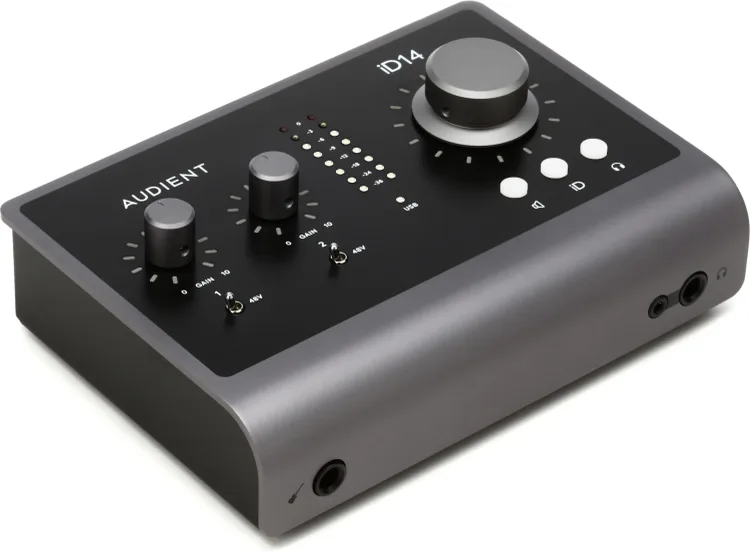
The Audient iD14 MkII ($340) is the standout pick. Two of Audient’s class-A console preamps, two additional ADAT inputs (so you can expand to ten total inputs later), an absolutely excellent headphone amp, and the same smart gain feature found on the EVO 4. The preamps in the iD14 are the cleanest in this entire price range — Audient’s reputation for preamp quality at the low and mid tiers is genuinely deserved — and the unit feels like a piece of professional studio gear rather than a budget product. For a singer-guitarist doing serious recording at home, this is the most-recommended interface in the price range.
The Focusrite Scarlett 4i4 4th Generation ($300) extends the 2i2 to four inputs, four outputs, MIDI I/O, and full loopback support. The preamps are the same as the 2i2’s. The reason to spend the extra hundred dollars is the input count, which lets you stereo-mic an acoustic guitar while recording vocal and direct-guitar at the same time — a combination that’s not possible on any two-input unit. If you record acoustic-driven singer-songwriter material, the 4i4 is worth the upgrade.
The Universal Audio Volt 476 ($500) is the high-character pick in this tier, with four inputs that each have their own preamp/compressor, plus the same vintage modes found on the Volt 2. Heavier and more expensive than the alternatives, but unique in delivering hardware compression on every input — a significant practical benefit for live tracking, where dialing in a compressor in real time is more useful than recording everything flat and adding compression in the mix.
The MOTU M4 ($280) is the four-input version of the M2 and shares its transparent, audiophile-leaning aesthetic. If clean audio is your priority and four inputs would be useful, the M4 is hard to beat at the price.
If you’re in this tier, the Audient iD14 MkII is the most-recommended single pick for singer-guitarists. The Scarlett 4i4 is the right alternative if you’ve already learned the Focusrite ecosystem and want to stay in it.
The Two-Input vs Four-Input Question
The single most common interface upgrade question for singer-guitarists is whether to spend the extra money on a four-input unit. Here’s the honest answer.
Buy two inputs if you primarily record vocals plus a single direct-guitar signal (or a single mic on the guitar), if you write demos rather than finished masters, if you’re new to recording and unsure how serious you’ll get, or if budget is genuinely tight. Two inputs is enough to capture the core of nearly every singer-songwriter recording.
Buy four inputs if you regularly stereo-mic an acoustic guitar (two mics for stereo capture is the canonical technique for high-quality acoustic guitar recordings), if you record collaborations where two performers track simultaneously, if you use external preamps or hardware processors and need ADAT expansion, or if you’ve already outgrown a two-input unit and know specifically why.
For most singer-guitarists, two inputs is the right starting point, and the upgrade to four becomes obvious within a year or two if it’s going to become obvious at all. There’s no shame in starting with the 2i2 and graduating to the 4i4 (or another four-input unit) when your workflow demands it.
Workflow: Simultaneous Tracking vs Overdubbing
Singer-guitarists divide into two camps, and the right interface depends partly on which camp you’re in.
The simultaneous-tracking camp records vocal and guitar at the same time, in a single take, capturing the natural interlock between voice and instrument that happens when both are performed together. This is how most folk, indie, and acoustic singer-songwriter records have been made for sixty years. It demands an interface with two clean preamps, low-latency monitoring, and ideally a direct monitor mode so the performer can hear themselves without round-trip delay. Any of the recommendations above support this workflow; the Audient iD14 and the SSL 2 are particularly strong picks because their preamps are quiet enough that bleed between mic and guitar source isn’t a problem.
The overdubbing camp records guitar first, then sings over it, treating the two performances as separate sessions even though they ultimately combine into the same song. This is how most modern pop and produced records are made. It demands the same interface features as simultaneous tracking but is more forgiving of latency and bleed because each source is captured in isolation. Almost any interface in this guide handles overdubbing competently.
Most working singer-songwriters do some of both; overdubbing during the writing phase, simultaneous tracking when capturing a finished take. Buy an interface that can handle simultaneous tracking well, and you’ll be covered for either workflow.
Common Mistakes Singer-Guitarist Buyers Make
The first mistake is buying a single-input interface to save money. The Focusrite Scarlett Solo, the Apogee Boom, and the various single-input USB microphones (which are essentially interfaces with a built-in mic) all rule out simultaneous vocal-and-guitar recording entirely. The marginal savings versus a two-input unit are not worth the workflow restriction.
The second mistake is overspending on an interface and underspending on a microphone. A thousand-dollar interface paired with a fifty-dollar mic will sound worse than a two-hundred-dollar interface paired with a three-hundred-dollar mic. The mic is closer to the source and matters more to the final sound. If you have to choose, spend less on the interface and more on the microphone.
The third mistake is ignoring the headphone output. A poor headphone amp ruins the recording experience even if the preamps are perfect, because you spend the entire session unable to hear yourself comfortably. The Audient and SSL units in this guide all have notably good headphone outs; the budget Behringer is notably weak. If you can, demo the headphone output before committing.
The fourth mistake is buying for features you don’t use. MIDI I/O, ADAT expansion, multiple monitor outputs — these are genuinely useful in some workflows and pure overhead in others. A singer-guitarist who only ever records one vocal and one guitar at a time does not benefit from a unit with eight inputs and ten outputs. Buy for the workflow you have, not the workflow you imagine.
The fifth mistake is treating the interface as a long-term commitment. Interfaces hold their value reasonably well, are easy to sell used, and can be upgraded incrementally as your workflow evolves. Buy what fits your current writing today; trade up when you can clearly articulate what’s missing.
Frequently Asked Questions
Can I just use a USB microphone instead of an interface?
Not for simultaneous vocal-and-guitar recording, no. USB microphones don’t have a guitar input, so you can’t record both sources at once. They’re fine for vocal-only podcasts but a dead-end for singer-songwriters.
Do I need an audio interface if I’m using my phone or tablet?
A class-compliant audio interface — every unit in this guide qualifies — works directly with iPads via USB-C, often with a powered hub. iPhones require a Lightning-to-USB adapter. For Android, support is hit-or-miss; check the manufacturer’s compatibility page.
Will a more expensive interface make my songs sound better?
Marginally. The biggest sound-quality factors in a home recording, in order, are the room, the microphone, the source (your performance and your instrument), the microphone position, and only then the interface. Upgrading a Scarlett 2i2 to a Universal Audio Apollo will produce a less-noticeable sound improvement than upgrading from a $50 condenser to a $300 condenser at the same interface.
Should I buy used?
Audio interfaces hold up well and used purchases are usually safe, especially from major manufacturers. Avoid units more than seven or eight years old, since driver support eventually drops off, and check that the unit is class-compliant if you plan to use it on multiple operating systems.
What about Thunderbolt vs USB?
Thunderbolt offers lower latency than USB at very high track counts, but for singer-guitarist workflows with two to four inputs, USB is more than fast enough. Don’t pay extra for Thunderbolt unless you have a specific reason.
What plugins should I get to go with a new interface?
Most interfaces in this guide ship with a starter bundle that’s enough for the first six months. After that, the most useful additions for a singer-guitarist are a vocal-friendly compressor (FabFilter Pro-C 2 or Waves CLA-2A), a clean reverb (Valhalla VintageVerb), and an amp simulator if you record electric guitar (Neural DSP plugins or the free Guitar Rig 7 Player).
A Final Word
The right interface for a singer-guitarist is the one you stop thinking about. It captures your voice clearly, captures your guitar clearly, lets you hear yourself in real time, and gets out of the way so you can write. Almost every interface in this guide meets that bar. The differences between them (preamp character, build quality, included plugins, input count) matter at the edges, but they’re not the difference between a good record and a bad one.
Buy the unit that fits your budget and your workflow. Plug in. Record the song. Singer-guitarist albums have been made on every interface in this guide and on plenty of cheaper ones. Yours can be too.