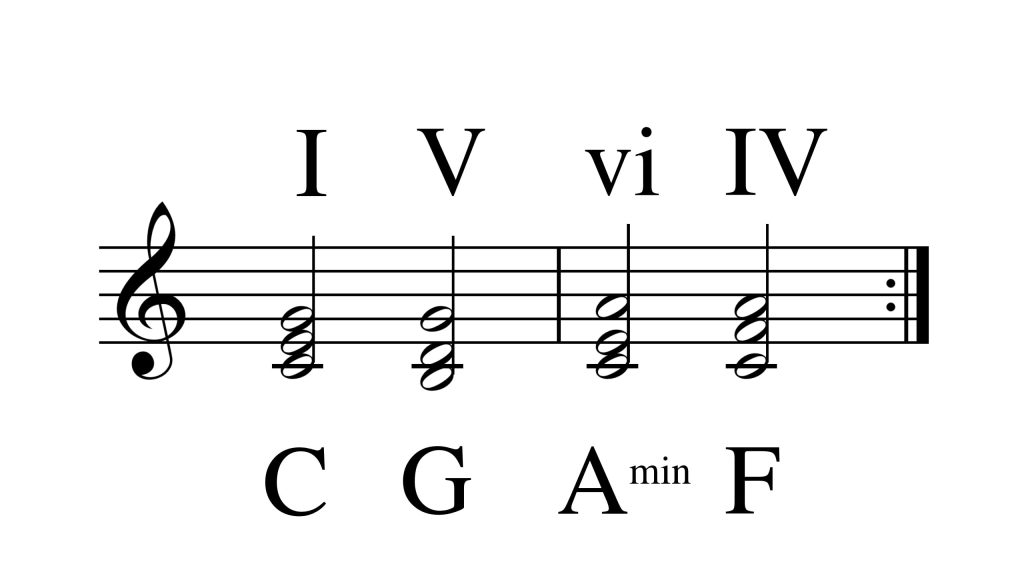

Most beginning songwriters fail to accept the following truth that the chord progressions inside professional records are almost never complicated. They are simple chord progressions, played with conviction, voiced with care, and dressed in production choices that make four ordinary chords feel like a finished song.
The gap between an amateur loop and a chart record is craft and not complexity.
This guide is for the writer who has the basic chords under their fingers and wants to know what to do next. Below are the most useful simple progressions in popular music, written in Roman numerals and in concrete keys, with real-song examples for each, plus the small voicing, voice-leading, and arrangement choices that make them sound pro instead of preset. By the end, you should be able to sit down, choose one progression, and write something that actually sounds like a record.
Why Simple Chord Progressions Sound Professional
Listeners process harmony emotionally before they process it analytically. A four-chord loop that lands on the right emotional contour will feel finished to a listener even if a music-theory student could write something more sophisticated.
This is why “Let It Be,” “With or Without You,” “Don’t Stop Believin’,” and “No Woman, No Cry” all share roughly the same chord progression and all sound completely different. The harmony is a frame, in which the song lies.
Professional-sounding records typically share three traits at the chord level. First, the chords serve the melody rather than competing with it. Harmony is scaffolding, not architecture. Second, the voice leading (the way individual notes inside the chords move from one chord to the next) is smooth. It often entails a single sustained tone running across multiple chords. Third, the production amplifies what the harmony is already doing, with bass notes, voicings, and rhythmic placement reinforcing the emotional gesture rather than fighting it.
Once you internalize those three traits, simple progressions become a feature rather than a limitation. You can spend your creative energy on melody, lyric, and arrangement, which is where listeners actually hear the song.
The Twelve Chord Progressions That Cover Most of Popular Music
The progressions below are written in the key of C major (and A minor for the minor-key progressions), so every example uses only natural notes. Once you can hear them in C, transposing them to any other key is a mechanical exercise. Roman numerals appear alongside the actual chord names so you can move them to wherever your voice or instrument sits best.
1. The Pop Axis: I–V–vi–IV (C–G–Am–F)
The single most common progression in modern popular music, sometimes called the “Axis of Awesome” progression after the comedy group’s medley demonstrating its ubiquity.
It’s used in “Let It Be,” “Don’t Stop Believin’,” “With or Without You,” “Someone Like You,” “She Will Be Loved,” and hundreds of others.
It begins on the home chord, lifts to the dominant, drops to the relative minor for emotional weight, and resolves back through the subdominant. Every emotional beat a pop chorus needs is built into the chord movement itself.
To make it sound less obvious, try starting the loop on the vi chord instead of the I. That single rotation gives you Am–F–C–G, which is the same progression with a darker entry and the foundation of “Zombie” by The Cranberries and “Save Tonight” by Eagle-Eye Cherry.
2. The Sensitive Female: vi–IV–I–V (Am–F–C–G)
A rotation of the axis progression that became so associated with millennial singer-songwriter ballads it earned the half-affectionate nickname “the sensitive female chord progression.”
It’s the harmonic skeleton of “Apologize” by OneRepublic, “Grenade” by Bruno Mars, and the verses of “Numb” by Linkin Park. Starting on the minor vi gives the loop a melancholy entry and a triumphant resolution back to the I, which is why it shows up in so many emotional crescendo songs.
3. The Doo-Wop / 50s Progression: I–vi–IV–V (C–Am–F–G)
Older than rock music itself, this progression dominated 1950s pop and never really left. “Stand By Me,” “Earth Angel,” “Every Breath You Take” (with a chromatic detail), and the verses of “Cry Baby” all live here.
It feels nostalgic almost by reflex now, which is exactly why contemporary writers use it when they want a song to feel timeless or wistful. Substituting the iii (Em) for the I on the second pass, Em–Am–F–G, opens the loop up emotionally without changing its essential gravity.
4. The Royal Road: IV–V–iii–vi (F–G–Em–Am)
Borrowed heavily from Japanese city pop and J-pop, where it’s known as the ōdōshinkō or “royal road” progression. It’s also the foundation of “Don’t Stop Believin'” before that song moves into its chorus, and you can hear it driving songs by Tatsuro Yamashita, Mariya Takeuchi, and a generation of contemporary R&B writers. The progression climbs up from the IV before dropping to the relative minor, which creates an unusually buoyant emotional arc that resists collapsing into either pure melancholy or pure triumph.
5. The Andalusian Cadence: i–VII–VI–V (Am–G–F–E)
A descending progression with roots in Spanish flamenco music. The major V chord at the end (E major instead of E minor) is what gives it that distinctive dark, dramatic flavor. The raised third creates a strong pull back to the i. You hear it in “Hit the Road Jack,” “Stray Cat Strut,” “Sultans of Swing,” and the verses of “Runaway” by Del Shannon. It’s a progression that sounds expensive at no extra cost, and it’s particularly useful for verses that need to feel like they’re descending into something.
6. The Pachelbel: I–V–vi–iii–IV–I–IV–V (C–G–Am–Em–F–C–F–G)
Pachelbel’s Canon is a chord progression as much as a piece. It has been borrowed continuously for three hundred years. “Basket Case” by Green Day, “Cryin'” by Aerosmith, “Graduation (Friends Forever)” by Vitamin C, and “Hook” by Blues Traveler all use it. The reason it sounds rich is that the bass line walks down the scale in a way that creates effortless voice leading: C–B–A–G–F–E–F–G. Even when you don’t notice the harmony consciously, your ear hears that descending bass and reads the song as carefully composed.
7. The Twelve-Bar Blues: I–I–I–I / IV–IV–I–I / V–IV–I–V (C–F–G blues structure)
Twelve bars, three chords, and roughly a hundred years of recorded music. It’s not just for blues. It’s the structural skeleton of “Johnny B. Goode,” “Hound Dog,” “Tutti Frutti,” “Rock Around the Clock,” and “Folsom Prison Blues.” Replacing the dominant V with a V7 (G7) and the IV with a IV7 (F7) gives you the more authentic blues color. The progression sounds professional because it’s a complete musical sentence in twelve bars (beginning, development, climax, resolution) and listeners feel the form even when they can’t articulate it.
8. The Modal Mixolydian: I–bVII–IV (C–Bb–F)
A three-chord progression that uses a borrowed chord (bVII) from the parallel Mixolydian mode, and one that has powered an enormous slice of classic rock. “Sweet Home Alabama,” “Sympathy for the Devil,” “Sweet Child O’ Mine” (intro), and almost any AC/DC chorus you can name.
The bVII chord is what creates the sound. It’s the chord that separates “rock” from “pop” harmonically, because it implies a key center without confirming it the way a V chord would. If you want a progression that sounds anthemic without sounding cheesy, this is the one.
9. The Minor Epic: i–VI–III–VII (Am–F–C–G)
The same notes as the vi–IV–I–V axis progression, but heard in the key of A minor instead of C major, and that perceptual shift changes everything. It’s the progression in “Numb” (chorus), “Africa” by Toto, “Save Tonight,” and most of the cinematic post-rock canon.
When a film score wants to feel triumphant and tragic at the same time, it usually lives here. The reason it works is that the III and VII chords (C and G major) provide brightness inside a fundamentally minor harmonic field, which creates emotional ambiguity that listeners experience as depth.
10. The Jazz Standard: ii–V–I (Dm7–G7–Cmaj7)
The most important progression in jazz, and a chord movement that has quietly infiltrated pop, R&B, and singer-songwriter music as well.
The ii–V–I creates the strongest possible pull toward the home chord because the bass line moves by descending fifths, the most stable resolution motion in Western tonal music. “Fly Me to the Moon,” “Autumn Leaves,” and the bridge of nearly every Beatles ballad use it.
To get a more contemporary sound, voice the chords with the seventh on top and the third in the bass: Dm7/F → G7/B → Cmaj7. Suddenly your simple progression sounds like a Bill Evans album.
11. The Pedal Tone: I–V/I–IV/I–I (C–G/C–F/C–C)
Holding a single bass note (the “pedal tone”) underneath a moving chord progression is a production trick more than a chord progression, but it transforms the way simple harmony reads to a listener.
Songs as different as “Shine on You Crazy Diamond” by Pink Floyd, “Stairway to Heaven” by Led Zeppelin, and “Bittersweet Symphony” by The Verve use sustained bass notes to make basic chord movement feel monumental.
On a guitar, this often means leaving the low E or A string ringing while you change chords above it. On piano, it’s left-hand octaves on the tonic while the right hand moves.
12. The Slash-Chord Descent: I–V/VII–vi–I/V–IV (C–G/B–Am–C/G–F)
This is the secret weapon of professional pop production. It’s the same skeleton as the I–V–vi–IV axis progression, but with the bass line walking down stepwise: C–B–A–G–F. That single change, moving the bass smoothly instead of jumping, is what makes a chord loop feel composed instead of looped. “Let It Be” uses this voicing.
So does the verse of “Don’t Look Back in Anger” by Oasis. If you take any standard progression and rewrite the bass line so that it moves stepwise instead of by leap, you will instantly sound more professional.
What Actually Makes a Simple Progression Sound Professional
The progressions above are in the public domain. Anyone can use them. A small handful of techniques described below bring these to life. Each is small enough to learn in an afternoon and powerful enough to transform a song.
Voice leading is the single highest-leverage skill. When you change from one chord to the next, try to keep at least one note in common, and move the other notes by the smallest possible distance.
On guitar, this often means using inversions and partial chord shapes rather than full open chords. On piano, it means letting your right hand stay in roughly the same position across the whole progression. The reason every Beatles ballad sounds inevitable is that Paul McCartney was an obsessive voice-leader, even on songs with three chords.
Slash chords smooth out bass lines. Writing “G/B” instead of “G” doesn’t change the chord. It changes the bass note, which changes the way the listener experiences the chord change. Replace any leaping bass line in your progression with a stepwise one using slash chords and the song will sound more produced immediately. C–G–Am–F becomes C–G/B–Am–C/G–F, and the bass walks down a scale.
Add9 and sus voicings add color without complexity. A Cadd9 (C with a D on top) sounds richer than a plain C major and is no harder to play. A Dsus2 sounds more emotional than a plain D major.
Acoustic singer-songwriter records lean heavily on these voicings because they sound finished without sounding fancy. Try replacing every plain triad in your progression with an add9 or sus version and listen to what changes.
Borrowed chords are the easiest way to sound sophisticated. A single non-diatonic chord, a chord borrowed from the parallel key, can lift an otherwise simple progression into territory that sounds like a craftsman wrote it.
The most useful borrowed chords for a pop writer are the iv minor (Fm in the key of C), the bVI (Ab in the key of C), and the bVII (Bb in the key of C). Try replacing the IV in any major-key progression with the iv minor on the last pass before the chorus and listen to what happens. That single substitution is a defining sound of contemporary pop balladry.
Rhythm is half of harmony. A chord progression played in straight quarter notes is a different song than the same progression played as syncopated eighths or as long sustained whole notes. The harmonic content is identical, while the song is not. Before you change your chords, change how you’re playing them. Many “boring” progressions become inspiring with a different rhythmic feel.
Inversions create drama for free. Playing F as F/A (with A in the bass) instead of root-position F changes nothing about the chord and everything about its emotional weight. Bridges and pre-choruses often use inverted versions of the same chords used in the verse, which is part of why they feel like a different section even when the harmony hasn’t actually changed.
Common Mistakes That Make Simple Progressions Sound Amateur
Writers who feel like their songs sound stuck almost always share a small set of habits, and almost all of them are fixable in a single sitting.
Using only root-position chords. If every chord in your song is built with its root in the bass, your song will sound like a chord chart instead of a record. Inversions, slash chords, and pedal tones are how professional records create motion within static harmony.
Strumming everything. A constant strummed eighth-note pattern is the default rhythm of a beginner playing through a song. Professional records vary the rhythmic density across sections, leave space, use sustains, and let chords ring. If your verse and chorus have the same rhythmic pattern, the song will feel flat regardless of how good the chords are.
Changing chords at every barline. Many great songs change chord every two bars, every four bars, or even less often. Holding a single chord for longer than feels natural is a remarkably effective compositional trick, especially in verses, because it puts the focus on the melody and lyric rather than the harmonic motion.
Avoiding repetition. Beginners often think repetition is boring. Listeners experience repetition as memorability. Most hit songs use the same four-chord loop for the entire verse and the entire chorus. The variation lives in the melody, the lyric, the rhythm, and the arrangement. It’s not in the chords.
Adding complexity to disguise weak melody. If a chord progression feels boring, the answer is almost never more chords. It’s usually a stronger melodic idea, a more committed vocal performance, or a better rhythmic feel. Beginners reach for harmonic complexity to fix problems that aren’t harmonic.
A Practical Songwriting Exercise
Here is the exercise that has rescued more half-finished songs than any other. It takes about thirty minutes.
Choose one progression from the twelve above. Set a metronome at a tempo that feels right for the mood you’re chasing. Play the progression as a four-bar loop, with one chord per bar, in root position, in straight quarter notes, for five minutes. Long enough that you stop thinking about the chords. Then do exactly one of the following:
- change the rhythmic feel
- replace the bass line with a stepwise version using slash chords
- replace one chord with its borrowed-chord cousin
- replace every triad with an add9 voicing, or change one chord to its first inversion.
Loop again for five minutes. Then do another single change. Then another.
By the time you’ve made four small changes, the loop will sound almost nothing like where you started. The chord progression is the same. The song is different. That is the entire trick of professional-sounding simple harmony, and once you’ve felt it happen in your hands, you’ll never write a song the same way again.
Frequently Asked Questions
Do professional songwriters really use these progressions, or are they just for beginners?
Professional songwriters use them constantly. The chord progressions inside top-forty hits are statistically simpler than the chord progressions in 1970s rock or 1990s alt-rock. What’s gotten more sophisticated is the production, the melody writing, and the rhythmic feel — not the harmony.
Should I learn music theory before I start writing songs?
No. Learn three chords, write thirty songs, then learn theory in the order your songwriting questions demand it. Theory is most useful as an answer to questions you already have, not as a prerequisite to having questions.
Why do my chord progressions still sound generic even when I use these examples?
Almost always because of voicing and rhythm, not chord choice. Try the same progression with different inversions, slash chords, and rhythmic patterns before assuming the chords themselves are the problem.
How do I know which progression fits the song I’m trying to write?
Start with the emotion you want the listener to feel, then pick a progression whose emotional shape matches it. The vi–IV–I–V will feel different from the I–V–vi–IV even though they share chords. Sing your melody over a few candidates and trust your ear.
Are there progressions to avoid?
Not really. Every progression in this guide has been used in great records and bad ones.
A Final Note
The fastest way to write better songs is to stop hunting for new chord progressions and start spending that energy on melody, rhythm, voicing, and arrangement. The chord progressions you already know are enough.
Hundreds of professional songwriters have built entire careers on three or four loops, varied with the techniques in this guide.
Pick one progression. Write the song.
The pros are working with the same twelve options you are.