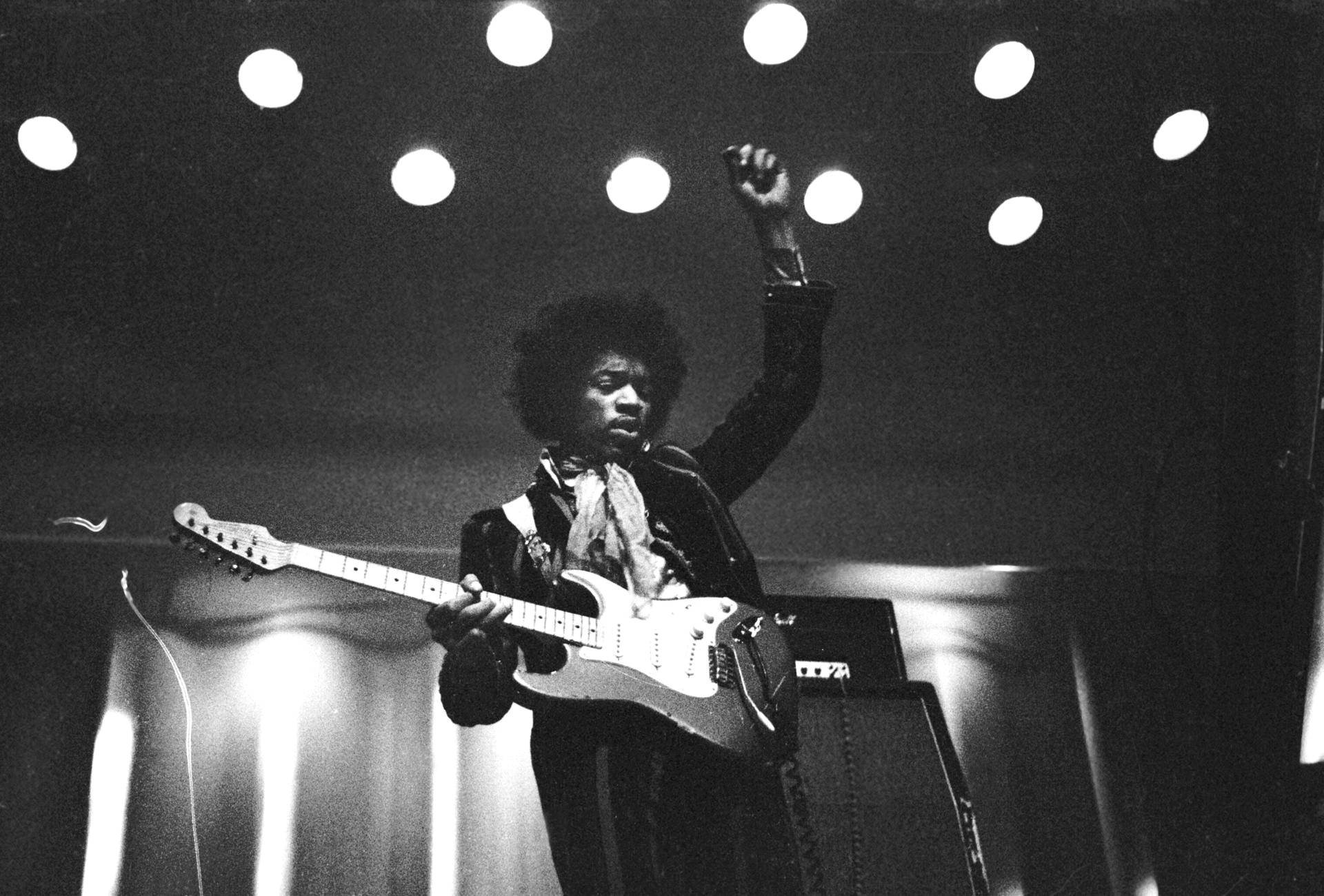

Introduction: A Sonority by Many Names
Few four- or five-note pitch collections have accumulated as much mythology as the dominant seventh sharp ninth chord — the so-called “Hendrix chord.” Voiced E–G♯–D–G in the verse of Purple Haze (Track 1, Side 1, Are You Experienced, May 1967), the sonority has functioned, over six decades, as shorthand for a particular kind of harmonic frisson: blues unease compressed into a single guitar grip, dispatched through a Fuzz Face into the listener’s ear. Its eponymic name is a testament less to invention than to canonization.
Let’s take a deeper look into this chord — its pitch-content, its voicing, its sonic identity, its prehistory, and its persistence.
The Hendrix chord was not Hendrix’s invention. It appears in jazz at least two decades before Purple Haze, and in classical modernism at least half a century before that. What Hendrix did, on January 11, 1967, at Olympic Studios in Barnes, was forge a particular convergence (pitch structure, voicing, idiom, instrumentation, and cultural moment) that retroactively claimed the chord as his.
The Anatomy of the Chord
The chord, in its most schematic form, stacks five intervals above a root: a major third, a perfect fifth, a minor seventh, and an augmented ninth. In E, that yields E, G♯, B, D, and F-double-sharp (notated F𝄪 or F##), which is enharmonically equivalent to G natural.
Two analytic features distinguish it from its more pedestrian cousins, the dominant seventh and the dominant ninth. The first is the deliberately enharmonic spelling of the upper extension. The F-double-sharp is theoretically the augmented ninth (an interval roughly an octave plus a third above the root) and by the rules of tonal voice-leading it is expected to resolve outward.
In practice, performers and listeners hear it as G natural, a minor third above the root, and therefore as the simultaneous sounding of a major and a minor third. Walter Everett, in The Foundations of Rock, treats this as the chord’s central “split-third” character: a modal ambiguity that is endemic to blues-derived harmonic vocabulary but rarely so explicitly notated.
The second feature is voicing-dependent. In strict close position, the major third and the sharp ninth are separated by a minor ninth, which is the most acoustically severe dissonance available within an octave. Hendrix’s actual voicing, however, separates them by a major tenth, with the third in the bass register and the ♯9 above the seventh. The result is a chord that appears formidable on paper but lies under the hand with relative ease, and that sounds, through gain-staged amplification, less like a cluster than like a single complex partial.
This distinction, between the chord as written and the chord as voiced, is critical. As Allan F. Moore observes in Song Means, popular-music analysis routinely conflates “abstract harmonic content” with “lived sonic content,” a conflation that distorts our understanding of how rock harmony actually functions.
The Stravinsky Question
The most frequently cited classical antecedent is the so-called “Augurs of Spring” chord from the second tableau of Stravinsky’s Le Sacre du printemps (1913). Notated in the orchestral score as a superimposition of an E♭ dominant seventh and an F♭ major triad, the sonority’s pitch content — E♭, G, B♭, D♭, F♭ (enharmonically E), A♭, C♭ (enharmonically B) — overlaps significantly with that of a dominant ♯9 chord built on E♭.
Pieter van den Toorn, in Stravinsky and The Rite of Spring, parses it as a polychord whose two constituents derive from a common octatonic collection (Collection III), and Richard Taruskin, in Stravinsky and the Russian Traditions, embeds it within a longer history of bitonal experimentation in Russian art music.
The temptation to draw a straight line from Stravinsky to Hendrix is strong but ought to be resisted. The two chords share a pitch-class profile. They do not share a function. Stravinsky’s chord is asserted as a static, percussive object — a “stamping” sonority that Mark McFarland and others have read as a rhythmically driven ostinato within an octatonic field. Hendrix’s chord, by contrast, operates within a tonally inflected modal frame: it is asserted as the tonic of Purple Haze, with no expectation of resolution at all.
What the two share, more usefully, is a strategy: the deployment of a sonority severe enough to register as event rather than as harmonic motion. The chord is not going anywhere. It is itself a place.
Bebop and the Altered Dominant
The more direct ancestor of the Hendrix chord lies in jazz harmonic practice from the mid-1940s onward. Charlie Parker’s “Confirmation” (1946), “Yardbird Suite” (1946), and the later “Donna Lee” all employ altered dominants — chords in which the upper extensions (♭9, ♯9, ♯11, ♭13) function as voice-leading agents toward a target chord. Henry Martin’s Charlie Parker and Thematic Improvisation documents Parker’s systematic exploitation of the ♭9/♯9 cluster as a means of intensifying dominant function before resolution.
By the early 1950s, Thelonious Monk had naturalized the sharp-nine voicing as a stylistic signature. Recordings such as “Off Minor” (1947, rerecorded 1957) and “Misterioso” feature dominant chords with the third and the ♯9 sounding simultaneously, often within the span of a tenth — the same interval class Hendrix would adopt twenty years later. Mark Levine, in The Jazz Theory Book, treats the altered dominant as “the most important chord in jazz harmony,” noting that by the late 1950s it had become an unmarked feature of bebop and post-bop vocabulary.
McCoy Tyner’s voicings beneath John Coltrane in the early 1960s (the famous “fourth voicings”) frequently include implied or explicit ♯9 sonorities, particularly in modal contexts where the chord was uncoupled from any imminent dominant resolution. By 1965, the year A Love Supreme was released, the dominant ♯9 chord was a stock item of the jazz pianist’s vocabulary. It was waiting to be claimed for another instrument.
The Blues Third and the Problem of Fixed Pitch
The deeper substrate, however, is older still. Gerhard Kubik’s Africa and the Blues and Peter van der Merwe’s Origins of the Popular Style both argue that the so-called “blue note” — the variable third scale degree of African American blues practice — is not a flatted version of the major third but a culturally specific zone of pitch lying somewhere between major and minor, often realized through microtonal inflection on the voice or on instruments with continuous pitch (the slide guitar, the harmonica).
The piano, the guitar in standard tuning, and the modern brass instruments cannot produce that zone. They can only approximate it. One historical solution has been to sound both the major and minor third together, allowing the listener’s perceptual system to construct an aggregate pitch percept whose centroid lies between them — a kind of acoustic averaging.
Read in this light, the Hendrix chord is not a chord in the European harmonic sense at all. It is a workaround. It is the equal-tempered guitar’s solution to a non-equal-tempered cultural concept. Robert Palmer’s Deep Blues and David Evans’s Big Road Blues both document the practice, on the pre-war Mississippi guitar, of bending the third toward and across the major-minor boundary, and the use of the simultaneous third as a way of inscribing that bend onto a fretted instrument.
What this means, analytically, is that the chord’s two thirds are not in dialectical tension. They are two attempts at the same note.
Direct Antecedents: 1965–1966
By the time Hendrix recorded “Purple Haze” in January 1967, the chord was demonstrably in the air of British and American rock production. The most cited direct antecedent is the Beatles’ “Taxman,” recorded by George Harrison at Abbey Road in April–May 1966 and released on Revolver in August of that year. The song’s opening riff hangs on a D7♯9 that, in Walter Everett’s reading, performs essentially the same idiomatic work as Hendrix’s later E7♯9: a static, syncopated dominant treated as a tonic substitute, with the ♯9 functioning less as a voice-leading agent than as a coloristic upper extension.
There is no documentary evidence that Hendrix had “Taxman” specifically in mind when he wrote “Purple Haze,” and Hendrix’s own jazz listening — Wes Montgomery, Roland Kirk, the contemporary Coltrane — provides a more than adequate explanation for his familiarity with the sonority. The point is not influence in any narrow sense. It is, rather, that the chord had already crossed the threshold from jazz vocabulary into popular vocabulary several months before Hendrix used it. The chord was available.
What was not available was the use.
“Purple Haze” and the Functional Inversion
The analytical key to “Purple Haze,” and to the Hendrix chord’s claim to that name, is functional inversion. In jazz practice, the dominant ♯9 chord is by definition transitional: it is a V chord, charged with maximum dissonance, awaiting resolution to its target tonic. Stravinsky’s chord is not transitional, but it is also not tonal in the conventional sense — it is the harmonic event of an octatonic field.
Hendrix’s chord is something else again. It is asserted as the tonic of an E-mode song. The verse riff (E5, G5, A5) outlines an E minor pentatonic frame, and the E7♯9 chord functions not as a dominant of A but as an embellished tonic of E — a chord whose dominant function has been hollowed out and whose dissonant upper extension has been reinterpreted as local color.
Christopher Doll, in Hearing Harmony, formalizes this kind of move under the rubric of “tonic transformation” — a process by which chords whose voice-leading would, in common-practice tonality, demand resolution are, in rock practice, allowed to stand as stable harmonic destinations.
Drew Nobile, in Form as Harmony in Rock Music, develops a related argument under the heading of “modal tonic” structures — sonorities that function as tonic in spite of, or because of, their non-triadic content.
What the chord means in “Purple Haze,” then, is not what it means in Le Sacre or in “Confirmation.” It does not announce a dominant function awaiting resolution. It announces a place — an E that has been so thoroughly inflected by its constituent dissonances that it can sustain an entire song’s harmonic weight.
Voicing, Hand, and the Body of the Guitarist
The chord’s identity is also instrumental in a literal sense. Hendrix voices it on the guitar as E (sixth string, open), G♯ (fifth string, eleventh fret), D (fourth string, twelfth fret), G (third string, twelfth fret) — a four-note grip with no fifth, fingered with the thumb wrapped around the neck for the bass note. This is not how a jazz pianist voices the chord. It is not how a jazz guitarist trained in the Wes Montgomery school voices it. It is a voicing that emerges from the specific hand-economy of the rock guitarist who has learned to keep one finger free for the high E string’s pentatonic turns.
Steve Waksman, in Instruments of Desire: The Electric Guitar and the Shaping of Musical Experience, has argued that the post-1965 electric guitar should be understood not as a transparent vehicle for pre-existing musical ideas but as a partner in their generation — a body whose ergonomic affordances actively shape what is composed for it.
Hendrix’s voicing of the dominant ♯9 is a textbook case. The chord lies under the hand. It frees the upper voice for melodic embellishment. It accommodates the thumb-fretted bass. Detached from the guitar, it becomes a different chord.
Susan Fast and Sheila Whiteley have, in related work on rock embodiment, made the broader point that rock harmony cannot be analyzed independently of rock’s instrumental conditions of production. The Hendrix chord is, in this sense, an artifact of the guitar as much as it is an artifact of post-bop harmony.
Distortion as Harmonic Content
There is one further variable, and it is perhaps the decisive one. Hendrix’s E7♯9 was not played clean. It was played through an Arbiter Fuzz Face into a 100-watt Marshall stack, with the resulting signal compressed and saturated to the point that the nominally pitched chord became a complex spectral object.
Robert Walser, in Running with the Devil, argues that distortion in rock is not an effect added to a pitched signal but a generator of additional pitched content: the non-linear transfer function of an overdriven amplifier produces sum and difference tones for every pair of input frequencies, multiplying the chord’s harmonic density by an order of magnitude. A clean E7♯9 contains, on the guitar, four fundamentals and their natural overtones. A distorted E7♯9 contains those frequencies plus every pairwise sum and difference, plus the harmonics of those products, plus the modulation artifacts produced by the Fuzz Face’s specific germanium transistors.
What this means is that the Hendrix chord, played on a clean Telecaster, is recognizable as a dominant ♯9 voicing. Played through Hendrix’s signal chain, it becomes a sonic event with a distinct timbral signature — closer to a noise spectrum than to a chord in the conventional sense. Peter Doyle’s Echo and Reverb, on the role of recorded space in popular music, makes the related point that mid-1960s rock recordings should be heard as composites of pitched and unpitched content, with the boundary between the two intentionally obscured.
This is why the chord, played clean on a piano, sounds so little like “Purple Haze.” It is also why no other guitarist’s E7♯9 quite reads as Hendrix’s. The chord’s identity is constituted, not just notated, by its instrumentation.
Reception and Eponymy
The eponymic naming “Hendrix chord” appears to enter the print record gradually through guitar pedagogy in the 1970s, where it served the practical function of giving students a memorable shortcut for a chord that would otherwise have required theoretical explanation. The chord became, in Charles Shaar Murray’s phrase from Crosstown Traffic: Jimi Hendrix and the Post-War Rock ’n’ Roll Revolution, “the harmonic equivalent of a fingerprint”: a sonority so identified with one performer that its naming bypassed the theoretical apparatus altogether.
David Henderson’s ’Scuse Me While I Kiss the Sky, the standard biographical treatment, places the chord within the longer narrative of Hendrix’s stylistic synthesis (Memphis R&B, Greenwich Village folk, post-bop jazz) and reads its eponymic naming as an act of folk-canonization, the kind of attribution that arises spontaneously among practitioners and circulates faster than any theoretical analysis can correct. Once the chord had been named for Hendrix, the name itself became a teaching device. Every student guitarist who learned the grip learned, with it, a version of Hendrix.
This is what reception studies in the tradition of Simon Frith and Roy Shuker have called the “loop” of canonization: cultural attribution stabilizes practice, which then reinforces attribution. The Hendrix chord is now, in any practical sense, the chord that Hendrix played, regardless of who played it first.
Persistence
The chord’s afterlife in subsequent rock practice is extensive but not uniform. Stevie Ray Vaughan and Robben Ford treated the voicing as a blues-rock idiom, often deploying it in dominant-function contexts that recovered some of its bebop heritage. Eddie Hazel’s playing on Funkadelic’s “Maggot Brain” (1971) extended the chord’s functional inversion into longer modal frames. Tony Iommi’s harmonic vocabulary in early Black Sabbath drew on the same split-third logic without always citing the specific voicing. Indie rock from the 1990s onward — most visibly in Radiohead’s “I Might Be Wrong” and the harmonic vocabulary of Jeff Buckley — re-read the chord as a marker of psychological interiority rather than of blues affect.
In each case, what is borrowed is not just the pitch content but the attitude: the chord as static event, the chord as tonic, the chord as a place where the song settles rather than a place from which it departs. That attitude is Hendrix’s contribution. The pitch class is Stravinsky’s, or Parker’s, or Monk’s, or older still the Mississippi guitarist’s. The synthesis — voicing, idiom, instrument, signal chain, cultural moment — is what the chord’s name commemorates.
Conclusion
The “Hendrix chord” is a misnomer in the narrow historical sense and a precise piece of cultural attribution in the broad sense. As a pitch-class collection it predates Hendrix by half a century. As a jazz idiom it predates “Purple Haze” by a quarter-century.
As a rock idiom it had been deployed by George Harrison eight months earlier, on a different continent. What Hendrix did was assemble the chord’s elements into a single sonic gesture — a dominant ♯9 voiced for the rock guitarist’s hand, asserted as a tonic rather than a dominant, dispatched through a fuzz pedal that converted its pitch content into a complex spectral object, and embedded in a song whose cultural reach guaranteed that the assembly would be remembered.
The chord’s name is, in this sense, accurate. It is not the name of a chord. It is the name of a synthesis. And the academic literature, fifty years on, is still working out exactly what was synthesized.
Selected Bibliography
Doll, Christopher. Hearing Harmony: Toward a Tonal Theory for the Rock Era. Ann Arbor: University of Michigan Press, 2017.
Doyle, Peter. Echo and Reverb: Fabricating Space in Popular Music Recording, 1900–1960. Middletown, CT: Wesleyan University Press, 2005.
Evans, David. Big Road Blues: Tradition and Creativity in the Folk Blues. Berkeley: University of California Press, 1982.
Everett, Walter. The Beatles as Musicians: Revolver Through the Anthology. New York: Oxford University Press, 1999.
———. The Foundations of Rock: From “Blue Suede Shoes” to “Suite: Judy Blue Eyes”. Oxford: Oxford University Press, 2009.
Fast, Susan. In the Houses of the Holy: Led Zeppelin and the Power of Rock Music. New York: Oxford University Press, 2001.
Henderson, David. ’Scuse Me While I Kiss the Sky: Jimi Hendrix, Voodoo Child. Rev. ed. New York: Atria, 2008.
Kubik, Gerhard. Africa and the Blues. Jackson, MS: University Press of Mississippi, 1999.
Levine, Mark. The Jazz Theory Book. Petaluma, CA: Sher Music, 1995.
Martin, Henry. Charlie Parker and Thematic Improvisation. Lanham, MD: Scarecrow Press, 1996.
McFarland, Mark. “Stravinsky’s Augurs of Spring Chord and the Octatonic Tradition.” Music Theory Online 18, no. 3 (2012).
Moore, Allan F. Song Means: Analysing and Interpreting Recorded Popular Song. Farnham: Ashgate, 2012.
Murray, Charles Shaar. Crosstown Traffic: Jimi Hendrix and the Post-War Rock ’n’ Roll Revolution. New York: St. Martin’s Press, 1989.
Nobile, Drew. Form as Harmony in Rock Music. New York: Oxford University Press, 2020.
Palmer, Robert. Deep Blues. New York: Viking, 1981.
Taruskin, Richard. Stravinsky and the Russian Traditions: A Biography of the Works through Mavra. 2 vols. Berkeley: University of California Press, 1996.
van den Toorn, Pieter C. Stravinsky and The Rite of Spring: The Beginnings of a Musical Language. Berkeley: University of California Press, 1987.
van der Merwe, Peter. Origins of the Popular Style: The Antecedents of Twentieth-Century Popular Music. Oxford: Clarendon Press, 1989.
Waksman, Steve. Instruments of Desire: The Electric Guitar and the Shaping of Musical Experience. Cambridge, MA: Harvard University Press, 1999.
Walser, Robert. Running with the Devil: Power, Gender, and Madness in Heavy Metal Music. Hanover, NH: Wesleyan University Press, 1993.Whiteley, Sheila. The Space Between the Notes: Rock and the Counter-Culture. London: Routledge, 1992.