
I. Introduction: The Problem of the Fifth Finger
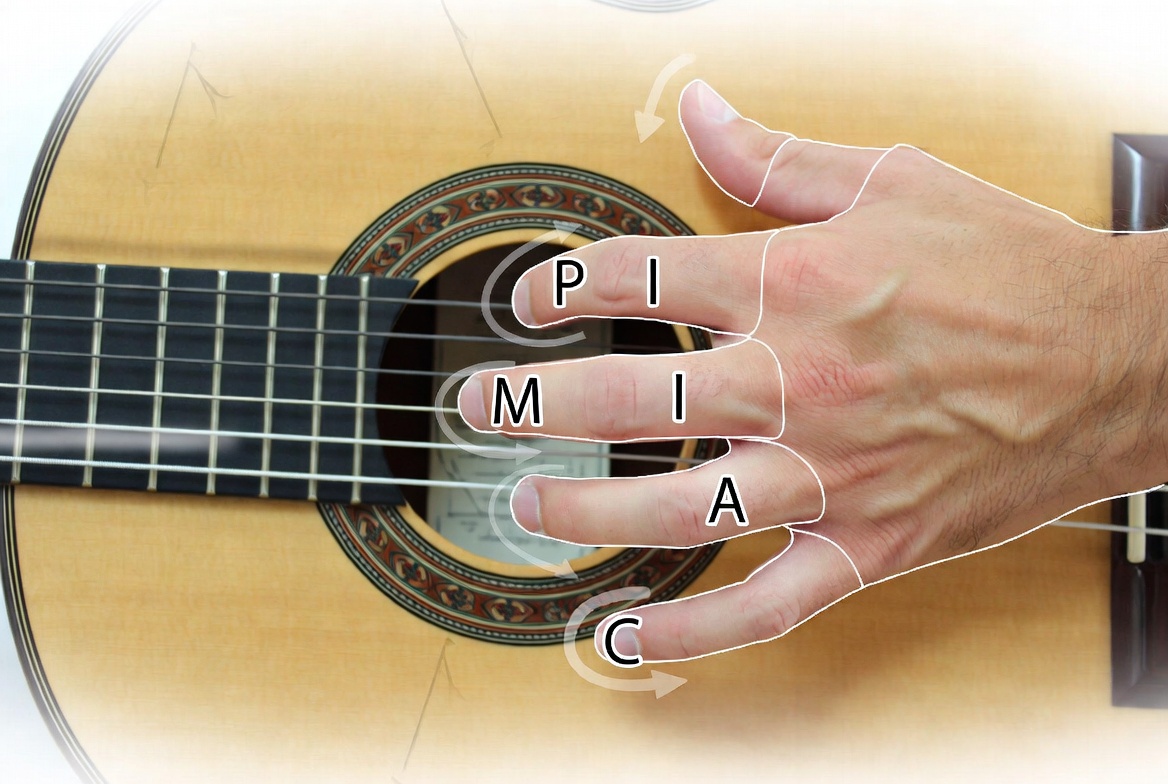
Open any standard classical guitar method — Aguado’s Escuela of 1843, Pujol’s four-volume Escuela Razonada de la Guitarra of the early twentieth century, Scott Tennant’s Pumping Nylon of 1995 — and you will find a right-hand technique organized around four fingers: the thumb (pulgar, p), the index (índice, i), the middle (medio, m), and the ring (anular, a). The pinky, the chiquito or meñique (c), is conspicuous in its absence. For most of the instrument’s modern pedagogical history, the fifth finger has been treated as if it were not there.
This absence is not an oversight. It reflects, at one level, a long-running judgment that the pinky is anatomically too weak, too short, and too dependent on the ring finger to bear independent musical responsibility.
At another level, it reflects an inherited stylistic constraint: the standard repertoire of the classical guitar was written, with very few exceptions, for a four-finger right hand, and to require the pinky would be to require what most players were never taught.
The premise of this guide is that the four-finger orthodoxy, while historically explicable, is no longer adequate to the full range of what is possible on the modern guitar. A small but growing tradition — formalized in the work of the Uruguayan pedagogue Abel Carlevaro and advanced by composers and performers including Sergio Assad, Roland Dyens, Charles Postlewate, and Marcin Dylla — has demonstrated that the c finger can be trained, integrated, and used to expand the instrument’s polyphonic, arpeggiated, and textural possibilities in ways the four-finger hand cannot match.
This essay is a long-form, scholarly introduction to complex fingerpicking on the guitar, with sustained attention to the question of engaging all five fingers. Its scope encompasses the classical right-hand tradition, the modern five-finger school, the steel-string fingerstyle and Travis-picking traditions, and the cognitive-motor research that bears on finger independence. Its argument is neither that every guitarist should use five fingers nor that the four-finger orthodoxy is wrong. It is, more precisely, that the choice between them should be informed so that the player who understands what the c finger does, what it costs, and what it enables can make a deliberate decision rather than a default one.
II. The Classical Pedagogical Inheritance
The four-finger right hand is not a natural fact but a pedagogical inheritance, transmitted from teacher to student across approximately two centuries of documented practice. Its line of descent can be traced with some precision.
Dionisio Aguado’s Escuela de guitarra (1843), one of the foundational classical guitar methods, codified a right-hand technique in which p, i, m, and a were assigned to specific strings and patterns. Aguado treated the pinky as auxiliary at best. Fernando Sor’s near-contemporary Méthode pour la guitare (1830), which competed with Aguado’s for primacy in nineteenth-century pedagogy, similarly assumed a four-finger right hand and devoted no systematic attention to the c finger.
The most influential figure in the late-nineteenth and early-twentieth-century formation of modern technique was Francisco Tárrega (1852–1909), whose teaching, transmitted not through a written method but through students including Miguel Llobet and Emilio Pujol, established the right-hand fundamentals that would dominate the classical guitar for the next century.
Pujol’s Escuela Razonada de la Guitarra, published in four volumes between 1934 and 1971, codified Tárrega’s approach in book form and remains, in many conservatories, the standard reference. Pujol treats the c finger as a peripheral resource — useful, occasionally, for specific effects but never as a routine member of the right-hand ensemble.
This Tárrega-Pujol orthodoxy was reinforced by the international success of Andrés Segovia (1893–1987), whose recordings and concertizing made the Spanish four-finger technique the global default. Segovia’s own technical practice was conservative; the c finger is essentially absent from his playing.
The first systematic challenge to the orthodoxy came from outside the Spanish line of descent: from Abel Carlevaro (1916–2001), an Uruguayan pedagogue whose Cuaderno No. 1 and the larger School of Guitar (English edition: Boosey & Hawkes, 1984) presented a comprehensive re-derivation of right-hand mechanics from biomechanical first principles.
Carlevaro did not insist on the c finger as a standard, but his framework, which analyzed right-hand motion in terms of the small flexor-extensor groups acting on each finger individually, made the integration of the c finger theoretically tractable in a way that the Tárrega school did not.
Carlevaro’s most consequential student in this regard was the American pedagogue Charles Postlewate, whose later work, including the explicit method Right Hand Studies for Five Fingers, represents the most systematic published attempt to integrate the c finger into a complete right-hand technique. Postlewate’s work, together with the compositional advocacy of Sergio Assad and Roland Dyens, both of whom have written repertoire that calls for the c finger as a routine matter, constitutes what can fairly be called the contemporary five-finger school.
III. The Standard Right Hand: PIMA
Before turning to the question of the fifth finger, it is worth stating the four-finger standard with some precision, because it is the technique on which any five-finger extension must be built.
The thumb (p) is assigned, by default, to the three bass strings: the sixth (low E), fifth (A), and fourth (D). The index (i), middle (m), and ring (a) fingers are assigned, respectively, to the third (G), second (B), and first (high E) strings. This default assignment — known in classical pedagogy as the posición fija or “fixed position” — is the starting point of all right-hand work.
From this base position, the four-finger right hand executes a vocabulary of patterns that has been gradually codified over two centuries of practice. The most fundamental of these include: the block chord, in which p plays a bass note while i, m, and a strike the three treble strings simultaneously, producing a four-note chord; the ascending arpeggio (p-i-m-a), in which the four fingers sound the strings in succession from low to high; the descending arpeggio (p-a-m-i), which reverses the motion; the mixed arpeggio (p-i-m-a-m-i and many variants), which produces more complex rhythmic and contrapuntal patterns; and the tremolo (p-a-m-i), the iconic technique of Tárrega’s Recuerdos de la Alhambra, in which the thumb sustains a slow bass line while the a, m, and i fingers strike the same treble note in rapid succession, producing the illusion of a sustained melody on a notoriously short-sustaining instrument.
These five basic patterns, in their variants and combinations, account for the great majority of standard classical guitar repertoire. A guitarist who can execute them cleanly and at speed has access to most of the canon.
What this guitarist does not have access to are the additional patterns that become possible when the c finger is added.
IV. The Biomechanical Problem of the Annular Finger
The reason the c finger is hard to use is not pedagogical reluctance. It is anatomy.
The four flexor-extensor systems of the hand are not, contrary to common intuition, fully independent. The ring finger (a) and the pinky (c) share substantial portions of the extensor digitorum communis tendon — the long extensor that runs across the back of the hand to all four non-thumb fingers. The flexor digitorum profundus and flexor digitorum superficialis, which run along the palm side, also bind the c finger to its neighbors more tightly than is the case for the index or middle finger.
The practical consequence is that the c finger cannot, in most hands, be flexed or extended fully independently of the a finger. Lift the a finger from the table while the others remain flat, and it rises only slightly — and the c finger tends to rise with it. Lift the c finger alone and similar coupling occurs in the opposite direction. This anatomical coupling — sometimes called enslaving in the motor-control literature — is the central technical obstacle to five-finger right-hand technique.
The good news, established by a substantial body of motor-learning research, is that enslaving is reducible — though not eliminable — by training. Pianists, who have somewhat greater functional independence of the c finger than guitarists (because piano repertoire demands it), are the standing proof. Their independence is acquired, not innate. The same is true for guitarists in the five-finger tradition.
The German neurologist Eckart Altenmüller and his colleagues have shown, in a series of studies of musicians’ motor control, that the cortical representation of individual fingers in skilled musicians is more spatially differentiated than in non-musicians. The brain, in other words, learns to treat the fingers as independent agents when the music requires it. The peripheral anatomical coupling does not go away, but the central control system learns to compensate.
For the guitarist, the implication is clear: the c finger’s apparent uselessness is a state, not a property. The technique can be acquired. What it requires is the systematic, patient practice that the standard four-finger pedagogy never asked for.
V. Carlevaro and the Modern Five-Finger School
Abel Carlevaro’s contribution was, at its core, conceptual. He reframed right-hand motion away from the global gestures of the Tárrega school — the wrist, the forearm, the whole right hand acting as a unit — and toward the local actions of the individual finger muscles. In his framework, each finger is analyzed independently in terms of its three joints (metacarpophalangeal, proximal interphalangeal, distal interphalangeal), its flexor and extensor groups, and the small movements available to it in isolation from the others.
This re-derivation had two consequences. First, it made the c finger analytically continuous with the other three fingers — it was a member of the same anatomical system, governed by the same principles, and trainable by the same methods. Second, it disposed of the implicit assumption that the four-finger technique was a natural or final state. If technique was a matter of training the individual finger muscles, then the question of how many fingers to train was a pedagogical, not an ontological, one.
Carlevaro himself did not insist that the c finger be made routinely available. His own playing and that of most of his students used it sparingly. But his framework opened the door, and the door has been walked through by the generation that followed.
Charles Postlewate, working in the United States, produced the most thorough published method. His Right Hand Studies for Five Fingers is an extended pedagogical sequence — comparable in scale to Pujol’s four volumes — devoted exclusively to developing the c finger as a peer of i, m, and a. The studies progress from basic finger-isolation exercises through five-finger arpeggios, scales, and ultimately the five-finger tremolo, which is to the four-finger tremolo what the four-finger tremolo is to a simple repeated note.
On the compositional side, the Brazilian guitarist-composer Sergio Assad has written extensively for the five-finger hand. His Aquarelle (1986), a three-movement suite, includes passages whose right-hand patterns require all five fingers and whose voicing density would be impractical with a four-finger technique. The French-Tunisian guitarist Roland Dyens, in his many original works and arrangements, regularly employs the c finger for both polyphonic clarity and rhythmic articulation.
The five-finger school is not the dominant strand of classical guitar pedagogy today. It is, however, the most fertile site of technical innovation on the instrument in the past half-century.
VI. Five-Finger Arpeggio Patterns
What does the c finger actually allow that the a finger does not?
The most immediate gain is in arpeggios. A four-finger arpeggio pattern such as p-i-m-a articulates four notes per cycle, with the cycle’s length set by the available fingers. A five-finger pattern — p-i-m-a-c, or any of its many variants — articulates five notes per cycle, and crucially changes the rhythmic feel: a five-note cycle resists subdivision into the standard duple groupings of Western metric practice and naturally aligns with quintuplet subdivisions, with five-against-three polyrhythms, and with the long-line phrasing that quintuple meters invite.
In practical terms, the addition of the c finger expands the available arpeggio vocabulary substantially. Where the four-finger right hand offers approximately a dozen useful arpeggio patterns (and a slightly larger number of theoretically possible ones), the five-finger right hand offers several dozen — and, more importantly, allows arpeggio patterns whose distribution across the strings is not constrained by the limited reach of the a finger to the first string.
A few specific patterns are worth knowing. The basic ascending five-finger arpeggio, p-i-m-a-c, places the thumb on a bass string while i, m, a, and c sound the fourth, third, second, and first strings respectively, producing a five-note ascending sweep that, repeated, generates a quintuple rhythmic feel.
The descending counterpart is p-c-a-m-i. An eight-note pattern combining ascending and descending motion within a single cycle is p-i-m-a-c-a-m-i. An irregular six-note pattern that exploits the c finger’s position above the a finger to create cross-string voice-leading is p-a-c-m-i-m.
For the player accustomed to four-finger work, these patterns initially feel impossible. They become tractable within a few weeks of dedicated practice and routinely playable within a few months — a return on investment that is, by the standards of guitar technique acquisition, generous.
VII. The Five-Finger Tremolo
The four-finger tremolo — p-a-m-i — is one of the most distinctive sounds of the classical guitar. In Recuerdos de la Alhambra, in Barrios’s Una Limosna por el Amor de Dios, in dozens of Romantic and post-Romantic miniatures, the technique produces what Andrés Segovia called the guitar’s most pianistic effect: a melody that appears to sustain itself across the inherent decay of the plucked string.
The five-finger tremolo — p-c-a-m-i or related patterns — extends this effect. Where the four-finger pattern repeats a single treble note at a rate of three sixteenth-notes per beat (in standard 4/4 time with sixteenth-note tremolo), the five-finger pattern produces four — increasing both the apparent sustain and the rhythmic density. The result is a tremolo that approaches the threshold of perceptual fusion: the listener hears, not a series of individual attacks, but a continuous tone.
The technique is more demanding than the four-finger version by a substantial margin. The c finger’s coupling with the a finger creates rhythmic instability that requires considerable practice to overcome. The standard pedagogical sequence — established in Postlewate’s method and refined in conservatory practice — begins with slow, isolated c-finger attacks; proceeds to two-finger c-a alternations; then three-finger c-a-m patterns; and finally to the full p-c-a-m-i tremolo.
Repertoire that explicitly calls for the five-finger tremolo is relatively rare but growing. Several contemporary composers (Postlewate himself, Marcin Dylla in his own arrangements, Carlo Domeniconi in certain works) have written passages that exploit it.
VIII. Hybrid Picking and the Steel-String Tradition
The classical right-hand tradition is not the only fingerpicking tradition on the guitar, and the question of engaging all the fingers takes a different form in the steel-string and hybrid-picking traditions.
Hybrid picking, the technique of holding a flat plectrum between the thumb and index finger while using the m, a, and (sometimes) c fingers to pluck additional strings, became a standard tool of country and bluegrass guitarists in the second half of the twentieth century. The Nashville session player Brent Mason is one of its most prominent contemporary exponents. In hybrid picking, the thumb’s role is taken by the plectrum, and the i finger is partially absorbed into pick-holding duties, leaving m, a, and c as the available pluckers.
The implications for engaging all fingers are different from the classical case. In hybrid picking, the c finger is more readily integrable because the right hand is freed from the classical posición fija and the fingers do not need to maintain alignment with specific strings. The trade-off is that hybrid picking sacrifices some of the textural control and polyphonic clarity that the four- or five-finger classical hand affords.
American fingerstyle, the tradition descending from Merle Travis through Chet Atkins to contemporary players such as Tommy Emmanuel, typically uses the thumb plus two or three fingers, with the c finger rarely engaged in the picking pattern itself. Where the c finger appears in this tradition, it is most often as a percussive agent: tapping the soundboard, generating a body slap, or producing the harmonic-rich attack that gives modern acoustic fingerstyle its characteristic textural complexity. The percussive vocabulary of players such as Andy McKee and Mike Dawes is a significant extension of what the “picking” hand can do, even when the c finger is not pulling strings.
IX. Cognitive Science of Finger Independence
The acquisition of five-finger technique is, in cognitive terms, a problem in motor learning. The relevant research literature — much of it developed in the context of pianism, but applicable to guitar — converges on several findings.
First, finger independence is acquired through slow, attentive practice rather than through fast repetition. The motor-learning principle is well established: the patterns that the brain encodes during practice are the patterns it will reproduce at performance. Practicing fast and sloppy teaches the hand to play fast and sloppy. Practicing slow and clean — with full attention to the independent action of each finger — teaches the hand the independence it will eventually deploy at speed.
Second, mental rehearsal — visualizing the motion of each finger before executing it — substantially accelerates the acquisition of independent finger control. Caroline Palmer’s research on pianists has shown that internal auditory and motor imagery is one of the principal differentiators between skilled and unskilled performers. John Sloboda’s earlier work on sight-reading and motor planning makes the related point that experienced performers plan motor actions one to two beats ahead of execution.
Third, and most importantly for the c-finger problem, finger-independence training is most efficient when it targets the specific coupling to be overcome. Generic finger exercises — Hanon, Czerny — produce generic gains. Targeted exercises that isolate the c-from-a coupling produce the specific gain in c-independence that five-finger technique requires. This is the methodological principle behind Postlewate’s Right Hand Studies for Five Fingers and the analogous exercise sequences in the Carlevaro and Tennant traditions.
The German neurologist Eckart Altenmüller’s research on focal dystonia in musicians offers a cautionary note. The neurological apparatus that allows finger independence to be acquired is also the apparatus that, under conditions of overuse and stress, can produce the involuntary finger-coupling characteristic of musician’s dystonia. The pedagogical implication is that finger-independence training should be undertaken with care: short practice sessions, frequent rest, attention to early signs of tension or pain. The c finger is acquirable, but it is not worth acquiring at the cost of a career-ending injury.
X. A Training Sequence
What follows is a suggested order of learning for the four-finger guitarist seeking to acquire the c finger. It synthesizes the published methods of Carlevaro, Postlewate, and Tennant and the cognitive-motor research summarized above.
First, establish the standard four-finger technique. The five-finger technique is built on top of a secure four-finger foundation. A guitarist without clean p-i-m-a arpeggios, scales, and tremolo should not yet be adding the c finger.
Second, perform daily finger-isolation exercises off the instrument. Place the hand flat on a table; lift each finger in turn, holding the others down; repeat slowly. Pay particular attention to the c finger, which will initially lift less than the others. Two to five minutes daily.
Third, introduce the c finger to the instrument in isolation. Rest p, i, m, and a on their default strings; pluck the first string with c, alone, repeatedly. Pay attention to tension; pay attention to whether the a finger moves. The goal is a clean attack with no associated motion in a.
Fourth, practice two-finger alternations: c-a, c-a, c-a, slowly, on the first string, with attention to the independence of each finger. Then a-c, a-c, a-c.
Fifth, introduce three-finger patterns: c-a-m, m-a-c, and so on, on the top three strings.
Sixth, introduce the five-finger arpeggio. Begin with p-i-m-a-c on a simple chord (a C major or E minor open chord works well). Practice slowly, with full attention. Increase speed only after the pattern is clean.
Seventh, introduce the five-finger tremolo: p-c-a-m-i. Begin extremely slowly. The c finger will initially produce a weaker, less even attack than the others. This is normal. It will gradually equalize with practice.
Eighth, integrate the c finger into repertoire. Begin with passages that use it sparingly, such as a five-finger arpeggio across a few measures of an otherwise four-finger piece. Gradually take on repertoire that requires it as a routine matter.
This sequence is a matter of months, not weeks. For the player with established four-finger technique, the five-finger technique can be expected to become reliably available within six to twelve months of daily, focused practice.
XI. Repertoire That Demands Five Fingers
A short, non-exhaustive list of repertoire that engages the c finger as a routine matter, for the guitarist who wants to test or apply the technique: Sergio Assad, Aquarelle (1986); Roland Dyens, Tango en Skaï and various arrangements; Carlo Domeniconi, Koyunbaba (selected passages); Charles Postlewate, studies from Right Hand Studies for Five Fingers; Marcin Dylla, various arrangements and transcriptions.
The corpus is small but growing, and its growth is not coincidental. As the technique becomes more widely available among performers, composers write for it more readily. This is the normal mechanism of instrumental development: technique enables repertoire, repertoire reinforces technique.
XII. Conclusion
The four-finger right hand is the historical orthodoxy of classical guitar pedagogy. It is not the limit of what the guitar can do. The fifth finger — the c, the chiquito, the meñique — has been treated, in mainstream pedagogy, as a vestige, and in the modern five-finger school as a peer. The truth lies between: the c finger is acquirable, it is musically useful, and it opens patterns and textures that the four-finger hand cannot match. But it is also anatomically resistant, pedagogically expensive, and stylistically optional. The serious guitarist owes it to themselves to make the choice between four and five fingers deliberately, rather than by default.
The technique is not, in the end, about the finger. It is about the relationship between the player’s training and the player’s musical aspirations. A guitarist content with the standard repertoire and the standard textures has every reason to remain a four-finger player. A guitarist seeking the next century of repertoire — the music that composers are writing now, for the hand of the future — has every reason to begin the long work of integrating the fifth finger.
The choice is the player’s. The point of this guide is to make it informed.
Selected Bibliography
Aguado, Dionisio. Escuela de guitarra. Madrid, 1843. Reprint, ed. Brian Jeffery, London: Tecla Editions, 1981.
Altenmüller, Eckart, and Hans-Christian Jabusch. “Focal Dystonia in Musicians: Phenomenology, Pathophysiology, Triggering Factors, and Treatment.” Medical Problems of Performing Artists 25, no. 1 (2010): 3–9.
Carlevaro, Abel. Cuaderno No. 1: Escala Diatónica. Buenos Aires: Barry, 1966.
———. School of Guitar: Exposition of Instrumental Theory. Trans. Jeffrey M. Bevin. London: Boosey & Hawkes, 1984.
Jeffery, Brian. Fernando Sor, Composer and Guitarist. 2nd ed. London: Tecla Editions, 1994.
Latash, Mark L., and Vladimir M. Zatsiorsky. “Multi-Finger Synergies in Hand Function.” Annual Review of Biomedical Engineering 12 (2010): 17–38.
Palmer, Caroline. “Music Performance.” Annual Review of Psychology 48 (1997): 115–38.
Postlewate, Charles. Right Hand Studies for Five Fingers: A Complete Method. Pacific, MO: Mel Bay, 2010.
Pujol, Emilio. Escuela Razonada de la Guitarra. 4 vols. Buenos Aires: Ricordi Americana, 1934–1971.
Sloboda, John A. The Musical Mind: The Cognitive Psychology of Music. Oxford: Clarendon Press, 1985.
Stenstadvold, Erik. “‘We hate the guitar’: Prejudice and polemic in the music press in early 19th-century Europe.” Early Music 41, no. 4 (2013): 595–604.
Tennant, Scott. Pumping Nylon: The Classical Guitarist’s Technique Handbook. Van Nuys, CA: Alfred Music, 1995.