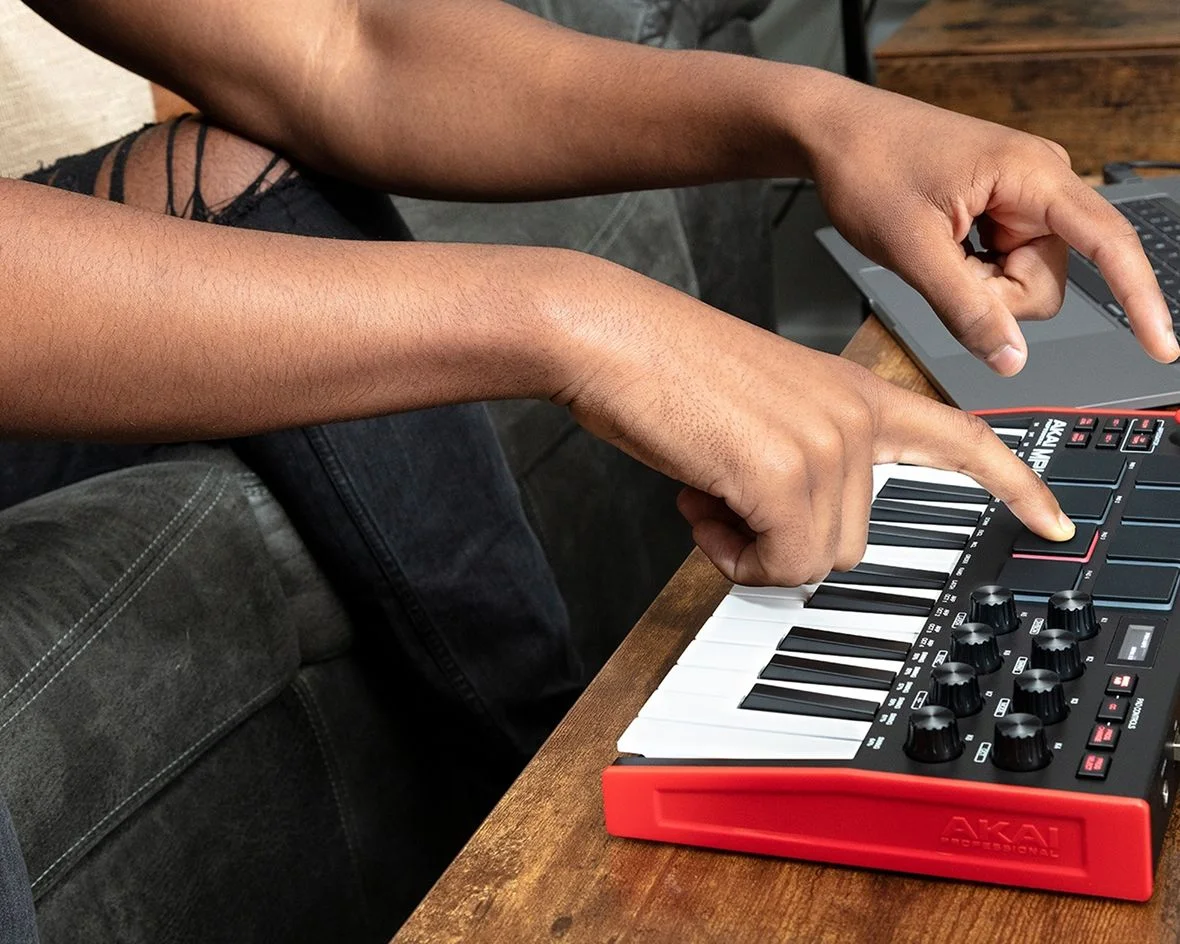

A MIDI controller is, dollar for dollar, the most useful piece of equipment a home songwriter or producer can buy. A $200 keyboard with sixteen pads, eight knobs, and a few faders unlocks more creative possibilities than a thousand-dollar guitar effect or an extra microphone. It is the bridge between musical ideas and the software where modern records are actually made.
The good news is that the MIDI controller market is the deepest and best-priced it has ever been. The bad news is that the depth is genuinely confusing. Every major brand makes a 25-key, a 49-key, and a 61-key, with multiple versions at each size, plus pad controllers, control surfaces, and expressive playing surfaces all fighting for the same shelf space. This guide cuts the field down to the units that actually serve songwriters and producers, organized by what they do best, and explains how to choose between them.
The cap throughout is $400, with most recommendations under $300. That is where the value sits.
Gear In This Article:
Arturia
Novation
Native Instruments
M-Audio
Korg
Other MIDI Controllers
What a Songwriter or Producer Actually Needs From a MIDI Controller
Before any product names, a clear-eyed view of the requirements. Different musicians need different tools.
A songwriter primarily needs: a usable key surface for chord and melody input, transport controls (play, record, stop) so they don’t have to reach for the laptop, a few assignable knobs for tweaking soft synths, and ideally a small pad section for triggering loops and drums. Velocity sensitivity matters for expressive playing. Aftertouch is nice but not essential. The key bed feel matters more than the spec sheet implies, as a bad key bed kills the writing flow within minutes.
A producer primarily needs a strong pad section for beat-making (sixteen pads, ideally backlit and velocity-sensitive), a reasonable number of assignable knobs and faders for hands-on mixing and synth control, tight DAW integration with the software they actually use, and ideally a way to navigate clip and scene grids in DAWs like Ableton Live and Bitwig.
Many writers and producers want both. A keyboard with great pads, or a pad unit alongside a keyboard. Most of the recommendations below address one of these two sides; a few try to address both.
What does not actually matter as much as marketing suggests: the number of keys (25 is fine for many users), polyphonic aftertouch (only useful if your soft synths support it), Bluetooth (useful for travel only), and the precise weighting of the key bed (synth-action is fine for most production work; fully-weighted hammer keys are a different category for piano players).
Mini-Key Controllers: The First Purchase for Most Songwriters
A 25-key mini controller is the right first MIDI controller for most home songwriters. It fits on any desk, costs under $150, and provides enough keys to cover any single-line melody or two-handed chord voicing within a single octave. The “mini” key size takes a few hours to acclimate to but is not a serious limitation for most users.
Akai MPK Mini MK3 (and MPK Mini Plus). The MPK Mini MK3 has been the best-selling MIDI controller on earth for several years and remains the strongest single recommendation for a songwriter’s first controller. Priced around $120, it offers 25 mini keys, eight backlit velocity-sensitive pads, eight assignable knobs, a four-way joystick for pitch and modulation, and an OLED display. The bundled software (MPC Beats, AIR Hybrid 3, several plugins) is generous and immediately usable.
The MPK Mini Plus, released in 2023, expands this to 37 keys and adds a sequencer, CV/Gate outputs (for hardware synth integration), and improved pads. It costs about $200. For a songwriter who knows they want hardware synth integration eventually, the Plus is the better long-term purchase.
Arturia MiniLab 3. Arturia’s response to the MPK Mini MK3 and, in this writer’s view, the slightly better unit. Priced around $110, the MiniLab 3 offers 25 mini keys, eight pads (less impressive than Akai’s, but adequate), eight knobs, four faders (a real advantage over the MPK), and an unusually clean integration with Ableton Live and Logic Pro out of the box. The bundled software (Analog Lab Intro, Ableton Live Lite, NI Komplete Start, UVI Model D) is the strongest bundle in the category.
For a songwriter who plans to work in Ableton Live or Logic, the MiniLab 3 is the more useful purchase. For a producer who prioritizes pad quality for beat-making, the MPK Mini MK3 is better.
Novation Launchkey Mini MK3. Designed first and foremost for Ableton Live integration. Priced around $110, the Launchkey Mini offers 25 mini keys, sixteen pads (twice as many as the Akai or Arturia), eight knobs, and a chord/scale/arpeggiator section that is genuinely useful for songwriting. The Ableton integration is the tightest of any controller at this price (clip launching, mixer control, and capture-MIDI all work out of the box.)
For an Ableton-centric songwriter, the Launchkey Mini MK3 is the right call. For users of other DAWs, it works but loses the integration advantage.
Native Instruments Komplete Kontrol M32. A 32-key mini controller priced around $130, with NI’s signature integration into the Komplete software ecosystem and the Kontakt sample engine. The keys are slightly smaller than the competition’s mini keys, which some users find awkward, but the software integration (Komplete Start free instruments, NKS-compatible plugin browsing, and tight Maschine ecosystem connection) is unmatched for users who plan to invest in NI’s software.
The M32 is the right purchase for songwriters and producers who already use or plan to use NI’s Komplete instruments. For users outside that ecosystem, the integration advantage is smaller and the harder hardware features (pads, faders) are weaker than the competition.
Korg microKEY Air 25/37/49. Korg’s mini-key offering, available in 25-, 37-, and 49-key sizes. The microKEY Air series adds Bluetooth MIDI (useful for iPad workflows) and benefits from Korg’s reputation for keyboard feel. The keys are widely considered to be the best in the mini-controller category. The trade-off is a sparse feature set: no pads, no knobs, no faders. The microKEY is a pure keyboard.
For songwriters who already own a separate pad controller and just want excellent keys at a budget price, the microKEY is the right call. As a single-purchase solution, the MPK Mini or MiniLab 3 is more versatile.
Full-Size Key Controllers: The Songwriter’s Step-Up
Once a songwriter has spent a few months with a 25-key mini, the limitations become apparent, particularly when writing piano-driven material that needs two hands across more than two octaves. A 49-key or 61-key full-size controller is the natural step up.
Arturia KeyLab Essential 49 / 61 mk3. The KeyLab Essential mk3, launched in 2023, is the strongest mid-tier MIDI controller for songwriters. Priced around $250 for the 49-key and $300 for the 61-key, it offers full-size synth-action keys, nine faders, nine encoders, eight pads, dedicated transport controls, and a clear OLED display. The bundled Analog Lab software gives access to thousands of vintage synth presets that many songwriters use as their primary writing palette.
The mk3’s deepest advantage is integration: Arturia maintains tight DAW scripts for Ableton, Logic, Cubase, FL Studio, Pro Tools, and Bitwig, so the controller’s transport, faders, and encoders map sensibly out of the box across the major DAWs. For a songwriter who wants one controller that works equally well across DAWs, the KeyLab Essential mk3 is the strongest recommendation.
Novation Launchkey 49 / 61 MK3. The full-size sibling to the Launchkey Mini. Priced around $250 for the 49-key and $330 for the 61-key, the Launchkey MK3 offers full-size synth-action keys, sixteen pads, nine faders, eight encoders, and the same chord/scale/arpeggiator features as the Mini. Ableton Live integration is industry-leading.
The Launchkey MK3 is the choice for Ableton-centric producers who want a real keyboard. Its integration with other DAWs is competent but less thorough than Arturia’s.
M-Audio Oxygen Pro 49 / 61. M-Audio’s flagship MIDI controller line, priced around $280 for the 49-key and $330 for the 61-key. The Oxygen Pro offers full-size semi-weighted keys (a notable upgrade from synth-action for piano-style playing), nine faders, eight knobs, sixteen pads, and bundled software including MPC Beats and Air plugins.
The Oxygen Pro’s distinguishing feature is the semi-weighted key bed, which feels more piano-like than the Arturia or Novation alternatives at the same price. For songwriters who play piano and want a keyboard that resembles one, the Oxygen Pro 49 or 61 is the right choice.
Akai MPK249 / MPK261. Akai’s flagship full-size MIDI keyboards, priced around $400 for the 49-key, which sits at the upper edge of this guide’s budget. The MPK series has been the workhorse of project-studio production for years, with semi-weighted keys, sixteen excellent MPC-style pads, and deep DAW integration. The pads are the best in this category, which matters significantly for hip-hop and beat-driven production.
The MPK249 is the right call for producers who want a keyboard with serious pad capability and have $400 to spend. For songwriters whose primary need is keys, the cheaper Arturia or M-Audio options are more cost-effective.
Native Instruments Komplete Kontrol A49 / A61. NI’s mid-tier full-size controller, priced around $250 and $300, with the same NKS integration and Komplete software bundle as the M32. Synth-action keys, no pads, no faders. This is a pure keyboard with NI software integration. For users committed to the NI ecosystem and the Komplete instrument library, this is the right purchase. For users outside that ecosystem, the Arturia and Novation alternatives are more useful.
Pad Controllers: The Producer’s Specialty
Some producers (particularly in hip-hop, electronic, and beat-driven genres) care more about pads than keys. Several units specialize in pad workflow.
Akai MPD218 / MPD226 / MPD232. Akai’s dedicated pad controllers, descendants of the legendary MPC samplers. Priced around $130 for the MPD218 and up to $280 for the MPD232, these units offer sixteen MPC-quality pads, assignable knobs and faders, and the workflow that defined hip-hop production for thirty years. For producers whose primary instrument is the pad grid, an MPD is often the right call alongside a separate keyboard.
Native Instruments Maschine Mikro MK3. A pad controller integrated tightly with NI’s Maschine software, which itself is a complete groove-production environment. Priced around $250 (often discounted), the Maschine Mikro is more than a controller. It is the front end to a coherent beat-making system. For producers who want a self-contained groove workflow, the Maschine ecosystem is mature and excellent.
Novation Launchpad Mini MK3 / Launchpad X. The dominant grid controllers for Ableton Live. The Launchpad Mini MK3, priced around $110, offers an 8×8 grid for clip launching, drum programming, and scale-aware note input. The Launchpad X (around $200) adds RGB feedback, velocity-sensitive pads, and dynamic note-mode workflows.
For Ableton-centric producers who organize their sets around clip and scene launching, the Launchpad is essential rather than optional. For producers in other DAWs, the Launchpad’s value is more limited.
DAW Control Surfaces: An Underrated Category
Faders for mixing, transport for navigation, and assignable buttons for workflow shortcuts make a real difference once a producer is mixing seriously. Several units specialize in this without including keys or pads.
Behringer X-Touch Mini. Priced around $90, the X-Touch Mini offers a single motorized-feeling fader, eight encoders, and assignable buttons. It is the budget standard for a small DAW control surface and works well alongside any of the keyboard controllers above.
Korg nanoKONTROL Studio (and nanoKONTROL2). Korg’s slim-form-factor control surface, priced around $100 for the wired version. Eight faders, eight knobs, and a transport section. Less powerful than dedicated mixing surfaces but adequate for a basic mixing rig.
PreSonus FaderPort. A single-fader, multi-purpose DAW controller with a motorized fader and dedicated transport buttons. Priced around $130. Works particularly well in Studio One but also functions in other DAWs with HUI/MCU support.
Akai MIDIMix. A simple 9-fader, 24-knob, 16-button mixer-style controller priced around $120. No transport section, but excellent for hands-on mix automation.
For most songwriters, a separate control surface is unnecessary if the keyboard controller has faders. For producers doing serious mixing, adding a dedicated control surface to the keyboard improves workflow.
Expressive and MPE Controllers: A Quick Note
A growing category of controllers offer per-note expression, including pitch bend, modulation, and aftertouch on a per-key basis (MPE, MIDI Polyphonic Expression). These controllers (Roli Seaboard, Linnstrument, ROLI LUMI, Sensel Morph, Joué Play) produce extraordinary expressive results in compatible synths.
The downside is that most are not affordable. The Roli Seaboard Block (around $300) is the closest entry, and used Roli Lightpads occasionally appear at sub-$200 prices. The Linnstrument is over $1,500 and outside this guide’s scope.
For songwriters curious about expressive playing surfaces, the Roli Seaboard Block is the budget entry point. For most users, an expressive controller is a second or third purchase rather than a first.
The DAW Question: Match the Controller to the Software
A practical fact most buying guides understate: MIDI controllers work with every DAW, but they work better with some DAWs than others. The integration depth varies.
For Ableton Live: Novation Launchkey series and Launchpad series are integrated to a level that no other DAW achieves with any controller short of Ableton’s own Push 3 (which is over $1,000 and outside our budget).
For Logic Pro: Arturia KeyLab series and Native Instruments Komplete Kontrol series are well-integrated. M-Audio Oxygen Pro is decent.
For FL Studio: Akai MPK series and AKai Fire (FL Studio’s official controller, around $200) are best-integrated.
For Studio One: PreSonus FaderPort and Atom controllers are best-integrated; most third-party controllers work via Mackie Control mode.
For Cubase: Steinberg’s own controllers (CC121, CMC) are best-integrated; Arturia and Novation also work well.
For Bitwig: Novation Launchkey and Launchpad have strong native scripts; Bitwig’s own controller integration is more open than most other DAWs.
The implication is clear: pick the controller whose tightest integration matches your DAW. The integration advantage is real and matters more than minor hardware-spec differences.
A Decision Framework
Faced with this many options, the decision can become paralyzing. Here lies a simplified framework:
- If you are buying your first MIDI controller and want a single all-in-one unit: Akai MPK Mini MK3 or Arturia MiniLab 3.
- If you are an Ableton Live user above all: Novation Launchkey series (Mini for desk, full-size for production).
- If you primarily play piano-style and want a credible keyboard feel: M-Audio Oxygen Pro 49 or 61.
- If you are committed to the Native Instruments ecosystem: Komplete Kontrol M32, A49, or A61.
- If you are a beat-maker who lives on pads: Akai MPD226 or Native Instruments Maschine Mikro MK3.
- If you want one full-size controller that works well across DAWs: Arturia KeyLab Essential 49 or 61 mk3.
- If you have a keyboard already and want a budget pad/control surface upgrade: Akai LPD8, MIDIMix, or Behringer X-Touch Mini.
- If budget is the absolute constraint and you only need keys: Korg microKEY 25 or 37.
What the Marketing Will Not Tell You
Three honest observations to close the analysis.
The first is that most songwriters and producers use about 30% of any controller they buy. The expensive controller with 88 weighted keys, dual screens, and motorized faders is wasted on someone who writes mostly with a single hand and a track pad. Buy for what you actually do, not for what you imagine you might do.
The second is that the controller’s role in your music is smaller than the marketing suggests. A great song can be written entirely on a $50 controller from 2008. A mediocre song does not become great by routing it through a $400 controller from the present day. The hardware matters less than the work.
The third is that the bundled software with most modern controllers is genuinely valuable and often overlooked. Arturia’s Analog Lab Intro alone is worth the price of the MiniLab 3. Native Instruments’ Komplete Start is enormous. The free DAWs (Ableton Live Lite, Pro Tools Artist, MPC Beats, Studio One Prime) bundled with various controllers are credible starting points. Account for the bundle when comparing prices.
Conclusion
The MIDI controller market in 2026 has matured to the point where any songwriter or producer can find a unit that meets their needs at a price they can afford. The Akai MPK Mini MK3, Arturia MiniLab 3, Novation Launchkey Mini MK3, and Native Instruments Komplete Kontrol M32 form an excellent budget tier of mini controllers. The Arturia KeyLab Essential mk3, Novation Launchkey MK3, and M-Audio Oxygen Pro form a strong full-size tier. The Akai MPD and Maschine Mikro serve dedicated beat-makers. And the budget control-surface tier (X-Touch Mini, MIDIMix, FaderPort) adds mixing-focused capabilities for under $150.
The bottom line is to pick the one that fits your DAW and your workflow.