
The Best Amp for Songwriting Is the One That Never Interrupts You
There’s a moment every guitarist who writes songs knows intimately: the riff arrives, fully formed, at 11:40 on a Tuesday night. In the tube-amp era, that moment died in the gap between inspiration and setup. Warm up the amp. Mic the cab. Worry about the neighbors. Turn the volume down until the tone disappears. By the time the signal chain was ready, the idea was gone.
Amp modelers ended that problem. And in doing so, they changed something more fundamental than tone — they changed the workflow of songwriting itself. The debate over whether a Kemper or a Quad Cortex sounds “as good as” a real tube amp misses the point for writers. The question isn’t which sounds better in a blind test. It’s which one gets a finished song out of you. On that measure, it’s no longer close.
Speed Is a Creative Feature, Not a Convenience
Songwriting runs on momentum. Research on creative flow consistently shows that interruptions — even short ones — are expensive; re-entering a creative state takes far longer than exiting one. Every minute spent positioning an SM57 against a grille cloth is a minute your idea spends decaying.
A modeler collapses the entire signal chain — amp, cab, mic, room, pedals — into one recallable preset. Plug in, open your DAW, and you’re recording a fully produced guitar tone in under a minute, at any volume, at any hour. That’s not a small quality-of-life improvement. For songwriting, it’s the whole game. The writers who finish the most songs aren’t the ones with the best gear; they’re the ones with the lowest friction between idea and capture.
Silent recording matters more than people admit, too. A cranked 50-watt tube head sounds glorious at stage volume and useless in an apartment at midnight. Modelers deliver power-amp saturation and speaker breakup through headphones, which means the hours when most songwriting actually happens — late nights, early mornings, stolen moments — are finally usable.
One Box, Every Sound Your Song Might Need
Songs rarely announce their genre in advance. A verse that starts as a clean, chimey Fender idea might want a wall of high-gain rhythm by the chorus. With real amps, chasing that arrangement means owning (and re-miking) multiple rigs. With a modeler, it’s two clicks.
That breadth changes what you write. When a Vox chime, a Marshall crunch, a Dumble-style lead tone, and a modern djent rhythm channel are all instantly available, you audition arrangement ideas you’d never have tried otherwise. Tone becomes a compositional tool rather than a fixed constraint. Plenty of songwriters report that a preset itself sparked the song — a specific delay-drenched clean patch or a fizzy fuzz tone suggesting a part that a single amp never would have.
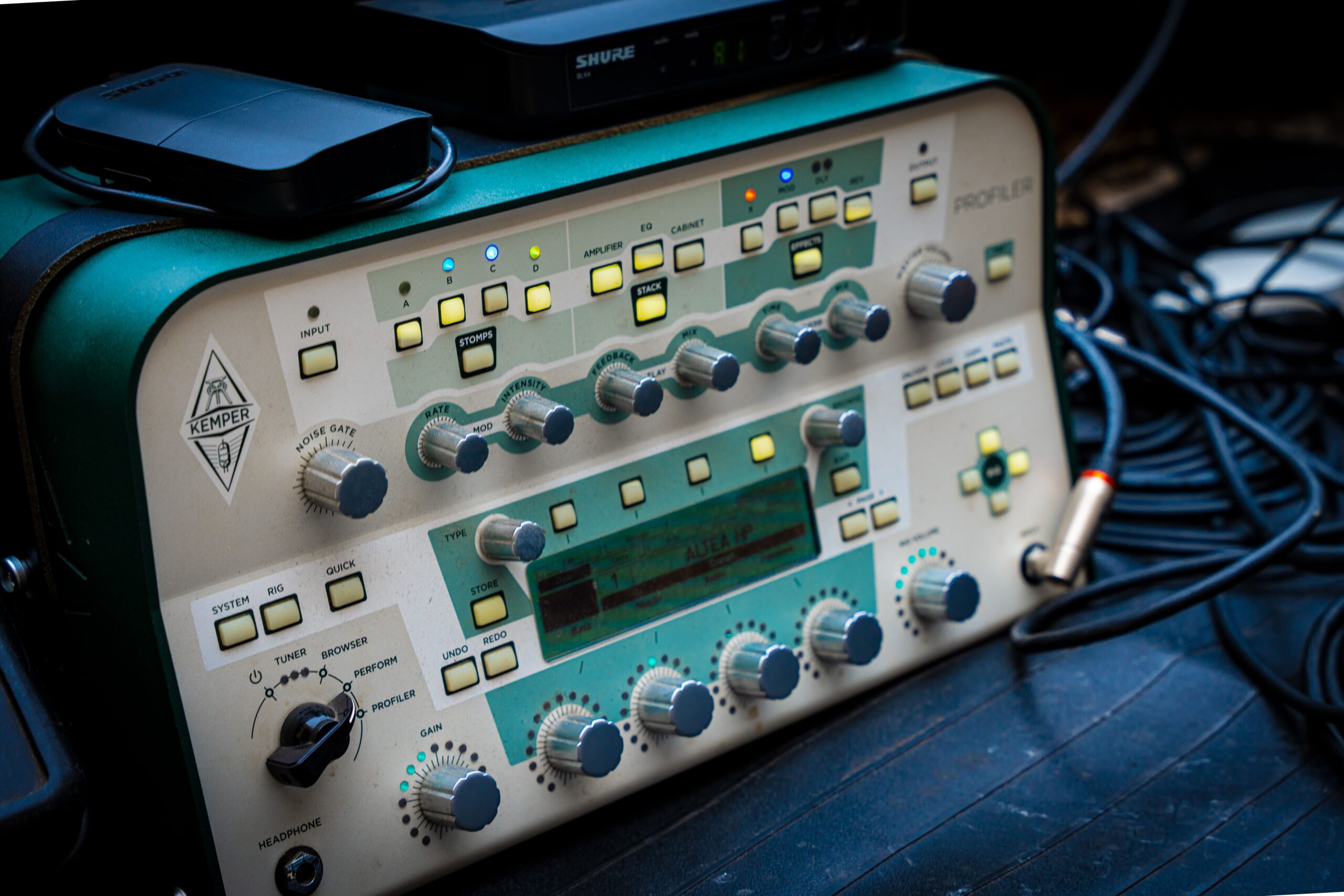
The current generation of gear makes this almost absurdly deep. Hardware flagships like the Neural DSP Quad Cortex (and the new Quad Cortex Mini), Line 6’s Helix Stadium series, the Kemper Profiler MK 2, and Fractal Audio’s units model or capture thousands of amps between them. On the software side, IK Multimedia’s TONEX ships with over a thousand tone models and access to more than 20,000 on ToneNET, while the free, open-source Neural Amp Modeler (NAM) — with its community hub TONE3000 — puts studio-grade captures within reach of literally anyone with a laptop and an interface. In blind listening tests, today’s flagship modelers are routinely indistinguishable from the tube amps they emulate, even to professional engineers. The “digital sounds sterile” argument was settled years ago; the market agreed, and modelers now outsell traditional amps on major used-gear platforms.
Your Demo Is Already Your Record
Here’s the argument that matters most for working songwriters: with a modeler, the line between demo and final recording disappears.
When you write through a real amp and capture a quick phone recording or a hastily miked take, that take is disposable. You’ll have to re-record it properly later — recreate the settings, re-mic the cab, hope the magic returns. Anyone who’s tried to re-cut a first-take demo knows the magic usually doesn’t return. Demos have a documented tendency to outperform their “proper” re-recordings; producers even have a name for the disease of chasing them: demo-itis.
Modelers cure it structurally. Because the tone is captured direct and the preset is saved with the session, the take you recorded at midnight is the keeper take — same tone, infinitely recallable, already sitting on the grid in your DAW. Better still, most modelers and amp sims let you record a dry DI signal alongside the processed one. Decide next month that the song wants a different amp entirely? Re-amp the original performance through a new model without playing a note. The performance and the tone are finally decoupled — which means a songwriting decision never has to be a permanent tone commitment.
That re-amping workflow is quietly the most powerful songwriting feature modelers offer. It lets you defer tone decisions until the arrangement is finished, which is exactly when you’re qualified to make them.
What About Feel? An Honest Caveat
The strongest case for real amps has never been tone — it’s feel. Moving air from a 4×12 compresses against your body; the guitar feeds back musically; you play differently at volume. Some writers need that physical dialogue to find parts, and no headphone mix fully replicates it.
That’s a real consideration, and the honest answer is: it’s a reason to keep a tube amp for tracking days and rehearsals, not a reason to write through one. The modern hybrid approach — write and demo through a modeler, then decide whether any final part earns a real-amp re-record — gets you the best of both. In practice, most people who adopt this workflow discover the re-record rarely happens, because the modeled take already sounds like a record. Latency, the other historical complaint, is functionally solved: at typical interface buffer settings, round-trip latency sits well under the threshold most players can perceive.
How to Start (Without Spending Flagship Money)
The barrier to entry is now effectively zero. Neural Amp Modeler is free and open-source, and TONE3000 hosts thousands of free captures of classic amps. IK’s TONEX CS is free with 40 tone models. From there, the ladder runs through Neural DSP’s Archetype plugin line and AmpliTube 5 into hardware — HeadRush and Line 6’s POD/Catalyst lines at the affordable end, up to the Quad Cortex, Helix, Kemper, and Fractal flagships. A songwriter with a $150 audio interface and a free amp sim today has more tonal range than a 1990s pro studio.
The gear question, though, is downstream of the real insight: songwriting rewards whatever removes friction between hearing an idea and hearing it back. Real amps still have a place — on stage, in the studio, in the room where volume is a feature. But for the actual act of writing songs, the amp modeler isn’t a compromise. It’s the better tool. The riff that arrives at 11:40 on a Tuesday night deserves to survive until 11:42.