Pioneering Design (1954)
Founder Leo Fender and his team established the Stratocaster as an ergonomic upgrade to the Telecaster, featuring body contours, three single-coil pickups, and a novel synchronized tremolo system for improved playability and tonal versatility.
Slow Start to Icon Status
Initial sales were slow due to the guitar’s futuristic look, but it became popular in the late 1950s thanks to artists such as Buddy Holly, ultimately becoming a staple in rock, blues, and beyond.
Cultural Revolution:
The Stratocaster helped to define modern music genres, from blues to funk, as legends like Jimi Hendrix and Stevie Ray Vaughan used the guitar as their weapon of choice.
Enduring Legacy:
Over 70 years, it has evolved through reissues and modern variants
The Birth of a Legend
In the early 1950s, guitarists complained of sharp edges on the Fender Telecaster digging into their ribs during long gigs. Leo Fender, a big fan of country music, worked with collaborators such as George Fullerton and Freddie Tavares and created the Stratocaster in 1954 with sleek contours for comfort, a vibrato (tremolo) system that stayed in tune, and three pickups for endless tonal options. The first models featured a sunburst finish and maple necks.
Rise to Fame
Sales initially lagged, but by 1957, a Buddy Holly TV appearance made it popular. The 1960s explosion came with Jimi Hendrix, who flipped it upside down (literally, as a lefty) and set one ablaze at Monterey Pop in 1967, turning the Strat into a symbol of wild innovation. Evidence from music histories shows how it bridged genres, from blues with Stevie Ray Vaughan to psychedelia with David Gilmour.
Modern Impact
The Strat remains a bestseller today, with Fender’s 70th-anniversary models in 2024 blending vintage vibes with modern tweaks like improved pickups.
The History Of The Fender Stratocaster
Created in 1954, the Stratocaster built on decades of experimentation in electric stringed instruments.
Leo Fender entered the music industry in the 1940s, starting with lap steels and amps through K&F Electric (1945). After his partner Doc Kaufman left, Fender went solo, producing solid-body prototypes. The 1950 Esquire and Broadcaster (renamed Telecaster in 1951) were breakthroughs: bolt-on necks, no truss rods initially, and direct-string pickups. The 1951 Precision Bass added to this, revolutionizing stage performance through a shift from chaotic amplification to unified electric sound.
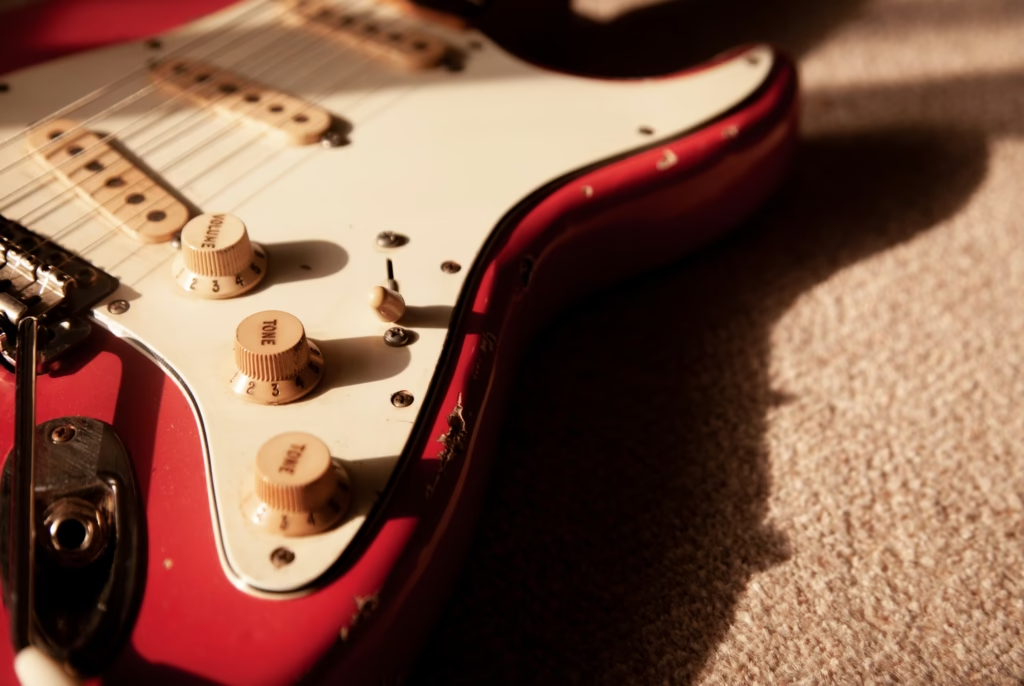
Image: Duncan Kidd
The Design Revolution: Crafting the Stratocaster
By 1952, Fender wanted to build a guitar sleeker than the Telecaster. Guitarists like Bill Carson had griped about the Tele’s sharp edges and poor intonation. As Carson recalled: “I began to have trouble with the Telecaster… I sawed mine in two and made me six bridges.”
This led to the Strat’s individual adjustable saddles. Leo, with George Fullerton and Freddie Tavares, built prototypes. Rex Gallion suggested body contours for comfort, while Carson pushed for a vibrato that held pitch and allowed half-tone bends.
The synchronized tremolo—Leo’s “pride and joy”—was redesigned after initial issues, delaying launch. Three single-coil pickups offered versatility: neck for warm riffs, bridge for bright feedback, middle for balanced tones.
The double-cutaway alder or ash body (sunburst finish standard) weighed less, with a 25.5-inch scale for crisp highs. Headstock drew from Paul Bigsby, and the recessed jack prevented cord damage. For these reasons, the Stratocaster represented an ergonomic leap, blending physics (electromagnetism for pickups) with cultural needs, making it “the most successful electric guitar in history.”
Production started October 1954, but sales were modest at less than 750 units by 1955, as its futuristic vibe seemed gimmicky. Early tweaks were made, including Rosewood fretboards in 1959 for warmer tone, and larger headstocks by 1965.
Launch, Reception, and the Rock Explosion
Priced at around $250 (with case), the Strat targeted pros but faced skepticism. Buddy Holly’s 1957 Ed Sullivan Show performance changed that, showcasing its clean twang. The 1960s surge came post-CBS acquisition (1965), despite quality dips in the ’70s CBS era (e.g., three-bolt necks).
Jimi Hendrix’s upside-down Strat at Monterey (burning one onstage) and Woodstock epitomized rebellion, boosting sales—Hendrix alone “caused more Stratocasters to be sold than all the Fender salesmen put together.”
The Stratocaster’s high-frequency pickups suited funk’s rhythms (e.g., Red Hot Chili Peppers’ Josh Klinghoffer), while series/parallel wiring enabled unique timbres in jazz and blues. In country, Keith Urban’s use echoes early adopters like Hank Marvin.
Cultural and Scholarly Significance
The Stratocaster’s pickups harness electromagnetism for versatile tones, promoting genres like jazz (thick humbucker variants), blues (concentrated neck pickup), and rock (bridge feedback). It’s “perfectly integrated into various musical styles,” reacting to music’s development while conforming to historical processes.
Museums like the Smithsonian house relics, and business cases (e.g., Harvard) note its role in Fender’s resurgence amid electric guitar sales booms.
Culturally, it’s a symbol of individuality—from Hendrix’s flames to modern hybrids like the Acoustasonic.
With over 70 years, it’s the most emulated guitar, proving timeless in a streaming era.
| Musician | Notable Strat(s) | Key Details/Notes |
| Jimi Hendrix | Flipped right-handed Strats; Burned one at Miami Pop Festival (1968) | Left-handed innovator; Used for psychedelic rock with heavy feedback and wah effects; Burned guitar sold for approximately $500,000 in 2008. |
| Stevie Ray Vaughan | “Number One” (c. 1959-1963 body, 1962 neck) | Redefined blues with heavy .013 strings; High action for tone; On display at Bullock Museum in Austin. |
| David Gilmour | “Black Strat” (1969); “0001” (1954) | “Black Strat” sold for $3.975 million; “0001” for $1.815 million; Iconic in Pink Floyd recordings. |
| Jeff Beck | 1962 Strat (used 1968-1998) | Switched to Strat in 1968, crediting it for global success; Transitioned for more control and innovative sound. |
| Eric Clapton | “Blackie” (composite 1950s parts) | Famous hybrid Strat; Sold for $959,500 in 2004; Key in his blues-rock era. |
| Mark Knopfler | Various Strats | Prominent in Dire Straits; Known for fingerstyle on Stratocasters. |
| John Mayer | Signature model | Modern blues and pop; Fender signature Strat based on his preferences. |
| Bob Dylan | 1964 Strat (Newport 1965) | Used for controversial electric set at Newport Folk Festival; Sold for $965,000 in 2013. |
| Frank Zappa | Hendrix’s burned Strat (c. 1960s) | Restored and modified Hendrix’s charred guitar; Used in his experimental work. |
| Sting | 1979 Strat | First professional-quality guitar, purchased new in New York. |
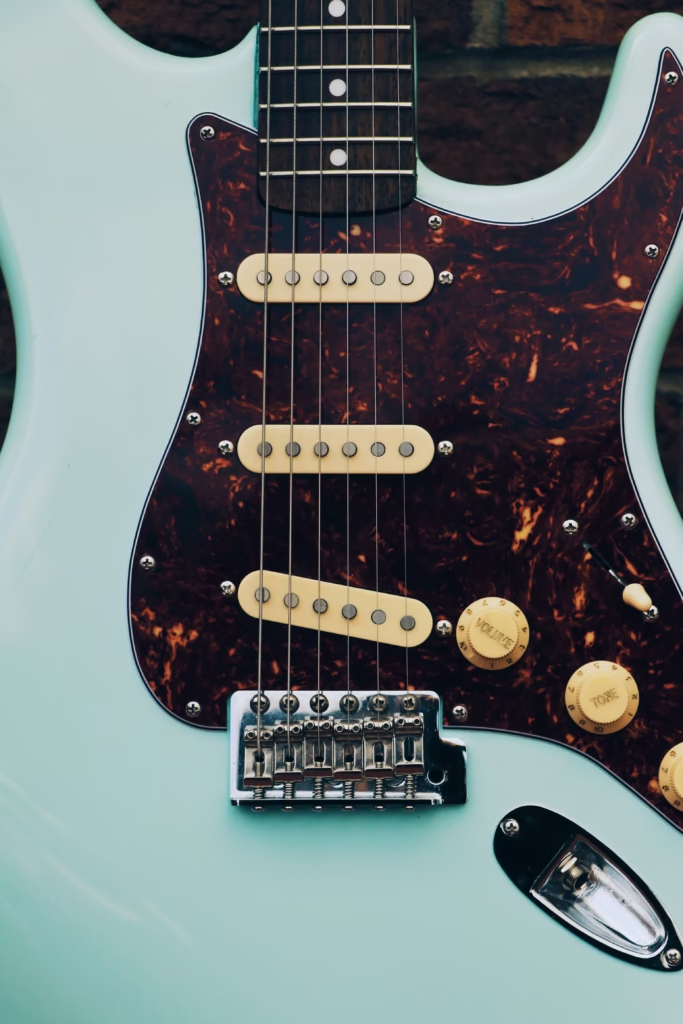
Image: Seth Reese
Related Links
Fender’s Historical Position in the Electric Guitar Family (PDF)
Project MUSE: A Design History of the Electric Guitar by Paul Atkinson (Review)]
[Fender Stratocaster | Description, History, & Facts (Britannica)
The History of the Development of Electric Stringed Musical Instruments (UIUC PDF)
A Timeline of Fender Stratocasters (Reverb)
An Oral History of the Fender Stratocaster (Guitar.com)
Seventy-One Years and Still Rocking On: The Fender Stratocaster (The Science Survey)
Fender Guitars: Can the Electric Guitar Make a Comeback? (Harvard D3)
Stratocaster Electric Guitar (Smithsonian)
Fender Stratocaster History: The 1950s (Fender)
Cover image: 戸山 神奈
Leave a Reply