
The right cheap tools don’t just save money — they remove friction. Here’s the under-$150 kit that shortens the distance between “idea” and “recorded,” and why friction, not talent, is what’s killing your output.
The Real Enemy Isn’t Lack of Talent — It’s Friction
Every unfinished song dies the same death. Not from a bad melody or a weak lyric, but from friction: the mic that takes ten minutes to set up, the DAW session that needs configuring, the chord you can hear in your head but can’t find on the keyboard. Every point of resistance between the idea and the recording is a place where songs quietly give up and disappear.
This changes what “good gear” means for a songwriter. The best songwriting gear isn’t the most impressive-sounding — it’s whatever shortens the distance between having an idea and hearing it back. And the happy surprise of 2026 is that the tools that do this best are among the cheapest things in the music store. This guide covers the affordable kit — mostly $50 to $150 per item — that makes writing feel less like work, organized by the kind of friction each one removes.
Friction #1: “I Can’t Get the Idea Down Fast Enough”
The tool: a looper pedal ($50–$130).
The looper is the single best songwriting purchase most writers never make. Play a chord progression once, and it repeats endlessly while you experiment with melodies, harmonies, and countermelodies on top — no DAW, no computer, no setup. It turns writing into a live, playful jam with yourself instead of a recording session.
The budget tier is genuinely great now: the TC Electronic Ditto (~$84) is famously one-button simple; the LEKATO looper (~$49) packs nine loop slots and a tuner; the Donner Circle Looper (~$100) adds 110 drum grooves so your loop has a beat under it. A step up, the Zoom MS-90LP+ (~$130) crams 90 minutes of recording, 100 storable loops, and rhythm patterns into a single stompbox, and the BOSS RC-5 offers 13 hours of storage and 99 phrase memories — which matters because storable, exportable loops turn your looper into an idea archive. Jam an idea at night, export it into your DAW later. The friction of “set up a session to try an idea” drops to stepping on a switch.
Friction #2: “I Know the Sound I Want but Not the Theory”
The tool: a mini MIDI keyboard with Scale and Chord modes ($50–$120).
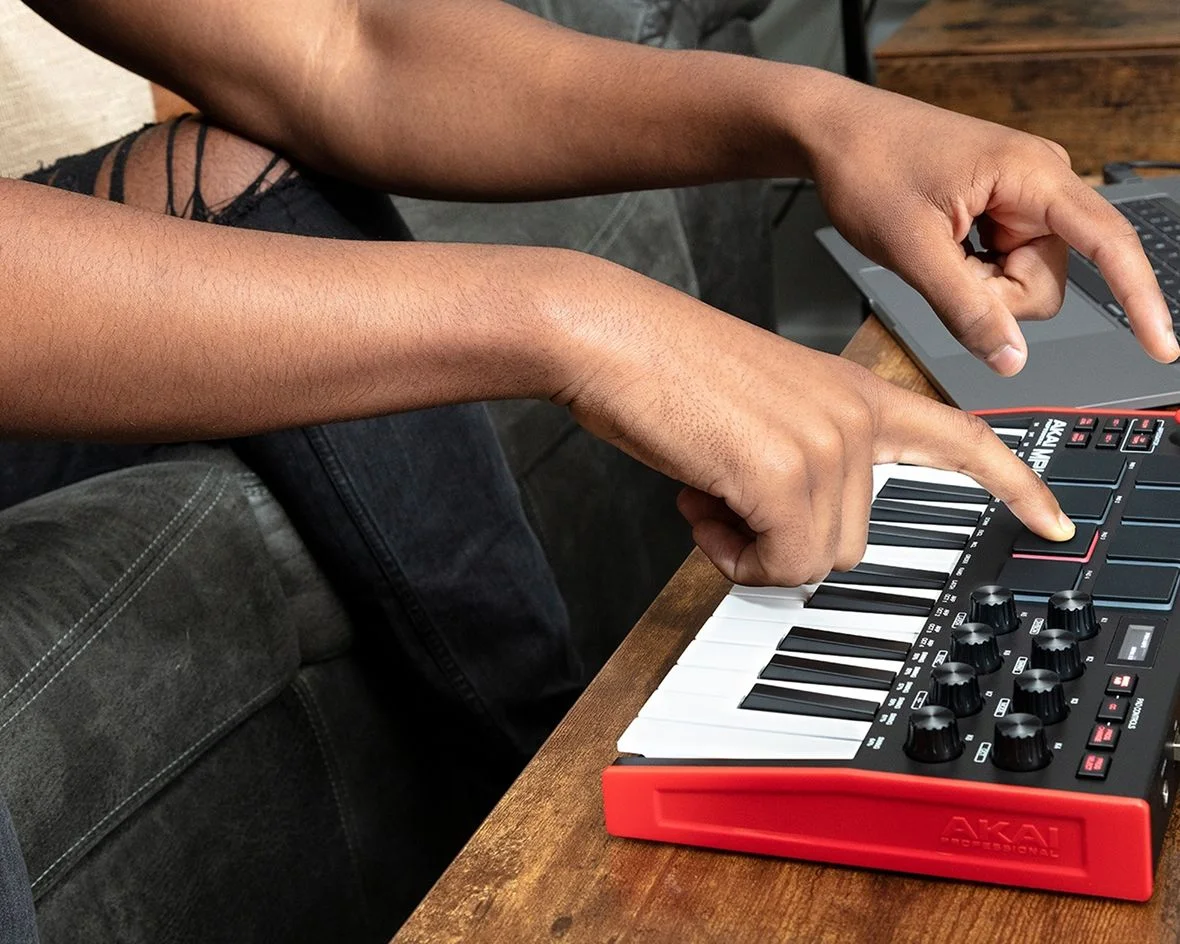
Modern budget MIDI controllers quietly solved a problem that used to require years of piano lessons. The Akai MPK Mini MK4 (~$99) and Novation Launchkey Mini MK4 both include Scale mode — which locks every key you press into your chosen key, making wrong notes literally impossible — and Chord mode, which plays full chords from single fingers (the Launchkey even shows you which chord you’re playing and its notes, so you learn as you go). The Launchkey adds a generative arpeggiator and step sequencer for stumbling into ideas you wouldn’t have played on purpose. The Arturia MiniLab 3 brings best-in-class build quality plus faders at the same price point, and the Nektar SE25 covers the bare essentials for around $50.
The point isn’t cheating theory — it’s removing the friction between imagination and audition. When every note is in key, you experiment fearlessly, and fearless experimenting is where hooks come from. These little keyboards also fit in a backpack, which means the studio comes to the couch, and the couch is where ideas actually happen.
Friction #3: “The Blank Grid Kills the Groove”
The tool: anything that gives you an instant beat ($0–$100).
Nothing deflates a writing session like programming a drum pattern before you’ve written a note. The fix is any tool that hands you a groove instantly: the drum patterns built into the loopers above, a drum-machine app on your phone, or your DAW’s loop library. Start every session with a beat already playing — borrowed, preset, whatever — and write against it. You can replace it later; its job is to make the session feel like music from the first minute. This is the cheapest friction-remover on the list, and arguably the most effective for anyone who writes rhythm-first.
Friction #4: “Recording Feels Like a Project”
The tool: an always-ready capture path ($0–$150).
The voice memo app on your phone is the most important songwriting gear you own — zero setup, always in your pocket, and completely adequate for capturing a melody before it evaporates. Honor it. Beyond that, keep a permanently plugged-in capture rig: a small 2-in interface and one mic that never gets packed away, or even a USB mic living on your desk. The principle is capture must cost zero setup. If recording an idea requires assembling anything, you’ll skip it, and the idea will be gone by morning. The gear here is cheap; the discipline of leaving it ready is free.
Friction #5: “My Sessions Die in Option Paralysis”
The tool: fewer, friendlier defaults ($0).
This one’s an anti-purchase. Friction isn’t only physical — it’s decisional. A template project in your DAW with your vocal chain, a beat, and four empty tracks pre-loaded removes the fifteen minutes of setup decisions that drain momentum before the first note. One default mic position. One default writing key. One template. The affordable-gear mindset, taken to its conclusion, is that defaults are gear — they’re just gear you configure once instead of buy.
The Under-$300 “Less Work” Kit, Assembled
If you’re building from scratch, here’s the whole friction-killing setup:
- A looper pedal (~$50–$130) — instant idea jamming and archiving. Pick the Ditto for simplicity or the Zoom/Donner for built-in drums.
- A mini MIDI keyboard with Scale/Chord modes (~$99) — fearless, in-key experimenting anywhere. MPK Mini or Launchkey Mini.
- Your phone’s voice memos ($0) — the always-on idea net.
- An instant-groove source ($0) — looper rhythms, a drum app, or DAW loops.
- A pre-built DAW template ($0) — zero-decision session starts.
Total: under $300, and every dollar of it is aimed at the same target — making the next idea easier to try than to postpone. That’s the entire philosophy: talent was never your bottleneck. Friction was. Buy against friction, not against insecurity, and songwriting starts feeling like play again — which is the state where the good songs actually come from.
Affordable Songwriting Gear
Affordable songwriting gear isn’t about settling for less — it’s about targeting the real enemy. Loopers make trying an idea effortless. Scale-and-chord MIDI keyboards make experimenting fearless. Instant grooves make sessions feel like music immediately. An always-ready capture path saves ideas from evaporating, and good defaults save your momentum from setup. None of it costs more than a mid-tier plugin bundle, and together it does something no expensive microphone can: it makes you want to write. Less work, more songs.
Sources & Further Reading (copy/paste)
Looper pedals (budget to pro)
- Best Looper Pedals 2026 — Guitar World — https://www.guitarworld.com/features/best-looper-pedals
- 14 Best Looper Pedals in 2026 (All Price Ranges) — Guitar Lobby — https://www.guitarlobby.com/best-looper-pedals/
- Best Looper Pedals: My Favourite Loop Stations for Every Budget — MusicRadar — https://www.musicradar.com/news/best-looper-pedals
- Best Looper Pedals 2026 — Guitar Player — https://www.guitarplayer.com/gear/the-best-looper-pedals
Budget MIDI keyboards
- Best MIDI Keyboards for Beginners 2026 — MusicRadar — https://www.musicradar.com/news/best-beginner-midi-keyboards
- Best Cheap MIDI Keyboards 2026 — MusicRadar — https://www.musicradar.com/news/best-cheap-MIDI-keyboards
- The Best MIDI Keyboards of 2026 — SoundGuys — https://www.soundguys.com/best-midi-keyboards-121615/
- 50 Best MIDI Keyboards in 2026 — LANDR — https://blog.landr.com/50-best-midi-controllers/
- Best MIDI Keyboards in 2026: Top Picks for Every Studio and Budget — Dubspot — https://blog.dubspot.com/best-midi-keyboards-2026