A Beginner’s Guide to Reading Piano Notation
I. Introduction: Notation as a Translation Problem
To “read piano music” is, on first encounter, to confront a system whose internal logic is far from self-evident. A page of piano notation presents two parallel staves, each composed of five horizontal lines, joined at the left by a brace. Two distinct clefs sit at the head of each line.
A constellation of round notes (some open, some filled, some flagged) populates the lines and the spaces between them. Sharps and flats accumulate at the start of each system. Italianate vocabulary scatters across the page: legato, andante, mezzo-forte. Above and below the staves, ledger lines extend into uncharted territory. To the trained pianist, this dense visual array is read fluently and at sight, often at speeds approaching ordinary prose. To the beginner, it can resemble nothing so much as a foreign script.
The premise of this guide is that the difficulty is not pedagogical accident but historical inevitability. Piano notation, as it appears on the modern printed page, is the result of approximately a thousand years of accumulated convention. Each of its components — the five-line staff, the system of clefs, the duration symbols, the bar line, the key signature, the dynamic mark — was introduced at a specific historical moment, in response to a specific musical or technological problem. The system is internally coherent only if one understands what those problems were.
This essay offers a longform, scholarly introduction to reading piano notation. Its audience is the absolute beginner, or the returning intermediate player who never quite understood why the system looks the way it does. Its method is to work outward from historical and cognitive first principles toward practical reading skill. Where standard beginner texts ask the student to memorize, this guide attempts, more ambitiously, to explain.
The argument throughout is straightforward: piano notation is not a transparent code. It is a dense, layered, instrument-specific system whose conventions are historically contingent, cognitively demanding, and — once understood — beautiful in their economy. To read it fluently is to participate in a thousand-year tradition of solving the same problem.
II. The Eleventh-Century Origin: Guido d’Arezzo and the Staff
The five-line staff, the most basic visual unit of piano notation, is not a natural representation of pitch. It is an invention, attributable in its essentials to a single eleventh-century Benedictine monk: Guido d’Arezzo (c. 991 – after 1033). Guido’s Micrologus, written around 1026 and one of the most widely circulated music-theoretical texts of the Middle Ages, established the principle of the staff lines as a visual coordinate system: each line and each space corresponded to a discrete pitch, with vertical position on the page mapping directly onto pitch height in the ear.
This was a substantial conceptual achievement. Earlier neumatic notations (the hooks, dots, and curves that populated the margins of pre-Carolingian liturgical books) had recorded the shape of melodic motion but not its absolute pitch. Singers learning a chant from such notation needed to have already heard the melody; the notation was a memory aid, not a sufficient instruction. Guido’s staff converted notation from a mnemonic into a script. A singer presented with an unfamiliar staff-notated melody could, in principle, sing it without prior exposure.
Guido’s staff was four lines, not five. The fifth line was added gradually over the following centuries as the range of polyphonic music expanded beyond the comfortable span of a single voice. By the early Renaissance, the five-line staff had become standard for most secular and sacred polyphony, and it remains the basic graphic unit of Western pitch notation today. The piano, when it emerged as the dominant keyboard instrument of the late eighteenth century, inherited this staff intact.
What the piano did not inherit was a single staff. Its range — typically seven octaves and a third in the modern 88-key instrument — exceeds the practical span of any single five-line staff. The solution was the grand staff.
III. The Grand Staff: A Piano-Specific Convention
The grand staff, which couples a treble-clef staff above a bass-clef staff and joins them at the left with a brace, is one of the few elements of piano notation that is genuinely piano-specific. Other instruments — the violin, the flute, the guitar — typically read from a single staff. The piano reads from two simultaneously, one for each hand.
The historical reason is straightforward. The piano’s predecessor, the harpsichord, also required a notation that could accommodate two hands at independent keyboard positions. The earliest substantial body of notated keyboard music — the English virginalist repertoire of the late sixteenth and early seventeenth centuries, the French clavecinistes of the seventeenth century, the German organ tradition culminating in Bach — used various two-staff and three-staff conventions before the modern grand staff stabilized around the time of Domenico Scarlatti and Johann Sebastian Bach in the early eighteenth century.
The grand staff carries an important visual feature that is easy to miss on first encounter. Between the two staves lies an implicit horizontal axis — a line that is not drawn but is functionally present. This is the position of middle C. On the treble staff, middle C sits one ledger line below the lowest line. On the bass staff, it sits one ledger line above the highest line. The two C’s meet at the same physical pitch. The grand staff thereby visually encodes the keyboard itself: lower pitches below, higher pitches above, with middle C as the visual and tactile fulcrum.
This is not coincidence. Middle C is, on the modern 88-key piano, very nearly the literal physical center of the instrument. The grand staff is a graphic analog of the keyboard, oriented so that the visual page mirrors the player’s body in space. Once the beginner internalizes this, the apparent arbitrariness of the two-staff system collapses into something closer to a map.
IV. Clefs: The Treble, the Bass, and Their Logic
The two clefs at the head of the grand staff — the treble clef (G clef) and the bass clef (F clef) — are not abstract symbols. They are stylized letters, evolved over centuries of manuscript practice, that name the staff line on which they are centered.
The treble clef is a stylized letter G. Its central spiral encircles the second line of the treble staff, declaring that line to be the G above middle C. From that anchor, the rest of the staff can be deduced: the first line below is E, the first space is F, the third line is B, and so on, alternating lines and spaces in alphabetic sequence (A through G).
The bass clef is a stylized letter F. The two dots that flank its main curve sit above and below the fourth line of the bass staff, declaring that line to be the F below middle C. Again, from that anchor, every other position on the staff can be deduced.
This logic — clef as a labeled anchor — is the historical key to all clefs in Western notation, including the now-rare alto and tenor clefs (both forms of the C clef, declaring whichever line they center to be middle C). The system is a relic of the medieval period, when staff lines were labeled directly with letters rather than with clef symbols. The clef is, in its origin, simply a stylized letter that has survived nine centuries of manuscript copying.
For the piano student, this means that every clef on the page is making a positional claim. The treble clef says: this line is G. The bass clef says: this line is F. Every other note is read by counting outward from that anchor. Memorizing mnemonics — “Every Good Boy Does Fine,” “All Cows Eat Grass” — is a workable shortcut, but it conceals the underlying logic and tends to leave the student permanently dependent on the mnemonic. Understanding the clef as an anchor is the more durable strategy.
V. The Pitch System: Letters, Octaves, and Accidentals
The Western pitch alphabet — A, B, C, D, E, F, G — predates Guido’s staff by several centuries and has its origin in late-classical and early-medieval theoretical treatises. The system repeats cyclically: above G comes A again, an octave higher than the previous A. The octave’s status as the “same” pitch at a different height is one of the deep and culturally near-universal features of human auditory perception.
On the piano, this seven-letter cycle is mapped onto the white keys, with a specific repeating pattern of black keys interleaved between them. The black keys, conventionally, are read as alterations of the adjacent white keys: a sharp (♯) raises a pitch by a half step (one key to the right on the keyboard, including black keys); a flat (♭) lowers it by a half step (one key to the left); a natural (♮) cancels a previous alteration.
Two features of this system are easy to miss. First, between B and C, and between E and F, there is no black key. These two pairs are already a half step apart. The keyboard’s seven-note cycle is not a uniform stair: it is five whole steps and two half steps, arranged in the specific irregular pattern that gives the major scale its characteristic sound. Second, sharps and flats are not strictly bound to the black keys. E-sharp, for instance, is enharmonically equivalent to F natural — the same key on the piano, written differently for theoretical reasons that depend on the prevailing key.
The accumulation of accidentals at the head of every staff — the key signature — is a notational shorthand that arose to spare the copyist (and the printer) from writing the same alteration repeatedly throughout a piece in a non-C key. Its logic is discussed below.
VI. Rhythm Notation: The Mensural Inheritance
The pitch system, as we have seen, is largely a medieval inheritance. The rhythm system is no less old, but it was systematized somewhat later, in the so-called ars nova of the fourteenth century and the mensural notation of the Renaissance.
In modern notation, duration is encoded by the appearance of the note head and its attachments. An open note head with no stem is a whole note (semibreve), four beats long in standard four-beat-per-measure time. An open note head with a stem is a half note (minim), two beats long. A filled note head with a stem is a quarter note (crotchet), one beat long. Adding a flag to the stem halves the duration: a flagged quarter becomes an eighth note, a doubly flagged eighth becomes a sixteenth, and so on. When several flagged notes appear consecutively, their flags are conventionally joined into beams, which improve readability without changing duration.
A dot to the right of any note increases its duration by half: a dotted quarter, for example, equals a quarter plus an eighth, or one and a half beats. A tie joining two notes on the same pitch sums their durations. Rests — symbols indicating silence — exist for each duration value and follow the same halving logic.
The system has the elegance of a binary tree. Almost every duration in standard practice can be derived by halving, dotting, or tying a small number of basic values. The cognitive task of reading rhythm is, in essence, the task of recognizing these graphic conventions and converting them, in real time, into temporal action. Research by John Sloboda and others has shown that experienced sight-readers do not parse rhythm note by note. They chunk patterns — common rhythmic figures — into single perceptual units and read those units as wholes.
For the beginner, the practical implication is that fluency comes not from learning to identify each note in isolation, but from accumulating a vocabulary of common rhythmic patterns that can be read at a glance.
VII. The Time Signature and the Bar Line
The bar line — the vertical stroke that periodically interrupts the staff — is a relative latecomer in notation history. It became standard only in the seventeenth century, well after pitch and rhythm notation had stabilized. Its function is to organize the music into measures of equal duration, the duration being specified by the time signature at the head of each piece (or each section).
The time signature consists of two stacked numerals. The upper numeral indicates how many beats fall within each measure; the lower numeral indicates which note value receives one beat. A time signature of 4/4, for example, declares four quarter-note beats per measure. A signature of 3/4 declares three. A signature of 6/8 declares six eighth-note beats, typically grouped into two larger beats of three eighths each.
The choice between simple meters (2/4, 3/4, 4/4) and compound meters (6/8, 9/8, 12/8) reflects the underlying rhythmic feel: simple meters subdivide the beat into twos, compound meters into threes. This distinction, which can seem abstract on the page, is immediately audible: the difference between a march (simple duple) and a jig (compound duple) is the difference between dividing the beat into two and into three.
For the beginner, time signatures are best understood as instructions for grouping. They tell the reader how to gather notes into the metrical pulses that the music’s character depends on.
VIII. Key Signatures and the Circle of Fifths
The key signature — the cluster of sharps or flats at the head of each staff, immediately following the clef — is a notational economy. Rather than mark every accidental in a piece in F major (which contains a B♭) with an explicit flat sign on every B, the convention is to declare, once, at the head of the system, that all B’s are flat unless otherwise specified. The student who internalizes this convention reads the piece more fluently; the student who does not will read every B as natural and produce a piece in C major with a perpetual mistake.
The pattern of accidentals in any key signature is not arbitrary. It follows the so-called circle of fifths, a structural feature of the twelve-tone equal-tempered system that governs all of common-practice Western music. Each new sharp added to a key signature appears a perfect fifth above the previous sharp; each new flat appears a perfect fifth below. The order is fixed and worth memorizing: sharps appear in the order F♯, C♯, G♯, D♯, A♯, E♯, B♯; flats in the reverse, B♭, E♭, A♭, D♭, G♭, C♭, F♭.
The number of sharps or flats in a key signature uniquely identifies the key — almost. Each signature corresponds to one major key and one minor key (its relative minor). Distinguishing them depends on the music itself: which pitch sounds like the tonal center, and which mode (major or minor) the piece inhabits.
For the beginner, the circle of fifths is best treated not as an abstract diagram to memorize but as a working tool that becomes intuitive with use. The specific keys most common in beginner repertoire — C major, G major, F major, D major, B-flat major, and their relative minors — should be learned first, with the more remote keys following gradually.
IX. Dynamics, Articulation, and Expression
Beyond pitch and rhythm, piano notation carries a third layer of information: instructions for how the notes are to be played. These fall into three broad categories: dynamics (how loud or soft), articulation (how connected or separated), and tempo and expression markings (how fast and in what character).
Dynamics are indicated by Italian abbreviations placed below the staff: p (piano, soft), f (forte, loud), mp (mezzo-piano, moderately soft), mf (mezzo-forte, moderately loud), pp (pianissimo, very soft), ff (fortissimo, very loud), and various extensions thereof. Crescendos and decrescendos — gradual increases and decreases in volume — are indicated either by the spelled-out word (cresc., decresc.) or by the so-called hairpin symbols (a long opening or closing wedge below the staff).
Articulation marks indicate how individual notes are to be detached or connected. A staccato dot above or below a note head shortens it. A legato slur — a curved line over a phrase — connects the notes within it into a single unbroken arc. An accent marking emphasizes the note. A fermata — a curved line with a dot beneath it — extends the note beyond its written duration at the player’s discretion.
Tempo markings — typically in Italian (allegro, andante, adagio, largo) or, since the early nineteenth century, in metronome marks (♩ = 120) — specify the speed. Expression markings (dolce, espressivo, con brio, cantabile) specify the character.
These three layers of information — pitch, rhythm, expression — are read more or less in parallel by the experienced sight-reader. For the beginner, they are best learned in sequence: pitch and rhythm first, expression as the music becomes secure.
X. Reading as a Cognitive Skill
Music reading, like prose reading, is a cognitive skill that depends on pattern recognition rather than letter-by-letter (or note-by-note) decoding. Research by John Sloboda, beginning with his foundational 1985 monograph The Musical Mind, has shown that experienced sight-readers fixate on the page in characteristic eye-movement patterns that resemble those of skilled prose readers: long saccades, brief fixations, rapid recognition of common patterns, and predictive reading-ahead of one to two beats. Andrea Halpern and Caroline Palmer have separately documented the role of internal auditory imagery — the ability to hear the notes one is reading, before playing them — in skilled performance.
For the beginner, the practical implications of this research are significant. First, fluency depends on accumulating a vocabulary of patterns — common scale fragments, common chord shapes, common rhythmic figures — that can be recognized at a glance, rather than parsed note by note. Second, mental rehearsal — looking at a passage and imagining it played, before placing the hands on the keyboard — accelerates the development of accurate sight-reading. Third, slow practice with full attention is more cognitively productive than fast practice with errors: the patterns learned in slow practice are the patterns that will eventually be read at speed.
Edwin Gordon’s Learning Sequences in Music makes a related pedagogical claim: musical literacy, like linguistic literacy, develops most efficiently when audiation — the ability to think musical sound — precedes notation. The student who can sing a melody before reading it learns the notation faster; the student who learns the notation without first knowing the sound learns more slowly and reads less musically.
XI. A Learning Sequence
What follows is a suggested order of learning, drawn from the major piano-pedagogy traditions and consistent with the cognitive research summarized above.
First, learn the geography of the keyboard. Identify middle C; identify the pattern of two-and-three black keys that repeats up and down the instrument; learn to find any white key by reference to the black-key pattern. This is keyboard literacy, prior to notation.
Second, learn the staff anchors. Internalize the position of middle C on both staves. Learn the location of treble G and bass F (the clef anchors). Learn to read the notes immediately around these anchors fluently. Resist the temptation to learn through mnemonics alone; the anchor logic is more durable.
Third, learn the basic rhythmic vocabulary. Whole, half, quarter, eighth notes; the corresponding rests; the dot. Learn to clap and count simple rhythms before playing them.
Fourth, learn the most common keys. C major, G major, and F major — one sharp, one flat, and none — cover the great majority of beginner repertoire. The corresponding key signatures should be recognized at sight.
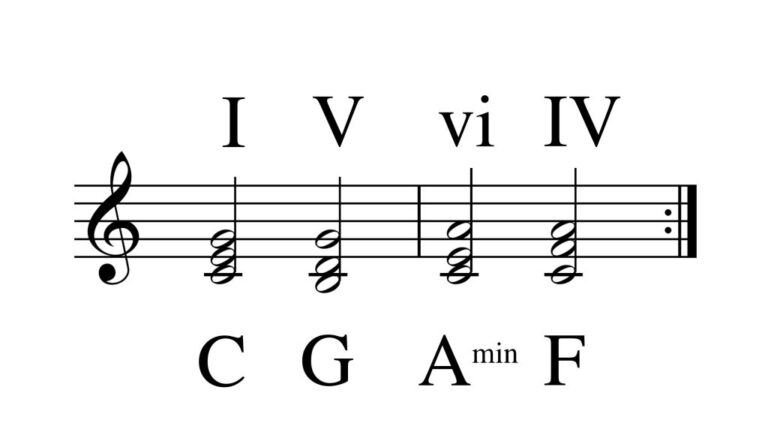
Fifth, accumulate pattern vocabulary. Practice scales (in the keys you are reading). Practice basic chord shapes (the I, IV, and V chords in your keys). When the same patterns appear in repertoire, you will read them as units rather than as individual notes.
Sixth, sight-read daily. Even brief sight-reading — five minutes a day, with material at a deliberately easier level than the music you are studying — builds the pattern vocabulary that makes reading fluent.
Seventh, audiate. Before placing your hands on the keyboard, look at a passage and try to hear it in your mind. The hearing will be approximate at first; it will become more accurate with practice. This is the cognitive skill on which sight-reading ultimately depends.
XII. Conclusion
Piano notation is a system that records, in a single visual array, three layers of musical information — pitch, rhythm, and expression — by means of conventions that have accumulated over a thousand years. It is not a transparent code; it is a dense, instrument-specific script whose conventions are the residue of medieval staff invention, Renaissance mensural systematization, and early-modern keyboard pedagogy. Each element on the page — the staff, the clef, the note head, the bar line, the key signature, the dynamic mark — exists for a specific historical reason.
To read it well is to understand those reasons. The beginner who memorizes mnemonics will play; the beginner who understands the system will read. The two paths converge over time, but the second path is faster, more durable, and, in the end, more musical. The conventions on the page are not arbitrary obstacles. They are the compressed wisdom of a long pedagogical tradition that has learned, through trial and refinement, what information a pianist needs and how it can most economically be encoded.
That economy is the system’s beauty. It is also, once seen, the answer to the beginner’s most common question: why does it look this way? Because, after a thousand years, this is what the problem’s solution looks like.
Selected Bibliography
Apel, Willi. The Notation of Polyphonic Music, 900–1600. 5th ed. Cambridge, MA: Medieval Academy of America, 1953.
Bent, Margaret. Counterpoint, Composition, and Musica Ficta. New York: Routledge, 2002.
Gordon, Edwin E. Learning Sequences in Music: A Contemporary Music Learning Theory. 2012 ed. Chicago: GIA Publications, 2012.
Halpern, Andrea R. “Mental Scanning in Auditory Imagery for Songs.” Journal of Experimental Psychology: Learning, Memory, and Cognition 14, no. 3 (1988): 434–43.
Hiley, David. Western Plainchant: A Handbook. Oxford: Clarendon Press, 1993.
Hoppin, Richard H. Medieval Music. New York: W. W. Norton, 1978.
Hughes, Andrew. Medieval Music: The Sixth Liberal Art. Rev. ed. Toronto: University of Toronto Press, 1980.
Leech-Wilkinson, Daniel. The Modern Invention of Medieval Music. Cambridge: Cambridge University Press, 2002.
Palmer, Caroline. “Music Performance.” Annual Review of Psychology 48 (1997): 115–38.
Parrish, Carl. The Notation of Medieval Music. New York: W. W. Norton, 1957.
Patel, Aniruddh D. Music, Language, and the Brain. New York: Oxford University Press, 2008.
Sloboda, John A. Exploring the Musical Mind. New York: Oxford University Press, 2005.
———. The Musical Mind: The Cognitive Psychology of Music. Oxford: Clarendon Press, 1985.