The Mind Of Damon Albarn (Blur/Gorillaz): A Deep Dive Into His Theory, Songs & Process
Damon Albarn’s songwriting process follows a structured routine, treating songwriting like a daily job with set hours, which helps maintain consistency even on unproductive days.
- He relies on quick demos as the “truest” form of ideas, captured intuitively without overthinking.
- It seems likely that collaboration plays a pivotal role, where he shares raw material with bandmates or producers to evolve songs organically.
- He emphasizes experimentation, blending prosaic details with emotional layers, and adapts his approach across projects like Blur, Gorillaz, and solo work.
Mentors like Tony Allen shifted Albarn’s rhythm understanding: “Tony Allen’s influence: Invented Afrobeat rhythms with Fela Kuti; cosmic, joyful drumming.” Hip-hop introductions, like A Tribe Called Quest, led to Gorillaz’s beats-driven style. He views collaboration as an “instrument to travel with,” bridging generations through shared popularity.
Albarn’s self-taught roots also play a role. In the July 2021 FADER Uncovered podcast, he recalls stopping classical training after a Mozart sonata’s chord progression inspired him: “I reached grade seven in classical training but stopped after being captivated by a Mozart sonata’s three-chord progression (major to minor) that he found profoundly affecting, deciding it would suffice for years.” This minimalist epiphany underscores his preference for imagination over perfection, where outcomes often surprise or fall short but evolve organically.
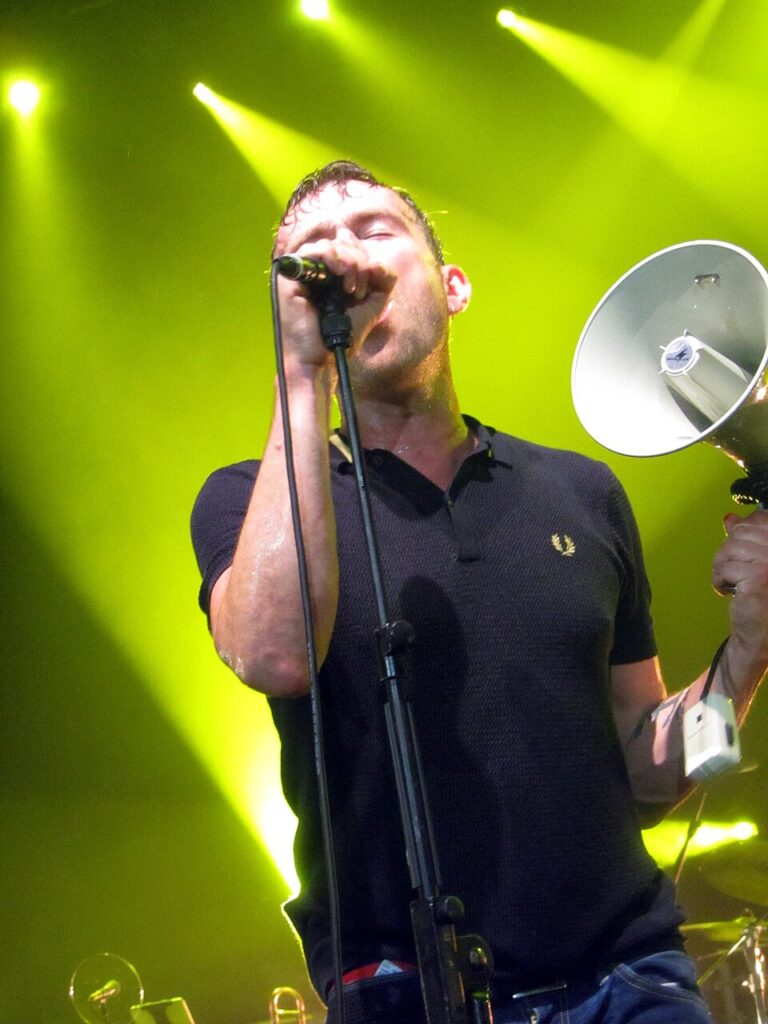
Daily Routine and Initial Inspiration
Albarn typically works from around 9:30 or 10 AM to 5:30 or 6 PM, five days a week in his studio.
This structure helps him stay in the songwriting process, even if on some days he does not compose anything. Persistence keeps the creative flow going.
Albarn describes his hands moving instinctively on the piano, with melodies and words emerging simultaneously, driven by chords that “feel” right.
The first spark of a song leads raw demos, capturing fleeting moments of authenticity. He uses software like GarageBand for quick recordings, including distorted guitar parts, so Albarn can build song templates without needing full instrumentation initially.
Collaboration and Song Development
Albarn’s process frequently involves sharing ideas with collaborators to refine them. For instance, he creates numerous demos, approximately 30 for Blur’s “The Ballad of Darren,” before showing them to the band for jamming sessions where tracks evolve through group input.
Bandmates like Graham Coxon add layers, such as angular riffs or effects, turning personal sketches into collective works. Albarn values trusting the flow, avoiding preciousness about outcomes, and incorporates guest input, like Brian Eno’s vocals on tracks where specific requests yield fresh elements, like on the song “Heavy Seas of Love” on Albarn’s solo album, “Everyday Robots.”
In Gorillaz projects, separation of roles—e.g., Jamie Hewlett handling visuals independently—fosters freedom, while producers like Danger Mouse helped transcribe mumbled ideas into lyrics during his time collaborating with the band.
Personal and Experimental Elements
Songs sometimes stem from real events, with every line in albums like “Everyday Robots” based on personal truths to convey universal truths.
Albarn layers prosaic details with emotional aspects, creating “parallel universes” in each track. Experimentation is central, from global instruments like West African horns to blending moods.
Damon Albarn’s Songwriting Process: A Comprehensive Exploration
Albarn’s approach blends disciplined routine, intuitive inspiration, personal vulnerability, and collaborative refinement, evolving from the Britpop era to contemporary works.
While Albarn’s methods adapt to each project’s context—whether the raw energy of Blur’s reunions, the animated world-building of Gorillaz, or introspective solo albums—they consistently emphasize capturing authentic moments and experimenting.
Early Insights: Playfulness and Experimentation in the Late 1990s
In a 1999 conversation, Albarn reflected on his process during Blur’s transition from Britpop, emphasizing playfulness and a relentless work ethic. He described writing songs like “B.L.U.R.E.M.I.” as lighthearted explorations rather than grand statements, noting, “When I write songs like that, it’s not an indictment or anything, it’s just playful, really.”
Experimentation was key, as he aimed to “keep experimenting—it really is the spice of life,”
shifting from frenetic performances to static, voice-focused delivery to improve singing quality.
Albarn highlighted his output frequency, criticizing industry pressures that force “big, robust” records every few years instead of allowing delicate, odd albums. He juggled projects concurrently, such as scoring a film and recording Blur’s “13” album in the same day, starting mornings on one and evenings on the other.
Mid-Career Discipline: Routine and Personal Truth in the 2010s
By 2014, Albarn’s process had matured into a structured, job-like routine, as detailed in interviews around his solo debut “Everyday Robots.”
He worked 9:30 AM to 5:30 PM, five days a week, toiling through unproductive days because “the fact that he went through the process means that he’s still in the process.”
Collaboration initiated projects; producer Richard Russell prompted the album after their Bobby Womack work, with Albarn needing a partner who “really wants to go down that path.” He provided a list of ideas but discarded most, focusing on personal narratives:
“I was at pains to make every line about something that happened… everything mentioned on the record took place.” Starting points emerged from revisiting places like Hollow Ponds in Leytonstone, expanding to global locales like Colchester or California.
Recording was intimate—Albarn on guitar/piano, Russell on drums—with guests like Brian Eno added for specific elements, such as vocals on “Heavy Seas of Love.”
Philosophically, he sought “complete truth” in personal accounts to achieve universal resonance: “That’s what a songwriter is always heading towards, finding that point where personal truth becomes a more universal experience.”
Recent Blur Reunions: Intuition, Demos, and Quick Production (2023)
Thomas Zillinger, long-time Gorillaz producer, said of Damon’s demo routine:
“Damon still uses an old cassette 4‑track, which travels with him where ever he goes, and an 8‑track reel‑to‑reel with a little desk at home. The 4‑track is what he mostly uses — it’s got a mic built in which makes it ultra‑easy to use, so for example if he’s away somewhere he can just sing and strum a guitar straight into it, no leads required. So if he gets an idea at any stage he can bash it out on there for future reference. He also uses the 4‑track for working out bits and bobs at home, like if we’ve tried to do something new in the studio and its potential hasn’t been fully realised — then he’ll use the 4‑track at home to work on it a bit more.
“When he brings it into the studio, we either use it as a reference or actually sample bits of it. If it’s sampled (well, recorded on disk in Logic) it will either be replaced, or on rare occasions will actually be used in the final project. The quality of these demos often leaves a bit to be desired, but at the same time they definitely have their own unique character, which is something special.”
Interviews from 2023, tied to Blur’s “The Ballad of Darren”, demonstrate a process driven by personal openness and rapid collaboration. Albarn wrote while in America, realizing the material was “about myself and Blur,” then presented the full album to the band in January.
Demos were central—he created about 30, viewing them as the “truest form” of ideas, addictive to produce even during tours.
The band jammed three or four tracks daily, capturing initial energy quickly to avoid dilution: “The first expression of something is the truest form of it.”
Graham Coxon’s input was vital, adding “brilliant things” like crazy noises from pedals, requiring his embrace for the material to become “Blur.”
Production with James Ford was swift, returning to roots in Albarn’s parents’ garage with minimal embellishment. In the Sodajerker podcast, Albarn discussed layering “multiple parallel universes” in songs, mixing prosaic details with emotional aspects. GarageBand featured prominently for demos, like in “The Heights,” where distorted guitar templates evolved with band additions.
Gorillaz and Ongoing Evolution: Global Influences and Archiving (2023–2025)
Albarn’s Gorillaz work, discussed in a 2023 Apple Music studio tour, underscores intuition and separation of creative roles.
He starts at 10 AM, letting hands guide piano intuitively, with songs rarely fully formed at once. Collaborations like with Lou Reed involved stream-of-consciousness lyrics, with the former Velvet Underground frontman riding around in a NYC taxi while penning the words to “Some Kind of Nature,” inspiring Albarn to adopt more raw emoting.
In the 2012 Guardian interview (from archives), he notes one-take recordings: “We recorded it live… One take. It’s the first Blur song where it’s been one take.” This spontaneity persists, as in carnival EPs with pan orchestras.
In a 2014 MOJO interview (quoted in various archives, such as Damon Albarn Unofficial), he described adopting a method from Lou Reed: “This was the first time that I used a method of writing that Lou Reed taught me. He said ‘I don’t obey the verse-chorus rule. I ignore that.’ And I suppose that’s what I did. I wrote a huge amount of prose and then sang it.” This prose-to-lyric technique allowed for denser, more personal content, as seen in albums like *Everyday Robots*. He contrasts this with traditional structures, noting in the Rolling Stone interview from April 2017 that flexibility is key when collaborating: “It helps to be very flexible when you’re working with people like Lou Reed.” Reed’s influence extended to rejecting songs Albarn sent him, pushing Albarn to adapt without rigid expectations.
For “Cracker Island,” sessions with Greg Kurstin unlocked “unashamed pop,” completing tracks like “Silent Running,” the first track the pair worked on together, in an afternoon.
In more recent reflections, such as the February 2023 FADER interview, Albarn emphasizes emotional processing through songwriting: “How do I feel about L.A.? How do I feel about the world at the moment? And how can I somehow put that through my own emotional cipher?” This “emotional cipher” approach is evident in Gorillaz’s *Cracker Island*, where geography and personal sentiment shape narratives. Similarly, in the July 2023 Broken Record podcast, he discusses vulnerability: “I suppose in many ways this is my vulnerable but I think vulnerability is by singing about it you’re somehow kind of easing it… I use where I’m at in my life and how I feel is a kind of tool to talk about other things sometimes.”
Hewlett’s independent visuals allow freedom, sometimes altering songs to fit. Influences include global instruments (e.g., 19th-century monocodes) and melancholy via minor chords.
Albarn archives unused material, like De La Soul tracks, for potential future release. The 2026 album, “The Mountain,” dove into past tracks from artists who have since passed away.
Albarn’s process remains adaptable, with recent interviews from 2025, like BBC Radio appearances introducing Gorillaz’s “The Mountain,” suggesting ongoing experimentation in collaborations and themes. While he tries to avoid self-consciousness to preserve flow, his work ethic ensures prolific output, balancing personal depth with innovative risks.
Related Links:
Damon Albarn’s Songwriting Addiction
Damon Albarn’s Songwriting Routine, Using Garageband
Episode 253 – Damon Albarn – Apple Podcasts
Interview: Damon Albarn: “With a deeply personal account comes complete truth”
A conversation with Damon Albarn from 1999
“That’s my job.” Lessons in work from Damon Albarn
Damon Albarn: Studio Tour, ‘Cracker Island’ & Coachella | Apple Music
The Importance of Emotion in Songwriting (Snipd)
Damon Albarn | Les Inrockuptibles – December 2023
Damon Albarn interview with Jo Whiley, BBC Radio 2, 11.09.2025
Damon Albarn on New Music Fix, BBC Radio 6 Music, 11.09.2025