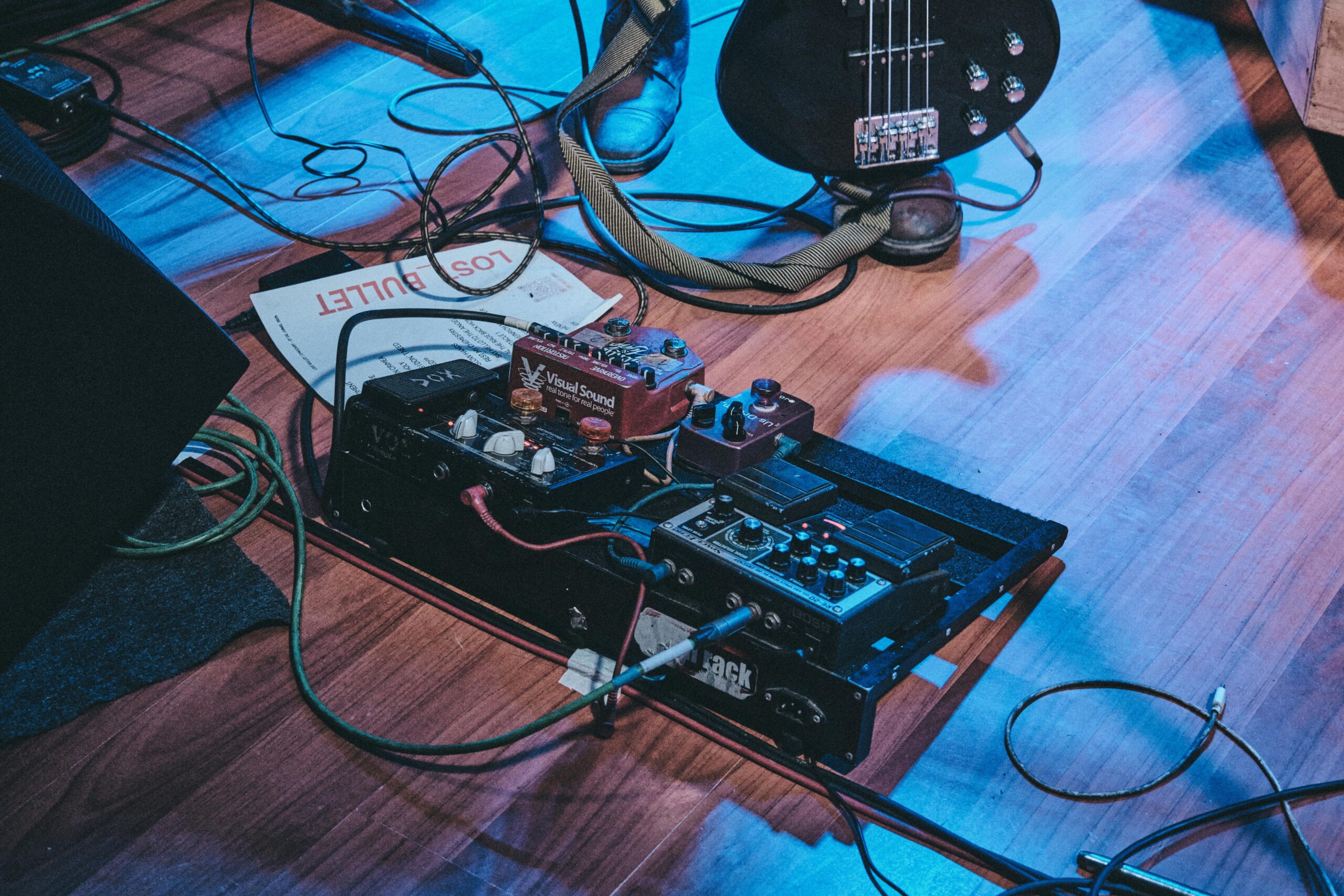

To match delay to a song’s mood, use a single 80–130 ms slapback repeat for intimate songs, a tempo-synced dotted-eighth delay with one or two repeats for big, driving songs, and a long delay of 600 ms or more with four to six quiet repeats for sad or spacious songs, setting tempo-synced times with the formula 60,000 ÷ BPM = one quarter note in milliseconds.
Quick answer
- A quarter-note delay in milliseconds equals 60,000 divided by the song’s BPM, so at 72 BPM a quarter note is 833 ms and a dotted eighth is 625 ms.
- Slapback delay, one repeat at roughly 80–130 ms with no feedback, is the close, “in the room” sound Sam Phillips put on Elvis Presley’s 1954 Sun Records singles.
- A dotted-eighth delay with little feedback, set about as loud as your dry signal, turns straight eighth notes into what sounds like sixteenth notes, the trick behind U2’s “Where the Streets Have No Name.”
- For sad or ambient songs, use a long delay (a quarter note or dotted quarter), four to six quiet repeats and a darker tone, and play fewer notes so the echoes have room.
- Echoes shorter than about 40 ms merge with the original note instead of sounding like a separate echo, so save those for stereo width, not for mood.
Best for: songwriters who can play open chords in time with a metronome and own a delay pedal, multi-effects unit or delay plugin, but leave it on one “default” setting for every song. Skip if: you already change delay time and repeats between verse and chorus, and tap tempo without thinking about it.
Time cost: 10 minutes a day. Most players hear a clear difference between moods on day one, because slapback and a long ambient delay sound nothing alike. Locking a dotted-eighth delay tightly to a metronome usually takes 7–14 days of short daily practice. The full 30-day plan below ends with one verse and chorus written around your delay settings.
What delay settings match each songwriting mood?
Each mood maps to a delay time, a number of repeats (feedback) and a mix level. The times below assume 72 BPM. Recalculate them for your own tempo with 60,000 ÷ BPM. “Mix” means how loud the repeats are compared with your dry note. Knob markings differ between pedals, so treat the percentages as starting points and adjust by ear.
| Mood | Delay time (at 72 BPM) | Repeats | Mix | Tone / extras |
|---|---|---|---|---|
| Intimate, confessional | Slapback, 80–130 ms (not synced) | 1 | 15–25% | Bright, no modulation |
| Big, anthemic, driving | Dotted eighth = 625 ms | 1–2 | 40–50% (echo nearly as loud as dry) | Clean, bright digital |
| Sad, spacious, ambient | Quarter = 833 ms or dotted quarter = 1,250 ms | 4–6 | 20–30% | Tone rolled down, add reverb |
| Nostalgic, warm | Quarter = 833 ms | 2–3 | 25–35% | Dark “tape” tone, light modulation |
| Tense, anxious | Eighth-note triplet = 278 ms | 4–5 | 30% | Over muted single notes |
| Playful, bouncy | Eighth = 417 ms | 1–2 | 20–25% | Bright, over short, choppy notes |
How do I set my delay time to my song’s tempo?
Divide 60,000 by your song’s BPM to get one quarter note in milliseconds. Multiply that number by 0.75 for a dotted eighth, 0.5 for an eighth note, 1.5 for a dotted quarter and 0.333 for an eighth-note triplet. At 90 BPM, for example, a quarter note is 667 ms, a dotted eighth is 500 ms and an eighth note is 333 ms. If your pedal has tap tempo, tap quarter notes and set its subdivision switch instead of entering the numbers by hand.
Practice block 1: tempo-to-delay calibrationDRILL: Tempo-to-delay calibration
SONG TEMPO: [BPM] e.g. 72
CALCULATE: quarter = 60000 / [BPM] -> [Q] ms
dotted 8th = [Q] x 0.75 -> [D8] ms
8th = [Q] x 0.5 -> [E] ms
8th triplet = [Q] x 0.333 -> [T] ms
PLAY: One open [CHORD] strummed once per bar, let it ring
TEMPO: Metronome at [BPM]
SET: Delay = [Q] ms, 3 repeats, mix 30%
REPS: 4 bars on each of the 4 delay times (16 bars total)
SUCCESS: You're done when every repeat lands exactly on a
metronome click (quarter), or halfway / three-quarters
between clicks, with no "flam" (double-hit) for 4 bars.
What delay setting makes a song feel intimate?
A single slapback repeat makes a song feel close and personal: 80–130 ms, feedback at zero and the mix low enough that you notice the echo only when it’s switched off. Slapback is usually defined as a delay of about 60–250 ms with little or no feedback. Sam Phillips used it on Elvis Presley’s first Sun Records sides in 1954. On a quiet verse, it makes a guitar or voice sound as if it’s in a small room with the listener, not in a big hall.
What delay setting makes a song sound big and anthemic?
A dotted-eighth delay makes a song sound big because it fills the rhythm for you. Play steady eighth notes, and each echo lands three sixteenth notes later, in the gaps between the notes you play. Together they sound like continuous sixteenth notes. Keep feedback low (one or two repeats) and set the echo about as loud as your dry note, as Premier Guitar’s lesson on The Edge recommends. U2’s “Where the Streets Have No Name” is the textbook example.
What delay setting works for sad or ambient songs?
Sad and ambient songs work best with a long delay (a quarter note or dotted quarter, 600 ms or more), four to six repeats and a low mix of roughly 20–30%. Roll the tone knob down so the repeats sound softer than the note you played. The important part is playing less: one chord or one note per bar leaves silence for the echoes to fill. That fading space sounds like reflection or loss, where a busy part with long delay just turns to mush.
Practice block 2: play less, hear moreDRILL: Play less, hear more (sad / spacious mood)
PROGRESSION: [CHORD 1] - [CHORD 2] - [CHORD 3] - [CHORD 4] e.g. Am - F - C - G
TEMPO: [BPM] (start at 70)
SET: Delay = dotted quarter (60000/[BPM] x 1.5), 5 repeats,
mix 25%, tone knob below halfway
PLAY: ONE note per bar: the chord's top note on beat 1 only
REPS: 3 passes of the 4-bar loop, then 3 passes playing
two notes per bar (beats 1 and 3)
SUCCESS: You're done when you can hear at least three distinct
repeats of each note before the next bar starts, and the
two-notes-per-bar pass still doesn't smear together.
What delay setting makes a song feel nostalgic?
A quarter-note delay with a dark, slightly wobbly repeat sounds nostalgic, because it copies the tape echo machines on records from the 1950s to the 1970s. Set two or three repeats, a mix around 25–35% and the tone knob turned down. Add a touch of modulation if your pedal has it. Tape echo is often described as warm and lush because the tape compresses and slightly distorts each repeat, so the echoes seem to recede into the distance instead of just getting quieter.
What delay setting makes a song feel tense or anxious?
An eighth-note triplet delay played under straight eighth or sixteenth notes creates tension, because the echoes fall in groups of three against a pulse that divides into two. That three-against-two rub keeps the listener slightly off balance. At 72 BPM the triplet delay is 278 ms. Use four or five repeats at about 30% mix over palm-muted single notes. Keep the rest of the arrangement steady so the friction comes from the delay, not from sloppy timing.
What delay setting makes a song feel playful?
A straight eighth-note delay with only one or two repeats sounds playful and bouncy, especially under short, choppy notes. The echo doubles the rhythm without adding a new feel against it, so the part sounds lively rather than tense. At 72 BPM an eighth-note delay is 417 ms. Keep the mix around 20–25% and the tone bright. Pluck single notes staccato (lift your fretting finger right after the note) so every echo is clearly audible.
What is the difference between a default delay setting and a mood-based one?
Most players set their delay once, where it “sounds cool,” and leave it on for every song. A mood-based approach picks the delay time, number of repeats and mix to support what the lyric is saying, and changes them between sections. The table compares the two.
| How most people use delay | What actually works |
|---|---|
| Set the time knob by ear until it “sounds cool” | Calculate or tap the time from the song’s BPM (60,000 ÷ BPM) |
| One setting from the first bar to the last | Different settings for the verse, chorus and bridge |
| More feedback to get “more atmosphere” | Fewer repeats and a lower mix; atmosphere comes from space in the part |
| Play the same busy part with delay on | Play fewer notes as the delay gets longer |
| Use delay to cover up shaky timing | Tempo-synced delay makes timing problems more obvious, so practice with a metronome |
| Echo louder than the dry note on every mood | Echo nearly as loud as the dry note only for rhythmic dotted-eighth parts, quieter everywhere else |
How do I use delay on a real chord progression?
Take the C–G–Am–F progression that opens the verse of the Beatles’ “Let It Be” (the I–V–vi–IV in C) and play it at 72 BPM, one chord per bar. The tab below is an original fingerpicked part in straight eighth notes, not the recorded piano part. The steps that follow show how to analyze the progression, which delay settings to use and what changes in each mood.
Step 1: analyze the progression
The progression is C (I), G (V), Am (vi), F (IV) in the key of C major. Three of the chords are major and one is minor, so it sounds hopeful with a little ache on the Am. That makes it a good test: the same four chords can sound intimate, anthemic or sad depending on the delay alone. At 72 BPM, a quarter note is 833 ms, a dotted eighth 625 ms and a dotted quarter 1,250 ms.
Step 2: the part (straight eighth notes, open chords)
    C                         G
e|--------------0----------|--------------3----------|
B|-----------1-----1-------|-----------0-----0-------|
G|--------0-----------0----|--------0-----------0----|
D|-----2-----------------2-|-----0-----------------0-|
A|--3----------------------|-------------------------|
E|-------------------------|--3----------------------|
    1  +  2  +  3  +  4  +    1  +  2  +  3  +  4  +

    Am                        Fmaj7 (xx3210)
e|--------------0----------|-----------0-------------|
B|-----------1-----1-------|--------1-----1----------|
G|--------2-----------2----|-----2-----------2-----2-|
D|-----2-----------------2-|--3-----------------3----|
A|--0----------------------|-------------------------|
E|-------------------------|-------------------------|
    1  +  2  +  3  +  4  +    1  +  2  +  3  +  4  +
Fmaj7 (xx3210) stands in for F so you don’t need a barre chord. Count one note per “1 + 2 + …” syllable, eight notes per bar.
Step 3: three moods, same part
| Mood | Settings | What you change in your playing | What you hear |
|---|---|---|---|
| Intimate verse | 110 ms, 1 repeat, mix 20% | Play the tab exactly as written, softly | A close, slightly thicker guitar, like a small room |
| Anthemic chorus | 625 ms (dotted eighth), 1–2 repeats, echo nearly as loud as dry | Play only the top two strings of each shape as steady eighth notes, and pick harder | A stream of sixteenth notes; the part sounds twice as busy as what you play |
| Sad outro | 1,250 ms (dotted quarter), 5 repeats, mix 25%, tone down | Play only the first note of each bar (C at A-string fret 3, G at low E fret 3, Am open A, F at D-string fret 3) | Single notes that fade across the whole bar, with lots of space |
DRILL: One progression, three moods
PROGRESSION: C - G - Am - Fmaj7, one bar each (tab above)
TEMPO:       72 BPM
SETTINGS:    A) 110 ms, 1 repeat, mix 20%        (intimate)
             B) 625 ms, 1-2 repeats, mix ~45%    (anthemic)
             C) 1250 ms, 5 repeats, mix 25%, tone down (sad)
PLAY:        4-bar loop x 2 on each setting, changing your part
             as described in the Step 3 table
RECORD:      30 seconds of each on your phone, labeled A / B / C
REPS:        1 full A-B-C cycle per day for [DAYS] days
SUCCESS:     You're done when someone else (or you, 24 hours later,
             with the labels hidden) can name the mood of each
             recording correctly.
How do I write a guitar part around the delay repeats?
Advanced players write the part together with the delay, instead of adding delay to a finished part. There are three ways to do it: fit the rhythm to the echo grid, leave gaps sized to the delay so the echoes reply to the vocal, and change settings by song section so the delay follows the song’s emotional arc. Each one is covered below, and each works on its own.
How does the dotted-eighth rhythm grid work?
Count in sixteenth notes: a bar has 16 slots, numbered 0–15. If you play eighth notes, you hit slots 0, 2, 4, 6 and so on. A dotted-eighth echo arrives three slots later, on 3, 5, 7, 9. From the second beat onward, your notes plus the echoes cover every sixteenth-note slot. Because of this, playing an accent only on beats 1 and 3 moves the accent to the “a” of beat 1 and 3 in the echoes. That kind of syncopation is how parts like The Edge’s get their momentum.
Practice block 4: dotted-eighth lockDRILL: Dotted-eighth lock
TEMPO: [BPM] (start at 90; dotted 8th = 500 ms)
SET: Delay = 60000/[BPM] x 0.75, 1 repeat, echo ~as loud as dry
PLAY: One note, [STRING] string fret [FRET], muted lightly
with the picking hand, steady eighth notes
REPS: 8 bars x 3 sets; set 3 accents beats 1 and 3 only
SUCCESS: You're done when dry + echo sound like one unbroken
line of sixteenth notes for all 8 bars, with no
gallop or flam, and your accents come back on the
"a" of beats 1 and 3.
How do I make the delay answer the vocal?
End each sung phrase with a rest the same length as your delay time, and let one repeat of the last guitar note fill it. At 72 BPM, a phrase that ends on beat 3 leaves two beats of space. A half-note delay (1,667 ms) with one repeat puts the guitar’s echo right in that gap, like a reply. Use this for call-and-response in the verse, and switch it off for the chorus so the chorus sounds fuller.
Should I change delay settings between verse and chorus?
Yes. Changing delay by song section is the quickest way to build an arc. One pattern that works: slapback in verse one, eighth note in the pre-chorus, dotted eighth in the chorus, then a long dotted-quarter delay with more repeats in the bridge. Most modern delay pedals and multi-effects units store presets or have a second footswitch. With a single-setting pedal, move just one knob per section: mix is the easiest to change with your foot or hand.
Practice block 5: section switchingDRILL: Section switching
SONG FORM: Verse [4 bars] - Chorus [4 bars] - Verse - Chorus
TEMPO: [BPM]
SETTINGS: Verse = [MOOD A setting] e.g. slapback 110 ms, 1 repeat
Chorus = [MOOD B setting] e.g. dotted 8th, 2 repeats
PLAY: Your own progression; change setting (preset, switch,
or one knob) on beat 4 of the bar before each section
REPS: 4 run-throughs without stopping
SUCCESS: You're done when every change lands before beat 1 of
the new section and you never stop strumming to reach
the pedal.
Can I use very short delays to widen a guitar in stereo?
Yes. An echo shorter than about 40 ms merges with the original note instead of sounding separate, which is known as the precedence or Haas effect. Put a 15–30 ms delay, with no feedback, on one side of a stereo rig or mix, and the guitar sounds wider rather than echoey. Always check the result in mono, because very short delays can hollow out the tone when both sides are summed. Use this for width, not as a mood setting.
What is a 30-day practice plan for delay pedal settings?
This plan uses 10 minutes a day with a guitar in your hands and no written homework. Each week builds one skill: calibrating delay to tempo, locking in the dotted eighth, using space, then changing settings by section. Days 29 and 30 turn the skills into a verse and chorus written around delay. Copy the block below into your practice log or phone notes.
30-DAY DELAY MOODS PLAN (10 minutes a day)
SONG TEMPO FOR THE MONTH: [BPM]    PEDAL / PLUGIN: [DELAY]

WEEK 1  Calibrate (days 1-7)
  Days 1-3  Practice block 1: tempo-to-delay calibration (all 4 times)
  Days 4-7  Slapback only: strum [PROGRESSION], 80 / 110 / 130 ms,
            pick the one that sounds closest; success = you can tell
            80 from 130 ms with your eyes closed

WEEK 2  Lock the dotted eighth (days 8-14)
  Days 8-11  Practice block 4 at 90 BPM
  Days 12-14 Same drill at [BPM], then at [BPM + 10]

WEEK 3  Space and mood (days 15-21)
  Days 15-17 Practice block 2: play less, hear more
  Days 18-19 Triplet delay (tense) over palm-muted eighth notes
  Days 20-21 Practice block 3: one progression, three moods

WEEK 4  Arc and write (days 22-30)
  Days 22-25 Practice block 5: section switching
  Days 26-28 Delay "answers" the vocal: hum a 2-bar phrase,
             leave a half-note gap, let one repeat fill it
  Days 29-30 Write one verse + chorus with a different delay
             mood in each; record it on your phone

SUCCESS FOR THE MONTH: a phone recording of your own verse and
chorus where a listener can hear the mood change at the chorus
without being told.
Get the free Delay Mood Presets Kit
The kit is a free printable PDF with:
- Six mood cards (intimate, anthemic, sad, nostalgic, tense, playful), each with delay time, repeats, mix and tone, plus a blank knob diagram for noting your own pedal’s positions.
- A delay-time chart for 60–160 BPM in steps of 2 BPM, covering quarter, dotted eighth, eighth, eighth triplet and dotted quarter, already calculated.
- The 30-day plan as a checklist you can tape to your amp.
Why it’s faster: you don’t need a calculator or an app mid-song, and you don’t have to rediscover your settings. Look up your tempo, read off the number and play.
[LEAD MAGNET FORM SHORTCODE — e.g. your email-provider form]
Upgrade: the interactive Delay Mood Drill Generator. Enter your song’s BPM and pick a mood for each section, and it returns the exact delay times, a practice drill for each section and a daily 10-minute routine. [UPGRADE LINK]
Use an AI chatbot as a delay practice coach
Paste this prompt into any general-purpose AI chatbot. It will calculate your delay times and put you through one mood drill. Prompt last reviewed September 23, 2026; it isn’t written for any particular AI model.
You are my guitar practice coach for delay pedal settings.
My song is at [BPM] BPM in [KEY]. My progression is [CHORDS].
The verse mood is [MOOD A] and the chorus mood is [MOOD B].
1) Calculate quarter, dotted-eighth, eighth, eighth-triplet and
   dotted-quarter delay times in ms using 60000 / BPM.
2) Recommend delay time, repeats, mix % and tone for each section.
3) Give me ONE 10-minute drill with tempo, reps and a clear
   success criterion.
4) After I describe what I heard, tell me which ONE setting
   to change next. Don't give me more than one change at a time.
Frequently asked questions about delay settings for songwriting
What is the best delay setting for sad songs?
For sad songs, the best delay is long: a quarter note or dotted quarter, usually 600 ms or more, with four to six repeats, a mix around 20–30% and the tone rolled down so the repeats sound softer than the original note. Play fewer notes, ideally one per bar, so each echo fades into silence. A sad sound comes from the space between notes, not from stacking up more repeats.
How do I calculate delay time from BPM?
Divide 60,000 by the BPM to get one quarter note in milliseconds. At 120 BPM that’s 500 ms. Multiply by 0.75 for a dotted eighth (375 ms), 0.5 for an eighth (250 ms) and 0.333 for an eighth-note triplet (167 ms). Pedals with tap tempo do this for you: tap quarter notes, then choose the subdivision with the pedal’s switch.
What is a dotted eighth delay and why does it sound so big?
A dotted eighth delay repeats each note three-quarters of a beat later. If you play steady eighth notes, the echoes land between them, and together they sound like a continuous line of sixteenth notes. You play half the notes you hear. It sounds bigger when the echo is about as loud as the dry note and feedback is kept low. U2’s The Edge made the technique famous.
What is slapback delay used for?
Slapback delay adds one quick repeat, roughly 80–130 ms with no feedback, that thickens a guitar or vocal and makes it sound present and close. It is the signature sound of 1950s rockabilly and early Elvis Presley records from Sun Studio. For songwriters it suits intimate verses and stripped-down arrangements, where a long delay would sound too dramatic.
How many repeats should a delay have?
Use one repeat for slapback and rhythmic dotted-eighth parts, two or three for warm or nostalgic sounds, and four to six for ambient or sad songs. The feedback knob controls the number of repeats. More than six usually turns into a wash that fights with the vocal, unless you’re deliberately building a swell into the next section.
Should delay go before or after reverb?
Most players put delay before reverb, so the echoes sit inside the reverb’s “room” and sound natural. Putting reverb first means every echo repeats the whole reverb tail, which sounds washier and can suit ambient or dreamlike parts. Both orders are valid. Try delay first as the default, and switch the order only if you want that washed-out, dreamlike sound.
Should I use delay on acoustic guitar when writing songs?
Yes, especially slapback and short eighth-note settings, which thicken an acoustic without making it sound processed. Keep the mix low, around 15–25%, because acoustic guitars already ring for a long time. Long delays can work for a single-note intro or an outro, but under full strummed chords they usually blur the chord changes the song depends on.
Sources and free tools
- Delay (audio effect), Wikipedia: slapback defined as 60–250 ms with little or no feedback; Sam Phillips, Elvis Presley and Sun Records in 1954; tape echo character.
- Precedence effect, Wikipedia: echoes under about 40 ms merge with the original for complex sounds such as speech or piano.
- BPM to delay time calculator, Sengpielaudio: 60,000 ÷ BPM = quarter-note delay in ms.
- Electric Etudes: U2’s The Edge, Premier Guitar: dotted-eighth delay turns eighth notes into perceived sixteenths; low feedback; dry and wet at equal level.
- Patch Work: “Where the Streets Have No Name,” BOSS: the song’s dotted-eighth digital delay setup.
- Delay: Settings to Start Exploring, JustinGuitar: starting points for slapback (90–130 ms), dotted eighth and long delays.
- Delay: What, How & History, JustinGuitar: tape, analog and digital delay explained.
- Dots and Ties, musictheory.net: free lesson on how a dot adds half a note’s value (the “dotted” in dotted eighth).
- Simple and Compound Meter, musictheory.net: background for triplet and dotted-quarter feels.
- Rhythmic Reading, teoria: free exercise for reading and tapping rhythms, useful for hearing dotted and triplet subdivisions.
- Chord progression ear training, ToneDear: train your ear on I–V–vi–IV and similar progressions.
Version notes: All links and figures were checked on September 23, 2026. JustinGuitar’s delay settings were taken from lesson FX-304 as published on that date. The delay math is plain arithmetic and doesn’t depend on any pedal or app. Pedal features mentioned (tap tempo, subdivision switches, presets) vary by model, so check your pedal’s manual. The AI coach prompt isn’t tied to any particular chatbot and was reviewed on September 23, 2026.
Related on Musical Grammar: How to Use a Delay Pedal to Improve Your Songwriting · The I–V–vi–IV Chord Progression Explained · Creating Emotional Chord Progressions · How a Looper Pedal Can Transform Your Songwriting Workflow · Best Cheap Reverb Pedal for Ambient Songwriting · Guitar Pedals for Songwriting: The Complete Guide