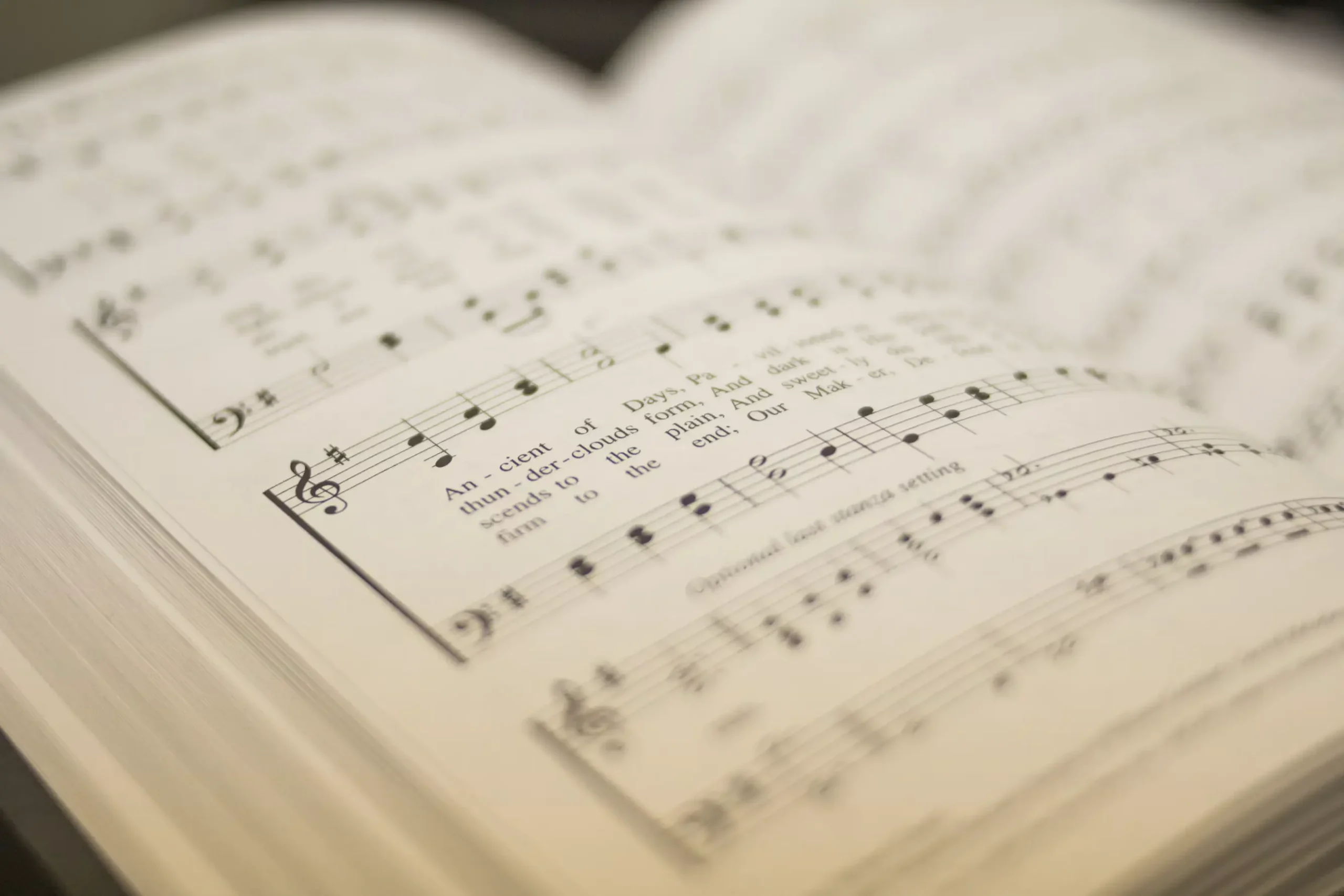

To write a unique, emotional vocal melody, move mostly by step, save one big leap (a 5th, 6th, or octave) for the most important lyric, land that leap on a strong beat on a note that clashes with the chord, and resolve it down by one step — while keeping stressed syllables on strong beats.
Quick answer
- Steps are the default, leaps are the event. Most notes in memorable melodies move by 1–2 semitones; a leap only feels emotional because the notes around it don’t leap.
- Spend your biggest leap once. “Somewhere Over the Rainbow” opens with an octave leap on “Some-where” — one interval, instantly recognizable, never overused in the phrase.
- After a leap, step back the other way. Leap up a 5th from G to D, then fall stepwise D–C–B; listeners expect the reversal, and melodies that ignore it sound unsteady.
- Land the peak on a “wrong” note, then fix it. Over a G chord, sing A on beat 1 (high E string, 5th fret) and resolve to G (3rd fret) — an appoggiatura, the device Sloboda (1991) linked most often to tears.
- Stressed syllables go on strong beats. In “Amazing Grace,” every stressed syllable — “-maz-,” “grace,” “sweet,” “sound” — lands on beat 1 as a held note.
Time cost: 10 minutes a day, guitar (or keyboard) in hand, plus a phone voice memo. Most writers hear a difference in their own recordings by day 7–10, once the one-leap rule and the appoggiatura landing become habits. The full plan runs 30 days.
What makes a vocal melody sound emotional?
A vocal melody sounds emotional when it creates an expectation, delays it, and then fulfills it at the moment the lyric matters most. Music psychologist David Huron describes this as the “sweet anticipation” cycle: tension, prediction, and reward. Brain-imaging research backs it up — Salimpoor and colleagues (2011) found dopamine release both while listeners anticipated a peak moment and when it arrived. In practical terms, emotion comes from three controllable tools: where the highest note sits, how long you delay it, and whether it lands as a clash that resolves.
Why do my melodies sound boring or generic?
Melodies usually sound generic for four fixable reasons. First, the notes trace the chord roots (G over G, D over D), so the voice adds nothing the guitar isn’t already saying. Second, verse and chorus sit in the same range, so the chorus can’t “lift.” Third, every phrase starts on beat 1, which makes rhythm predictable. Fourth, the melody has no single peak — it hits its highest note five times, so none of them matter. Fix one of these per song and the melody immediately sounds more personal.
How big should the intervals in a vocal melody be?
Most intervals in a singable vocal melody should be steps of one or two semitones, with larger leaps used sparingly for emphasis. Research on melodic structure consistently finds small intervals dominate Western melodies, which is why a leap stands out. Learn the leaps by reference song: a minor 3rd opens “Greensleeves,” a perfect 4th opens “Here Comes the Bride,” a perfect 5th starts “Twinkle, Twinkle,” a major 6th opens “My Bonnie Lies Over the Ocean,” and an octave opens “Somewhere Over the Rainbow.” Larger leaps feel bigger and more exposed.
DRILL 1 — STEPWISE HUM
Key:          [KEY]            e.g. G major
Chord loop:   [PROGRESSION]    e.g. G – D – Em – C, 1 bar each, 4/4
Tempo:        [72] BPM
What to sing: a 4-bar phrase using ONLY steps (next scale note up or down).
              Start on the 3rd of the key ([B] in G), not the root.
Reps:         5 different phrases, voice-memo every one.
Done when:    you can sing 5 distinct 4-bar phrases with zero leaps,
              none starting on the root, without stopping the loop.
What should happen after a big leap in a melody?
After a big leap, the melody should usually change direction and move by step. If you leap up a perfect 5th from G to D, follow it with D–C–B, not D–E–F#. Von Hippel and Huron (2000) showed this “post-skip reversal” is largely a range effect: a leap tends to carry the voice toward the edge of its range, so the next notes naturally fall back toward the middle. Singers also find stepwise recovery easier to tune. Break the rule only on purpose — a second leap in the same direction sounds like a shout.
DRILL 2 — THE ONE-LEAP RULE
Key / loop:   [KEY] over [PROGRESSION]
Tempo:        [72] BPM
What to sing: a 4-bar phrase that is all steps EXCEPT one leap of
              [INTERVAL: 5th | 6th | octave]. Immediately after the leap,
              move 2–3 notes by step in the OPPOSITE direction.
Guitar check: G (high E, 3rd fret) → leap to D (10th fret) → C (8th) → B (7th)
Reps:         3 phrases per interval size (9 total).
Done when:    you can place the leap on a chosen word — [LYRIC WORD] —
              and every leap is followed by a stepwise reversal.
How do I make a melody hit harder emotionally at the climax?
Land the climax note on a strong beat as a note that doesn’t belong to the chord, then resolve it down by one step. That move is called an appoggiatura. In John Sloboda’s 1991 study of listeners’ strongest reactions to music, passages that brought tears most often contained appoggiaturas and melodic tension of this kind. On guitar over a G chord, leap up to A (high E string, 5th fret) on beat 1, hold it for two beats, and resolve to G (3rd fret). The brief clash is the ache; the resolution is the release.
DRILL 3 — APPOGGIATURA LANDING
Key:          G major        Tempo: [66] BPM, 4/4
Strum each chord for 1 bar. Leap to the TENSION note on beat 1,
hold 2 beats, step down to the RESOLUTION on beat 3.

  Chord   Tension (sing)       Resolution (sing)
  G       A  (e string, 5)  →  G  (e string, 3)
  C       D  (B string, 3)  →  C  (B string, 1)
  Em      F# (e string, 2)  →  E  (open e)
  D       E  (B string, 5)  →  D  (B string, 3)

Reps:         4 passes of the full chart, then 4 passes with your own lyric [LYRIC LINE].
Done when:    you can land each tension note in tune on beat 1 WITHOUT
              first playing it on the guitar, and you can hear the clash
              "want" to move before you resolve it.
Want the backing loops for this drill? The free Melody Contour Kit includes this exact chart plus four looping backing tracks at 66–84 BPM, so you can practice the landing without stopping to strum.
Where should the highest note of a song go?
Put the highest note of a song in one place only — usually the emotional peak of the chorus or the final chorus — and keep it out of the verse entirely. Think of it as a “peak budget”: every time you sing that note, it loses some power. A practical layout is to keep the verse within a 5th, let the pre-chorus climb 2–3 steps higher, and reserve the top note for the chorus hook word. If your verse already touches the song’s highest note, the chorus has nowhere to go.
DRILL 4 — PEAK BUDGET MAP
Song:         [SONG TITLE]     Key: [KEY]
Step 1:       Sing your lowest and highest comfortable notes. Write both.
Step 2:       Assign ranges:
                Verse       lowest note → 5th above it
                Pre-chorus  up to 2–3 steps higher
                Chorus      the top note, ONCE, on [HOOK WORD]
Step 3:       Sing the whole song top to bottom; tap the table every time
              you hit the top note.
Reps:         2 full run-throughs.
Done when:    the top note appears only in the chorus (max once per chorus)
              and you tapped the table no more than [3] times per song.
How do I make lyrics fit a melody naturally?
Make lyrics fit a melody by placing naturally stressed syllables on strong beats and giving them longer or higher notes. Songwriting teacher Pat Pattison of Berklee calls this alignment prosody. Say the line out loud first: in “I can’t go back,” the stresses fall on “can’t” and “back.” If the melody puts “I” on beat 1 and rushes “back” on an off-beat, the line sounds awkward even if every note is pretty. Speak, mark the stresses, clap them, then sing — in that order.
DRILL 5 — STRESS-FIRST SETTING
Lyric:        [LYRIC LINE]
Tempo:        [80] BPM, metronome on beats 1 and 3 only
Step 1:       Speak the line 3 times at normal conversational speed.
Step 2:       CAPITALIZE the stressed syllables. e.g. "i CAN'T go BACK"
Step 3:       Clap the line so capitals land on the metronome clicks.
Step 4:       Sing it: capitals get longer or higher notes than lowercase.
Reps:         3 lyric lines, 4 sung takes each.
Done when:    a friend (or AI tutor) can read the line back from your
              recording with the same stresses you marked.
How do I write a melody that doesn’t just follow the chords?
Write the melody over a single drone or held chord first, then add harmony afterward. When you hum over a changing progression, your ear grabs each chord’s root, and the melody ends up tracing the bass line. Instead, strum only a G chord (or play the open G string) for four minutes and hum freely. Once you have a phrase you like, try it over G–Em–C–D. Notes that were chord tones over G will become 9ths, 6ths, and suspensions over the new chords — instant color you didn’t have to plan.
What is melodic contour and why does it matter?
Melodic contour is the up-and-down shape of a melody, ignoring exact notes. It matters because listeners remember shape before they remember pitches. The four workhorse shapes are the arch (rise, then fall), the inverted arch (fall, then rise), the ascending line (steady climb, typical of pre-choruses), and the descending line (a sigh, typical of verse endings). Sketch the shape as a line on paper before writing notes. If verse and chorus have the same contour, change one — contrast is what makes the chorus feel like arrival.
DRILL 6 — CONTOUR FIRST
Shape:        [ARCH | INVERTED ARCH | ASCENDING | DESCENDING]
Key / tempo:  [KEY], [76] BPM
Step 1:       Draw the shape as one line across 4 boxes (1 box = 1 bar).
Step 2:       Sing a phrase that follows the drawing on "la."
Step 3:       Put the highest point of the line on beat 1 of bar [3].
Reps:         1 phrase per shape, all 4 shapes, 2 takes each.
Done when:    someone listening can draw your shape from the recording alone.
How do I make a vocal melody memorable and unique?
Make a melody memorable by repeating a short motif and unique by changing one element of it each time. Take a 3–5 note idea, state it, repeat it exactly, then alter it on the third pass — shift it up a step, stretch one note, or start it half a beat later. Rhythmic displacement is the fastest route to uniqueness: moving a phrase to start on the “and” of beat 1 instead of beat 1 changes its personality without changing a single pitch. Repetition earns recognition; variation earns attention.
What is the difference between how most people write melodies and what actually works?
Most writers improvise melodies over a strummed progression and keep whatever sounds pleasant. The approach below reverses that: shape and tension are decided first, and pleasant notes fill in around them.
| Element | How most people write melodies | What actually works |
|---|---|---|
| Starting point | Strum the full progression, hum until something sticks | Hum over one drone chord, then add the progression |
| Note choice on strong beats | Chord roots (G over G, C over C) | 3rds, 5ths, and one planned tension note (A over G) |
| Leaps | Leaps whenever the chord changes | One leap per phrase, placed on the key lyric, followed by a step back |
| Highest note | Hit in verse, pre-chorus, and chorus | Reserved for the chorus hook word only |
| Range | Verse and chorus in the same octave zone | Verse within a 5th; chorus peak 3–5 semitones above the verse peak |
| Rhythm | Every phrase starts on beat 1 | At least one phrase per section starts on an off-beat |
| Lyrics | Words forced into a finished tune | Stresses marked first; stressed syllables get strong beats |
| Judging it | “Sounds nice while I play it” | Voice-memo playback the next day, without the guitar |
How does a real melody use these techniques? (Worked example: “Amazing Grace”)
“Amazing Grace” (text by John Newton, 1779; tune “New Britain,” first published in 1829) is in the public domain and shows every technique in this guide in eight bars. Here is the full chain: progression, analysis, what to play, and fret numbers.
Step 1 — The input: key, meter, and progression
Key of G major, 3/4 time, about 72 BPM. A common guitar harmonization of the first line (hymnals vary slightly):
pickup | G     | G     | C     | G     | G     | Em    | D     | D     |
   A-  | maz-  | ing   | sweet | sound | saved | wretch| me    |       |
       |       | grace how     the  that      a       like
Step 2 — The melody as fret numbers (high E and B strings)
        pickup   m1          m2       m3       m4       m5          m6       m7
Chord:           G           G        C        G        G           Em       D
Note:   D        G   B G     B   A    G   E    D   D    G   B G     B   A    D (high)
Beat:   3        1   3 &     1   3    1   3    1   3    1   3 &     1   3    1 (held 3 beats)
Word:   A-       maz-ing     grace how sweet the sound that saved a  wretch like me

e|---------------3---7-3-----7---5----3---0-------------3---7-3-----7---5----10----|
B|------3----------------------------------------3---3-----------------------------|
         (D = B string 3rd fret; G = e 3; A = e 5; B = e 7; E = open e; high D = e 10)
Step 3 — The analysis
- Stepwise body, one leap per gesture. The pickup leaps up a perfect 4th (D→G) to announce the key, then the line moves mainly by step and small arpeggio moves (G–B–G).
- Contour is an arch, twice. Bars 1–4 rise to B and fall to low D on “sound” — the valley. Bars 5–7 repeat the opening, then climb A→high D on “me,” a 4th leap to the phrase’s highest note so far.
- Peak budget. The high D appears once in the first line, on the phrase’s last word, held for a full bar — maximum duration on the peak.
- Prosody. Every stressed syllable (“-maz-,” “grace,” “sweet,” “sound,” “saved,” “wretch,” “me”) falls on beat 1 with a half note or longer; the unstressed words (“how,” “the,” “like”) get short notes on beat 3.
- Pentatonic simplicity. The melody uses only G, A, B, D, and E — no C or F# — which is part of why it is so easy to sing and remember.
Step 4 — The output: an original phrase built with the same rules
Now apply the same principles to a new, original melody over G–Em–C–D in 4/4 at 76 BPM. It starts off the beat, climbs by step, leaps a perfect 5th to an appoggiatura, reverses by step, and ends open.
Chord:  G                 Em                C                 D
Count:  1 &  2  3  4      1   2   3   4     1   2   3   4     1  2  3  4
Note:   -  D  G  A  B     B ---   A   G     D'---   C'  B     A ---------
        (rest on 1)                         ↑ leap G→D' (P5), D' = 9th over C

e|--------3---5---7-|-7-------5---3-|-10------8---7-|-5-------------|
B|-----3------------|---------------|---------------|---------------|

Why it works:
  Bar 1  starts on the "and" of 1 → rhythmic displacement
  Bar 2  arch peak on B, steps back down → contour
  Bar 3  one leap, landing on D over C (tension) on beat 1 → appoggiatura
         then D'–C'–B steps down → post-leap reversal
  Bar 4  ends on A, the 5th of D → unresolved, pulls into the next phrase
What are advanced techniques for writing emotional melodies?
The advanced version of this method is to control emotion without moving the melody at all — by changing what’s underneath it — and to score tension bar by bar so the peak is engineered, not lucky. The three techniques below are what separate a pleasant topline from one that listeners describe as “hitting them.”
How do I change a melody’s emotion without changing the notes?
Hold one melody note while the chords change underneath it, and the note’s emotional meaning changes with each chord. Sing and sustain G (high E string, 3rd fret) over four chords in G major. Over G, it is the root: home, settled. Over Em, it is the minor 3rd: tender, wistful. Over C, it is the 5th: open, spacious. Over D, it is a suspended 4th: tension that wants to fall to F#. This common-tone reharmonization lets a single held word carry four different feelings.
LEVEL-UP DRILL A — ONE NOTE, FOUR CHORDS
Held note:    [G] (high E string, 3rd fret) — sing it, don't play it
Chords:       G → Em → C → D, 2 bars each, [60] BPM
Reps:         4 cycles; on the last D bar, let the note fall to F# (2nd fret)
Done when:    you can describe, in one word each, how the SAME note feels
              over each chord, and your pitch doesn't drift as chords change.
How do I measure tension in a melody?
Score each strong-beat note with a simple tension ledger, then check that the numbers rise toward one peak. Give each beat-1 note points: chord tone = 0, arrival after a leap = 1, non-chord tone resolved by step = 2, highest note of the song so far = 2. Add the points per bar. A strong song typically runs low in the verse, climbs through the pre-chorus, and spikes once in the chorus. Flat totals mean a flat song; spikes everywhere mean a song with no peak.
LEVEL-UP DRILL B — TENSION LEDGER
Song:         [SONG TITLE]
For each bar, score the beat-1 note:
  chord tone ........................ 0
  arrival after a leap .............. +1
  non-chord tone, resolved by step .. +2
  new highest note of the song ...... +2
Write:        V1: [0 1 0 0]  PRE: [1 1 2 2]  CHORUS: [2 5 1 0]
Done when:    your chorus contains the single highest bar score in the song
              and no verse bar scores above [2].
How do I make the final chorus feel bigger than the first?
Delay the final chorus’s appoggiatura resolution by one extra beat. If the tension note resolved on beat 3 in earlier choruses, hold it to beat 4 in the last one. Listeners have learned exactly when the release is due, so the extra beat stretches the anticipation phase that Salimpoor’s research connected to dopamine activity. It costs nothing in range, requires no key change, and works with any tempo. Use it once, at the end — a delay used in every chorus stops being a delay.
What is a 30-day plan for writing better vocal melodies?
This plan takes 10 minutes a day with your guitar or keyboard and a phone voice memo — no written homework. Each week adds one skill; days 29–30 put everything into one finished chorus. Copy the block into your practice log or metronome app notes.
30-DAY MELODY PLAN — 10 MIN/DAY — INSTRUMENT IN HAND
Key: [KEY]   Loop: [PROGRESSION]   Voice memo every session.

WEEK 1 — STEPS & SHAPE (Days 1–7)
  Days 1–3  Drill 1 Stepwise Hum, [72] BPM, 5 phrases/day
  Days 4–6  Drill 6 Contour First, one shape per day + arch again on day 6
  Day 7     Replay all week-1 memos; keep your 2 favorite phrases

WEEK 2 — LEAPS & REVERSALS (Days 8–14)
  Days 8–10   Drill 2 One-Leap Rule: 5th (day 8), 6th (day 9), octave (day 10)
  Days 11–12  Put a leap on a real lyric word [LYRIC WORD]
  Day 13      Drone day: hum over G only for 10 min, then test over the loop
  Day 14      Rewrite a week-1 favorite so it has exactly one leap

WEEK 3 — TENSION & WORDS (Days 15–21)
  Days 15–17  Drill 3 Appoggiatura Landing, full chart, [66] BPM
  Days 18–20  Drill 5 Stress-First Setting, one lyric line per day
  Day 21      Combine: one lyric line with one appoggiatura on its stressed word

WEEK 4 — PEAK & POLISH (Days 22–30)
  Days 22–23  Drill 4 Peak Budget Map on one song idea
  Days 24–25  Level-up Drill A: One Note, Four Chords
  Days 26–27  Level-up Drill B: Tension Ledger for your song idea
  Day 28      Displace one phrase to start on the "and" of 1
  Days 29–30  Record one finished chorus: 1 leap, 1 appoggiatura,
              peak once, stresses on strong beats

SUCCESS CHECK (Day 30): play your Day 1 and Day 30 memos back to back.
Done when: the Day 30 chorus has one clear peak you can point to.
Can I practice melody writing with an AI tutor?
Yes — an AI chatbot can act as a melody coach if you give it strict rules and feed it your note names, stresses, and chords. It can’t hear you, but it can audit what you describe against the rules in this guide and generate fresh drill variables. Paste the prompt below into ChatGPT, Claude, or Gemini, then describe each phrase as note names plus chords. Treat its feedback as a checklist, not taste — your ears make the final call.
AI ROLE-PLAY PROMPT — "TOPLINE COACH"
You are a strict melody-writing coach. I will describe vocal phrases as
note names, beats, lyric syllables, and chords. For each phrase, audit it
against these rules and score each 0–2:
  1. Mostly stepwise motion; at most ONE leap larger than a 4th.
  2. Every leap is followed by stepwise motion in the opposite direction.
  3. The phrase peak lands on a strong beat.
  4. At least one strong-beat note is a non-chord tone resolved by step.
  5. Stressed syllables fall on strong beats and get longer/higher notes.
  6. The highest note is not repeated in the same phrase.
Then give ONE specific rewrite suggestion using note names.
Finally, generate my next drill: key [KEY], tempo [BPM], chord loop
[PROGRESSION], target interval [INTERVAL], and a success criterion.
My skill level: [BEGINNER | INTERMEDIATE | ADVANCED]. My vocal range: [LOW NOTE]–[HIGH NOTE].
First phrase: [PASTE PHRASE]
Upgrade: the Melody Drill Generator
The Melody Drill Generator is a free interactive tool: choose your key, vocal range, and progression, and it builds a day’s drill — tempo, target interval, the appoggiatura chart for your chords with fret numbers, and a pass/fail criterion — with a built-in metronome and loop player. It replaces the variables in every block on this page automatically, so there’s nothing to fill in by hand.
Open the Drill GeneratorGet the free Melody Contour Kit
Everything in this guide, ready to practice without setup:
- 12 contour templates (arch, inverted arch, ascending, descending, and 8 hybrids) printed as 4-bar grids you sing over.
- The interval reference card: minor 3rd to octave, each with a public-domain reference tune and fret shape on the high E and B strings.
- Appoggiatura charts in 6 keys (G, C, D, A, E, F) with tension and resolution fret numbers for every diatonic chord.
- 4 looping backing tracks (66, 72, 76, and 84 BPM) of I–V–vi–IV and I–vi–IV–V.
- The 30-day plan as a one-page tick-box checklist.
Why it’s faster: building these charts by hand means working out tension notes for 42 chord-and-key combinations and recording your own loops — roughly an evening of setup. The kit gets you practicing in under two minutes.
Send me the kitFrequently asked questions about writing vocal melodies
Do I need to know music theory to write a good melody?
No, you don’t need formal music theory to write a good melody, but a few concepts speed you up dramatically. Knowing what a step, a leap, and a chord tone are lets you fix a weak melody on purpose instead of by luck. Many successful songwriters work entirely by ear; theory simply gives names to what their ears already do, so you can repeat it.
Should I write the melody or the chords first?
Writing the melody first, over a single drone chord, usually produces more distinctive results than writing chords first. Chords-first writing pulls your voice toward each chord’s root, so the melody copies the bass line. Melody-first writing lets notes clash with later chords, creating suspensions and 9ths naturally. Both work; switch methods whenever your songs start sounding alike.
How do I find a melody for lyrics I’ve already written?
Speak the lyrics aloud, mark the stressed syllables, and build the melody’s rhythm from those stresses before choosing any pitches. Clap the rhythm so stressed syllables land on strong beats. Then choose pitches: keep most syllables stepwise, and give the most important word the phrase’s highest or longest note. Speech rhythm first, pitch second, prevents awkward, forced-sounding lines.
What vocal range should a melody cover?
A melody for most untrained singers works best within about an octave to a 10th across the whole song, with verses staying within roughly a 5th. Find your lowest and highest comfortable notes, not your absolute extremes, and write inside them. Keep the top two or three notes for the chorus so the song can build rather than start at its limit.
Why does my melody sound like another song?
Your melody likely sounds like another song because short, simple phrases over common progressions naturally overlap with existing tunes. Change one dimension to make it yours: start the phrase half a beat later, move its peak to a different word, or swap one chord tone for a non-chord tone. Rhythm and phrase placement distinguish melodies as much as pitch does.
How long does it take to get good at writing melodies?
Most writers hear a clear improvement in 1–2 weeks of focused daily practice, and a reliable personal method takes a few months. Ten minutes a day with a voice memo beats a two-hour weekend session, because short daily reps build the habit of hearing tension and release. Compare recordings from Day 1 and Day 30 to track progress honestly.
What is an appoggiatura in pop music?
An appoggiatura is a note that clashes with the chord on a strong beat and then resolves by step to a chord tone. In pop, it usually appears as a leap up to the hook word’s first syllable, landing a step above the chord note, then falling onto it. Sloboda’s 1991 research linked appoggiaturas with listeners’ reports of tears, which is why songwriters use them at emotional peaks.
Who wrote this guide?
Justin Ray performs as Enviot von Beardio and runs musicalgrammar.com. More about [AUTHOR NAME]
Sources and further reading
Research cited
- Huron, D. (2006). Sweet Anticipation: Music and the Psychology of Expectation. MIT Press. — Expectation, tension, and reward in music listening.
- von Hippel, P., & Huron, D. (2000). Why do skips precede reversals? The effect of tessitura on melodic structure. Music Perception, 18(1), 59–85. — Post-leap reversal as a range effect.
- Sloboda, J. A. (1991). Music structure and emotional response: Some empirical findings. Psychology of Music, 19(2), 110–120. — Appoggiaturas and tears.
- Salimpoor, V. N., Benovoy, M., Larcher, K., Dagher, A., & Zatorre, R. J. (2011). Anatomically distinct dopamine release during anticipation and experience of peak emotion to music. Nature Neuroscience, 14, 257–262.
- Mori, K., & Iwanaga, M. (2017). Two types of peak emotional responses to music: The psychophysiology of chills and tears. Scientific Reports, 7, 46063.
- Berklee Online. Prosody in music and songwriting. — Aligning lyric stress with melody.
- Pat Pattison. patpattison.com — Berklee songwriting professor; books and courses on prosody.
Free tools for practicing
- musictheory.net Interval Ear Training — identify the leaps used in this guide.
- Tonedear Interval Ear Training — quick interval quizzes.
- teoria.com — ear training and theory tutorials.
- JustinGuitar — free guitar lessons for the chord shapes used in the drills.
- Premier Guitar — lessons and artist interviews on songwriting.
Last updated: · Next review: by October 5, 2026
Changelog: v1.0 (Sept 21, 2026) — First publication: 6 drills, 3 level-up techniques, “Amazing Grace” worked example, 30-day plan, AI Topline Coach prompt.
Version notes: External tool links checked September 21, 2026. The Topline Coach prompt was written for general-purpose chatbots as of September 2026 (ChatGPT, Claude, Gemini); none can hear audio in this workflow, so describe phrases as note names. Tonedear content also appears in an archive on ToneSavvy — if tonedear.com redirects, this link will be updated. Fret numbers assume standard tuning (E A D G B E) at A4 = 440 Hz.